Burlingame High School, Burlingame, CA March 29, 2011

by George J Elbaum

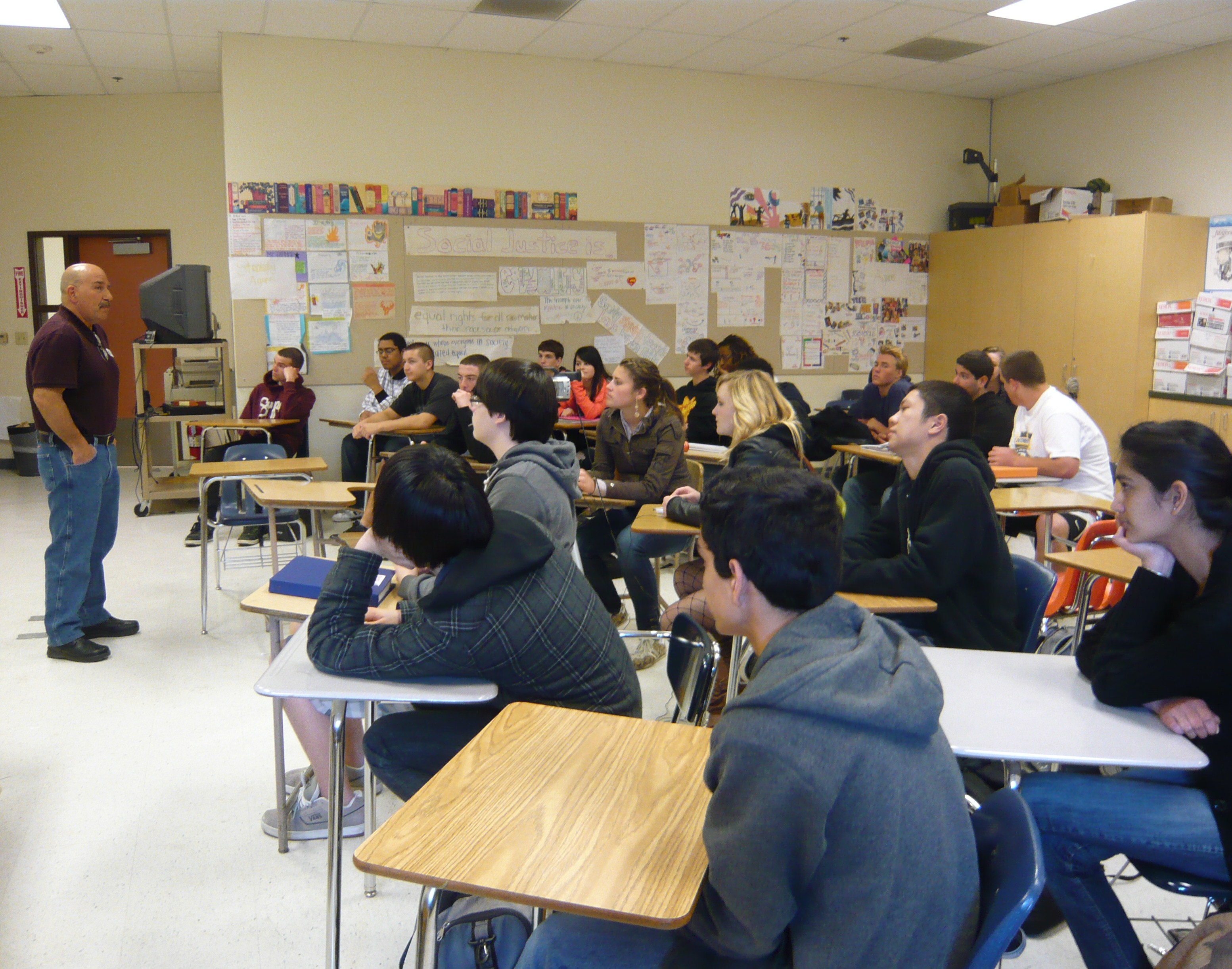
Teacher Michelle Riley’s semester-long class on “Facing History” was well-prepared for my talk on the Holocaust as viewed through my eyes as a child, and the students were alert and attentive.  Since this was my first experience with a 50-minute class time constraint, I shortened my presentation but not sufficiently, and the 5+ minutes remaining for Q&A was too short to develop the momentum usually needed to get an active flow of student questions.  Based on my previous talks, the first few questions produce more and more thoughtful questions and student involvement, and I truly regret not allowing adequate time for this.  After all, the primary reason for having this weblog is to showcase student questions as these mirror the views and concerns of their generation about the Holocaust.   The event was arranged by Jack Weinstein of Facing History and Ourselves.

PS: The wonderful comments that follow are examples of letters received subsequently from teacher Michelle Riley’s students, comments that encourage me to continue giving these talks.

  • “Hearing your story makes me appreciate and honor life.  Thank you so much”
  • “A pain in my chest appears when I think of what you and your mother have been through; the pain brings me to tears.”
  • “I have four younger siblings, and with your story in mind I cannot even imagine how horrible it must be to have them and the rest of my family taken away or lost.”
  • “I thank you for coming to speak.  I wish you the best for educating more people of all ages about the world you came from, and also to continue to inspire others.”

Leave a comment

Spanaway Lake High School, Spanaway, WA – March 11, 2011

By George J Elbaum

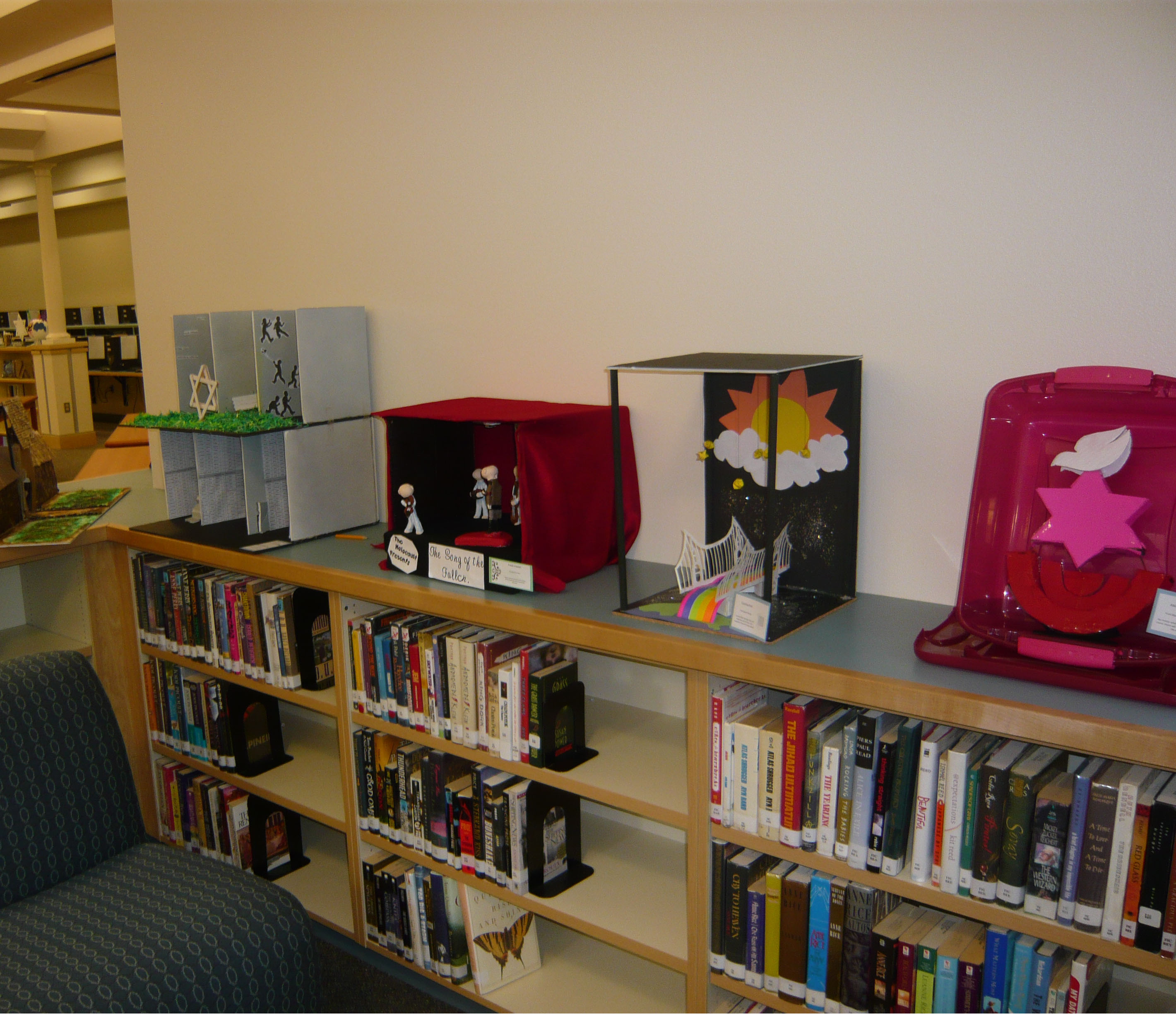
The newly remodeled Spanaway Lake High School is situated in a tranquil, wooded, green lawn campus, and thus a surprising sight shortly after turning off a busy commercial thoroughfare.  An even bigger surprise was teacher Kelly Wheeler and her 3 combined Honors classes, Communication Arts and AP Language and Composition,  of 10th, 11th, and 12th graders.  The 3 classes totalling 78 students had spent about a month studying the Holocaust, including Elie Wiesel’s Night, and working for several weeks designing and constructing small Holocaust memorials, some table-top and some wall-hanging, which showed  amazing sensitivity, creativity, and serious effort.   These were placed throughout the library with the help of librarian Sandy Wusterbarth-Brown the day before my talk, and are shown on some of the photos below.  I was deeply moved by these memorials which, together with heartfelt statements by some of the students, told me why Kelly was named Bethel School District’s Teacher of the Year.  The event was arranged by Janna Charles of Washington State Holocaust Education Resource Center.


with teacher Kelly Wheeler


with Emma


with Nneka


with Melody


Students' Holocaust memorials


...note the chain...

..note tattooed numbers on arms and crematorium smokestack (smoke puffs not in photo)

8 Comments

Washington High School, Fremont, CA – March 2, 2011

By George J Elbaum

Together with Jack Weinstein of Facing History & Ourselves, I visited the humanities class of 11th and 12th graders entitled “Literature, Justice, and Society” taught by Daniel McCarthy. Dan had prepared the students well in basic knowledge of the Holocaust, and Jack started our session by asking them several simple but insightful questions such as “What image does the word ‘Nazis’ brings to your mind?”, eliciting their answers and back-and-forth discussions.  Then, after Jack’s introduction, I gave my presentation followed by Q&A, and again the quality of their questions and interest reflected the quality of Dan’s preparation.  It is always a pleasure to see the results a good teacher produces in his/her students.

Jack Weinstein of Facing History and Ourselves


LETTERS FROM STUDENTS

A few weeks after my visit I received a personal and very heartfelt letter from teacher Dan McCarthy and about 2 dozen letters from his students.  I truly appreciate Dan’s personal openness and his statement: “It has been one of my goals as a teacher to empower students to view their learning as something that has real implications and connections to their lives…. I know that your visit challenged and inspired my students.”  I was also moved and gratified by the students’ letters which validate Dan’s stated goal in teaching, and the most memorable phrases of these letters are excerpted below.

  • I wish I could put into words how your visit really resonated with me, and made something that was just scary stories and images into something so real.  I can assure you that many of us feel very differently about this material now, and I can tell from conversations with my classmates that it’s more real for them.  I hope you continue to speak to students like you did to us.
  • All the things we’re taught are presented to us in books or videos.  No real-life person has ever come in to talk to me about something so extraordinary and important.  This experience will stick with me for a very, very long time.  Thank you so, so much!
  • It’s one thing for a student, like myself, to read a book about the Holocaust, but it’s an entirely different experience to hear a personal story.  Having heard your story was the most important part of this course yet.
  • Just like the film “Paper Clips” inspired you to write your book, you have inspired me to not take life for granted and to cherish every moment.
  • I am sorry that you never asked your mom the questions you wanted to ask, but I think that deep in your mind you really didn’t want to know the truth. ….. I also think you should get a candy bar every time you talk with a class.  That would make the whole experience sweeter.
  • This was a once-in-a-lifetime experience for me.  It truly made the Holocaust personal, much more than any book or story can in 50 years.  I can empathize much more now.
  • There is no way for me to know what it’s like to open up about such an experience as the Holocaust.  I do understand, however, that it takes determination and courage of another kind.  You answered our questions, giving truly lasting answers, like “I don’t really blame the soldiers who are trained to obey.  The leaders are to blame.”  This is something I’ve always wondered.  For your honesty, courage, enlightening, remembering, sharing – thank you truly.
Leave a comment

Novo Community School, San Jose, CA – Feb 9, 2011

By George J Elbaum

Novo Community School serves high risk students in grades 9-12 who are placed at the school for reasons such as expulsion, truancy, out-of-control behavior at school or home, and probation.  The students typically work in a classroom setting, interact with their peers and change classes in ways similar to those of a comprehensive high school.  However, the classes are small enough  so the students are able to receive one-on-one assistance from their instructors, who not only provide academic instruction but also emphasize the skills needed to improve attendance and behavior.  There is strong emphasis in maintaining a safe, orderly school environment conducive to learning.

My visit was arranged by Jack Weinstein of Facing History and Ourselves with strong support of Novo principal, Carey Johnson, and I met with about 2 dozen students from the combined classes supervised by instructors Ev Willason and Chris Clark.  Ev and Chris had prepared the students for my visit by reviewing the chronology of the Holocaust and by reading Robert Cormier’s “Tunes For Bears To Dance To” or Hans Peter Richter’s novel “Friedrich”.  (The former references the Holocaust and explores anti-semitism, while the latter traces the rise of the Nazis and early stages of the Holocaust through the experiences of a young boy.)   At the same time, Jack had prepared me by stressing that students in this special alternative school often lead very insular lives in a narrow social environment, yet paradoxically are quite “worldly” in ways that may or may not be acceptable in society at large – they “may have made big mistakes or bad choices, but can sometimes reinvent themselves and commit to improving academically and in their life choices.”   This potential was evident in the range and depth of their questions, some very naive and some very deep and philosophical.   Photos of several students whose perceptive questions really resonated with me are shown below.

Leave a comment

Keddem Congregation, Palo Alto, CA – Dec 12, 2010

By George J Elbaum

Keddem Congregation is a community-led, Reconstructionist Jewish congregation, and my talk was part of their “Bagels, Lox, & Learning” adult education program.  Unlike my previous talks to schools, this was an adult audience with a deeper knowledge of the Holocaust, resulting in a vigorous back-and-forth Q&A (included in the “Student Questions” section of this site). 

Leave a comment

Fenway High School, Boston, MA – Dec 2, 2010 afternoon

By George J Elbaum

Fenway High School is a unique Pilot school next to Boston’s Fenway ballpark.  Its stated mission is to create a socially committed and morally responsible community of learners, and its slogan is: “Work Hard.  Be Yourself.  Do the Right Thing.”  One of Fenway’s unique and key features is its humanities curriculum, which rather than using the traditional chronological format is taught instead as an interdisciplinary course on a 4-year cycle, with each year focused on an essential question that frames that year’s inquiry: 1) Who built America? 2) How do we govern ourselves? 3) What does it mean to be human? 4) How do you do the right thing in the face of injustice?  Another unique feature is how well this academic approach works, and works very well: student test scores, graduation rates and college admissions data are all above Boston and the state averages, and even more above other schools of similar demographics.   

My presentation, arranged by Jan Darsa and Judi Bohn of Facing History and Ourselves, was to the 9th grade class of humanities teacher Meredith Hubbell, imaginative, empathetic, and focused on students’ active involvement: one pair of students met us at the front lobby and escorted us into the classroom, another pair presented me with a great gift (Fenway HS coffee cup!) after my talk, and a third pair escorted us out.  The next day she had the class discuss how the presentation impacted them personally and asked the students to reflect on the following: 1) What did you learn?  2) What will you remember? 3) What will you share?  The students’ responses, shown below, speak for themselves.

With student greeters


Welcome by teacher Meredith Hubbell

Headmaster Peggy Kemp, teachers, and guests

Thanks for a great memento: Fenway HS cup

Smiles all around

STUDENT  RESPONSES
What did you learn?
How the Nazis attacked people.
How he survived.
Jews weren’t the only people the Nazis killed.
Some Jews found safe places to hide from the Nazis.
That he didn’t call himself a hero.
That you should appreciate what you have.
There were people in the ghetto who tried to fight even with no experience.
That there were some good people who helped Jews survive the Holocaust. 
I learned that people have stories to tell and it’s good to listen to them.
I learned how difficult it was for him and his mother.  He was very lucky, and that he is a strong man.
How bad life was back then and how it is best to remember the good stuff.
I learned what his mother had been through and had seen a lot of things no one should see.
How important it is that everyone has a story to define who they are.
I learned to appreciate what I have in United States because not many people have the chances we do.
I learned that even though it may hurt, it is good to share your story with the world.
What will you remember?
I will remember how many times he was away from his parents.
I will remember that 10 of his family members were killed by the Nazis.
I will remember everything.  Also how for every falling star a person died and he thought of his Dad.
I will remember how heartless the Nazis were.
I will remember what George went through growing up during the Holocaust and how lucky he is to still be alive.  I will also remember how hard it was for his Mom to work and keep him in a nice family.
I will remember from his story how there were so many instances where  he could have died, but he managed to survive.
I will remember when the German soldier looked at him and he wasn’t scared – he continued eating his soup.
I will always remember how emotional he got when he mentioned his father. 
I will remember when I walked him out.
I will remember how he said that he thought his father could have been a falling star and how he thought of his father a lot.  I can kind of connect to that in a way, so it will always stay in my mind.
Six million Jews died.
When he threw the bomb over his shoulder and it landed in a ditch.
Times were very had for all who lived at the time.
Everything, and the sadness he felt.
What will you share?
I will share everything that happened in class, especially about his father.
I will share his book and his story.
My memories of his emotion, his mood, and how it changed throughout his talking.
That he was lucky enough to throw the bomb over his shoulder, which then exploded.
I will share everything.
I will share the great experience I had hearing someone’s story from the Holocaust and what it meant to me.  I will share that I got to introduce someone I revere.
I will share my story as well as his story because it has influenced me deeply.
I will share that I met a Holocaust survivor.
I am going to share that some people did escape, although 6 million Jews died – 2/3 of Jews were killed.
I will share that he called himself lucky and not a hero and that he got through because of luck.
I will share his story with others and let them know how someone survived the Holocaust.
.
LETTERS FROM STUDENTS
About a week after my visit I received a touching “thank you” note from teacher Meredith Hubbel together with letters from her 9th grade students.  I was truly moved by these letters, and their most memorable phrases are excerpted below.
  • I have never thought about the Holocaust and honestly I really didn’t care about what had happened… but I decided to listen to your story and I learned a lot.  I learned that there isn’t only one type of racism, “blacks and whites.”  I realized how painful it was to be alive during the Holocaust.  You can change the world by telling your side of the story.  I know you changed my perspective.  Thank you for visiting.
  • I understand what & how you feel about your past and at first not wanting to talk about it.  I can connect, since I have grown up through some hard times as well.
  • With my family I hope to share your story.  You inspired me to not give up on anything.
  • You made me feel very inspired to share my story and to pass on yours.
  • One of my friends was killed and I had a very hard time dealing with it, so I can’t even imagine what I would do if 10 of my family members were killed, as yours were.
  • I learned that at any time a German soldier could barge in and force you out of your house and into a concentration camp.  Your life can change in a blink of an eye and you can’t do anything about it.
  • Learning about the Holocaust was something new to me, and I learned that everything you have you should appreciate. 
  • I really appreciate your telling us your story because this helps me value the life I have.
  • A person can be sitting next to you with a big important story without your knowing it, so you cannot judge someone right away.
  • I know how hard it could be to talk about something that had a huge impact and changed your life because I just got out of something tragic in my life.  From you I learned it’s OK to share your story.  I was always scared to share what I witnessed and for so long and until this day it’s been hard for me to talk about it.  From you I realized everyone does have a story that makes them the person they are today, and sharing stories makes an impact on the people around you.  
  • I wish that all the things that happened to you didn’t really happen, and that it was all a nightmare.
  • In the future you and every other Holocaust survivor will pass.  Then there will only be stories and books, but nobody to speak personally about them as you did to our class.
 
Leave a comment

Cohen Hillel Academy, Marblehead, MA – Dec 2, 2010 morning

By George J Elbaum

This presentation, my first in the Boston area, was arranged by Facing History & Ourselves’ Jan Darsa at the Cohen Hillel Academy,  a private school providing “an academically challenging program grounded in Judaism” with a focus on social justice that “teaches students that they are an integral part of many communities: school, home, religious, family, local, and global, and that their actions can change those communities for the better.”  I spoke to 8th graders taught by Pamela Aranov who are currently studying the Holocaust.  Their awareness of and sensitivity to the subject showed in their many insightful questions.  Speaking with them and answering their questions was personally very gratifying.

A few days after my visit I received a large envelope from Pamela Aranov with letters from her 8th grade students.  These letters were very heartfelt and all contained phrases and sentences that reinforced my decision to give these talks.  The most memorable of these are excerpted below.   

  • In all honesty I really did not know what the War did to families and individual lives.  However, when you came in I felt you were really able to connect me with all that really happened unlike anything I had seen or read at the Holocaust Museum in Washington, DC.
  • After you told us your story you inspired me to find out more about my family’s past and how they escaped.
  • As soon as you began speaking about the events you dealt with, I started to realize that this horrible occurrence in our history really did happen.  I will NEVER let this horrific event be forgotten, that is something I can promise you forever.
  • When I got home yesterday I had a very thorough conversation about the Holocaust with my parents.  It was the first talk that we really had about this subject.
  • Remembering is such a small task, but it must be done.  If it is done correctly, it becomes a large event that can change the course of history.
  • As a result of your presentation we students are thinking about new ways we can reach out and help our community in a profound way such as you are.
  • I have learned that when I’m thinking of things that upset me, I will think of all the things that others had to go through that I can’t even imagine.
  • It is hard to listen to what happened, but now I have the knowledge to pass it on and never forget it.
  • Your story and my grandpa’s story are two stories that symbolize the small chances and luck that it took to survive.
  • Out of every person you met throughout the war, the kindest one is the one who remained in your mind.  This taught me that kindness is remembered throughout the years while evil can be forgotten.  By learning this, I was inspired to try to make a kind-hearted impact in someone else’s life. …. You shared your story, which is the first step in motivating my generation to prevent such disasters.

Leave a comment

Charles Wright Academy, Tacoma, WA – Oct 15, 2010

By George J Elbaum

October 15, 2010, was the last day of Charles Wright Academy’s (CWA) annual Global Teen Summit, with 32 high school students from China, Poland and United Arab Emirates visiting CWA for 10 days and staying with CWA host families .  The Global Summit is designed to promote peace and social justice by developing the students’ understanding of universal human rights, the concept of fair trade and sustainable life styles, and the realization that the choices we make every day can impact the world.  The core of the Summit is a series of speakers and group discussions on these subjects, and mine was the last presentation in this series.  The Summit’s founder, organizer, and my contact was Nick Coddington, whose amazingly intense & varied background is exceeded only by his enthusiasm in instilling these concepts in his students.  The students’ attention, understanding, and questions (see Students’ Feedback) made this, only my second presentation in a school, as great and personally rewarding as my first one only two days earlier.  (Both presentations were arranged by Washington State Holocaust Education Resource Center.)

Nick Coddington & I

Nick Coddington addressing students

My presentation

International students & I

2 Comments

Alternative School No. 1, Seattle, WA – Oct 13, 2010

By George J Elbaum

This was my first presentation at a school, and it couldn’t have gone better.  Arranged by the Washington State Holocaust Education Research Center (WSHERC), my contact at this middle school was teacher Jo Cripps, whose unbounded enthusiasm leaped from her several emails and was evident from the students in her and teacher Carolyn Kyle’s combined classes with whom I met.  The students  sat and  listened attentively, asked questions (see Speaking Events), then crowded around for autographs, first on paper slips, then on notebooks, backpacks, shirt sleeves & arms!  The whole event was very rewarding for me and a great encouragement to continue doing more. 

Jo Cripps, Carolyn Kyle & I

Students with me

Signing autographs

Students with my wife Mimi & me

3 Comments

First website, first blog

By George J Elbaum

Though I encouraged my wife, an artist, to get a website some years ago for her art, I nevertheless resisted her encouragement to get one for my recent book, “Neither Yesterdays Nor Tomorrows – Vignettes of a Holocaust Childhood.”  While giving her all kinds of reasons why a website was not necessary, deep down I suspected the real reason was inertia, that most-powerful force in human affairs.  However, when a newspaper interviewer asked about it and my plans for speaking in schools about the human face of the Holocaust, that was the tipping point: as in writing this book, I said “yes” and made a move the next day.  Having survived the Holocaust, I hope to be true to the last few lines of my book: to “somehow convey, to even a small degree, our experiences, our feelings, our loss and our hope to a new generation, and to inspire them to convey it onward.  The first responsibility is ours….”

Through this blog, I hope to focus not so much on my presentations as on the reactions of the middle and high school students who, I hope, will be my primary audience.  It is, after all, their reactions and their take-away that will determine the value of what I have managed to convey onwards.

3 Comments