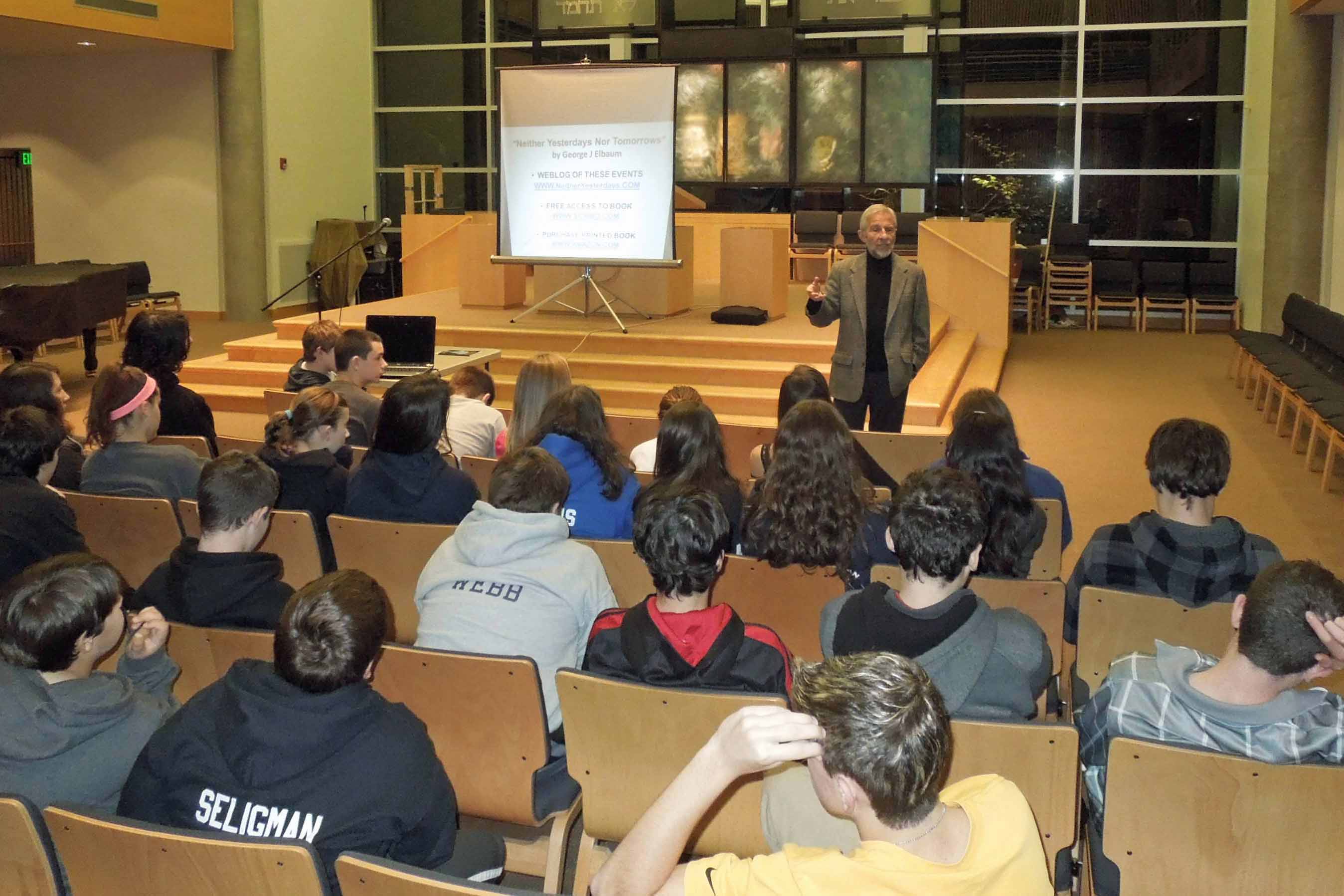
Arroyo High School, San Lorenzo, CA – March 28, 2013

by George J Elbaum

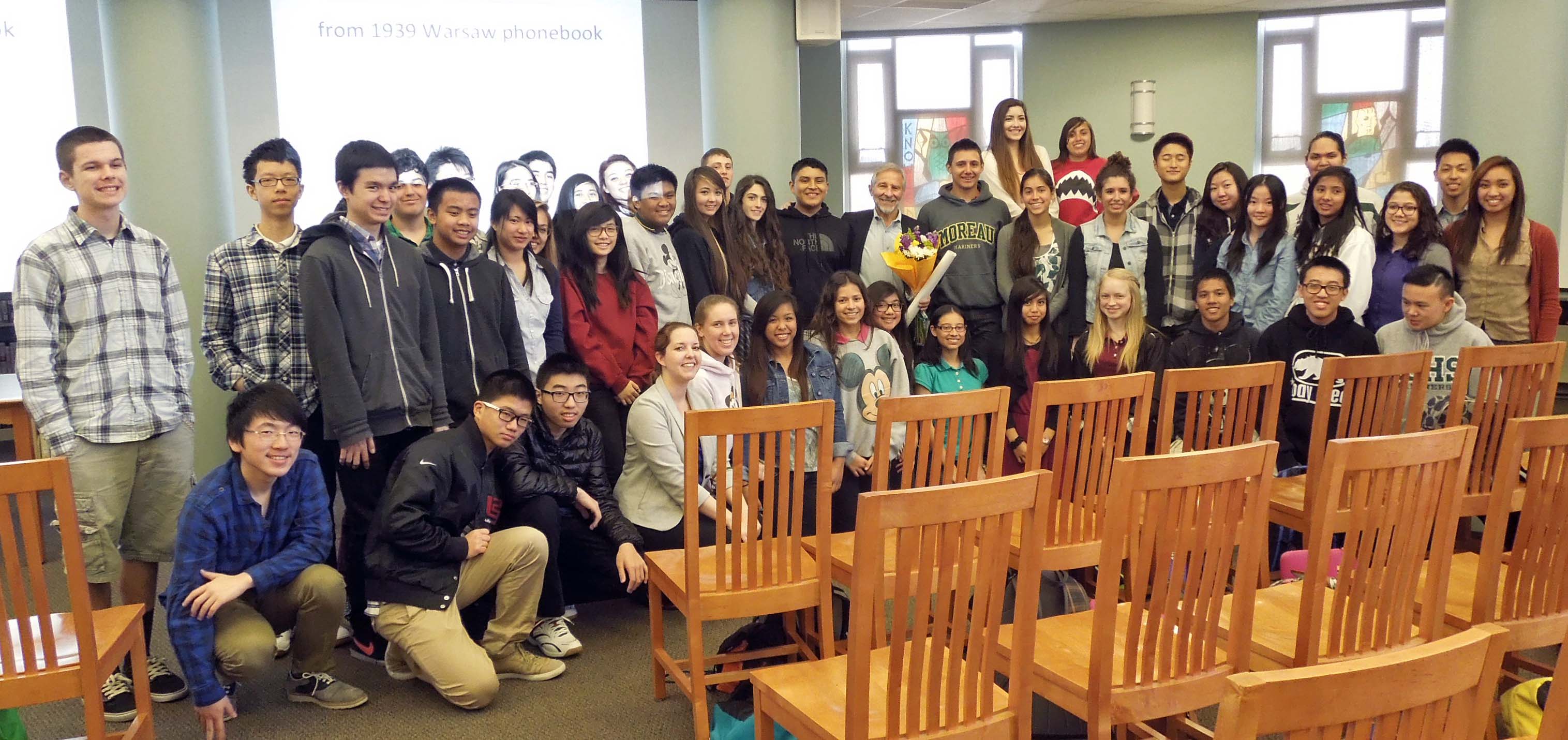
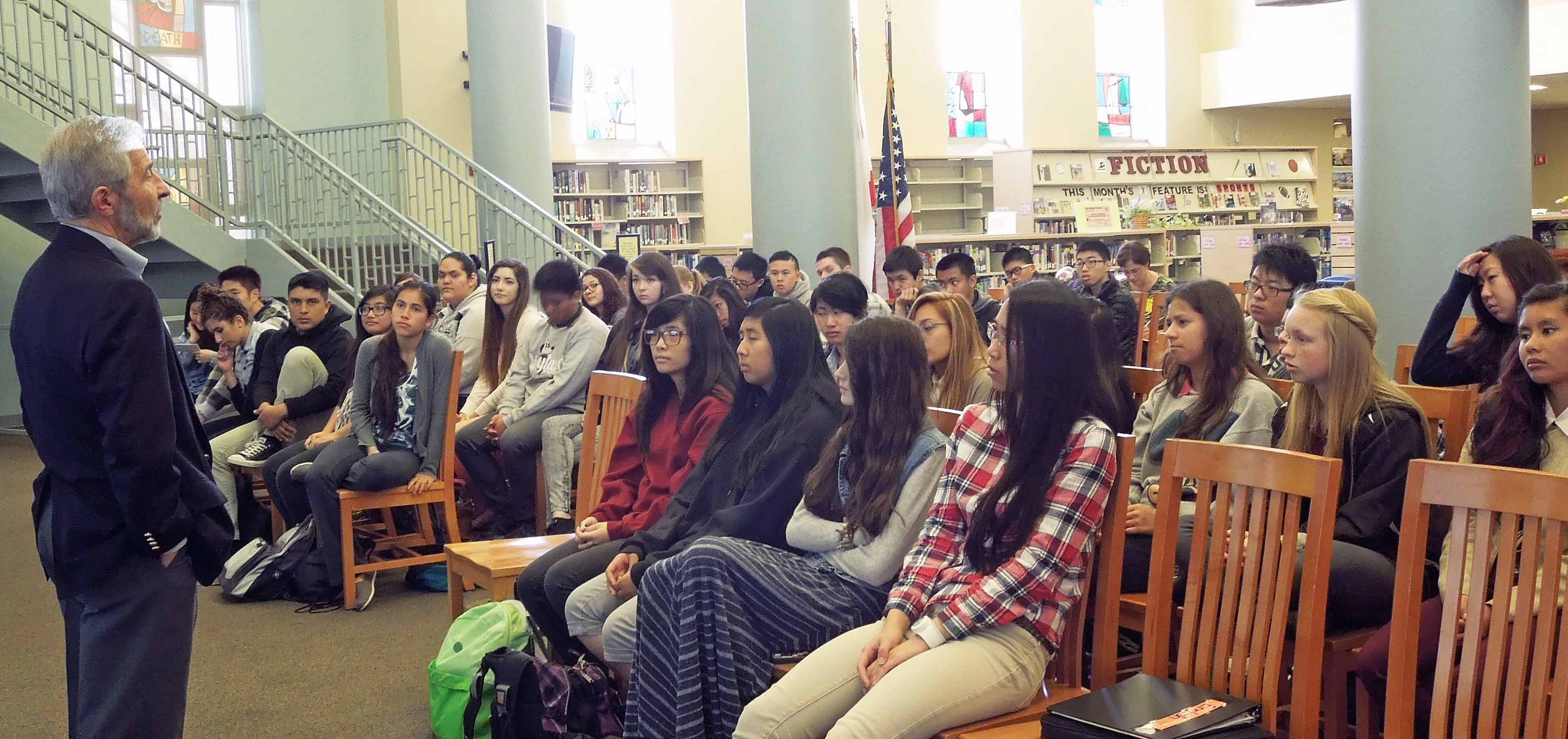
Arroyo High School in San Lorenzo, across the bay from San Francisco, has approximately 2000 students and high diversity, with 34% Latino, 30% White, 27% Asian and Filipino, 7% African-American, and 2% other ethnic or racial groups. Having visited it last year (one year and one day ago!), I looked forward to an enthusiastic and well-prepared audience, and I was not disappointed.  I observed with great pleasure how the enthusiasm of teacher Jorja Santillan transfers to her students.  As last year, she had already prepared the students through her Facing History-based unit focusing on Elie Wiesel’s Night.

 Ms. Santillan and her students are part of a small learning community, Future Leaders for Social Change, within the larger high school; there are three other academies at Arroyo, each with a focus of its own.  The Future Academy, as it is often called, is known for attention to broadening its students’ exposure to the wider community. One example is that when the students study a subject such as the Holocaust, they not only explore its historical context but also read a memoir, meet a scholar or survivor, and consider contemporary issues related to what they have studied.

In April, the group will take a field trip to San Francisco’s Contemporary Jewish Museum, where they will learn something about Jewish life today. Jack Weinstein, of Facing History, who arranged for my presentation at Arroyo both last year and this year, will accompany the group. He says, “The students do an in-depth study of the Holocaust, and it may be among the most moving explorations of their high school experiences. And their visit to the Museum will teach them that Jewish life is vibrant, diverse, and present in their own society, and that there is more to know about this subject than the Holocaust alone.”

Letters from Students

After the students’ visit to the Contemporary Jewish Museum with teacher Jorja Santillan and Jack Weinstein I received a large envelope with over 60 letters from them.  As has become our habit by now, after dinner my wife Mimi read each letter aloud while I listened and absorbed it, mentally and emotionally. We were both touched by the students’ openness and sensitivity as reflected in the letters, and we felt very gratified by their responses to my story. Statements from these letters that particularly resonated with us are excerpted below.

  • Hearing your story makes me want to make the world a better place.  You have inspired me, and I am extremely grateful to have had this opportunity.
  • Your story taught us to be tolerant, to stand up for others, and never be hateful.  For that I thank you.
  • Now that I have heard your story I feel that I should share it with others.
  • With your visit I learned that innocence is not as bad as high school students make it seem.  It is a part of you that continuously saved you.
  • I learned from you the name of something that I will never forget because I believe in it myself: The Golden Rule.
  •  I never went through a hard situation that could equal your years of pain but I understand your stuttering.
  • I think that if I was risking my life for something that I believe was fair, I would rather die trying to fight for justice than let go the opportunity to do the right thing.
  • After hearing your story I felt that I’ve been taking things for granted.  I feel kinda guilty because I have food in my house but when I get home I say there is nothing to eat.
  • Your whole story made me very grateful for the life I have right now.
  • You have impacted me to not forget your story and to keep an open mind.
  • I’ve gone through a really tough time since my parents’ divorce, but hearing your story made me feel that it wasn’t bad compared to what you endured during the Holocaust.  I also appreciate my parents a lot more.
  • I think everyone in the room who heard your story has the responsibility to tell its truth to our future children, and to anyone who doesn’t believe in that truth, because it is      history, a horrible period that no one should forget or try to erase.
  • Thanks for coming and for opening our minds a bit more.
  • When you told us how you defended Jews but felt ashamed to be one when learning that you were, I thought of my background and I realized that I was doing the same, so I thank you for opening my eyes to not be ashamed of who I am.
  • I was truly touched by your story of  survival, and felt water building in my eyes time and time again.  I cannot imagine having the strength to overcome such landscape of despair.
  • I’ll do my best to tell the people after me what I experienced and learned during the time you shared with my class.  You did not tell us only your own story but also about humanity and how to be better people.
  • I felt hatred and pity towards the Nazis even if I’m not Jewish, and resent them for all the inhumane things they did.  Even if the war ended there is still pain and tears to shed.  There’s never enough time or too late to mourn.
  • I honestly wish I could have the power to take away all the horrible things that happened.
  • When you were talking I felt scared myself.
  • I learned that I should follow my dreams to become anything I want, and to not take anything for granted, like my family, friends, or life.  And for that I thank you, sir, for opening my eyes.
  • What makes me think the most from what you said is what if this happened today?  Who would you try to save, or would you just save yourself?  I honestly don’t know what I would do in such a horrible situation.
  • What we do now will reflect the world that will be inherited.
  • Your story has changed me to want to help people in need, like the families that helped you and your mom.
  • I hope you have a wonderful time on your trip to Poland.  Eat many sweet pastries for me!

the audience

Leave a comment

Amador Valley High School, Pleasanton, CA – March 19, 2013

by George J Elbaum

Amador Valley High School (AVHS) has set a challenging question for its 2700 students to explore: “How will you A.I.D. your world?” wherein A stands for Academic Achievement, I for Innovative Thinking, and D for Demonstration of Civic Responsibility.  The school success in academic achievement is shown by being deemed a three-time California Distinguished School, a National School of Character, and a two-time National Blue Ribbon School.  The Daily Beast/Newsweek ranked Amador Valley High School 238th in its 2012 list of the 1,000 Best High Schools in America.  This success in academics is paralleled in AVHS’s extracurricular activities such as music, theater, and athletics, as well as the development of civic awareness and responsibility in its students.  In national competitions such as We the People: The Citizen and the Constitution, the Amador Valley team has ranked in the top four places many times.

In developing the students’ civic responsibility, a strong multi-week exploration of the Holocaust, its historical context and its literature, including Elie Wiesel’s Night, are an integral part of teacher Stacey Sklar’s Honors Sophomore English.  (Ms. Sklar is among the teachers in Pleasanton’s schools who have accessed training and resources from Facing History and Ourselves over several years.)  To augment the Holocaust study, Ms. Sklar and Jack Weinstein of Facing History organized my visit to AVHS.  The students were very well prepared and the schedule was for the usual 90 minutes of presentation and Q&A, but their interest and enthusiasm were such that we continued an impromptu discussion and Q&A while standing in a group for almost another hour – it was very gratifying!

(Help with replacing the ?? below with students’ names, pls?)

group photo

the whole group!

Jack's intro1

Jack Weinstein’s introduction

Leave a comment

Moreau Catholic High School, Hayward, CA – March 13, 2013

by George J Elbaum

Moreau Catholic High School is a college preparatory Roman Catholic secondary school established in 1965 by the Congregation of the Holy Cross.  With college preparation as a focus for its 900 students, the results are admirable: of the recent graduating class, 100% went to college, 50% received at least one Merit-Based Scholarship/Award, and over 75% scored 3 or higher on their AP exams.  As a result of this academic strength, Moreau was one of only 8 schools in California and 54 schools nationwide to be selected as a 2010 Apple Distinguished School, recognized for educational excellence through use of technology across its curriculum to provide its students with the 21st century skills needed to succeed.

However, as a community of faith, the school also prepares its students through social and spiritual learning to become responsible citizens of the global community.  Thus, as part of its humanistic and liberal arts curriculum, Moreau’s 10th grade English class includes a study of the Holocaust as taught by teacher Samantha Wainwright, who arranged my talk together with Jack Weinstein of Facing History and Ourselves.  She prepared her students for my talk through reading of Eli Wiesel’s Night, the Terezin poetry collection, and a variety of stories of victims, survivors and perpetrators, plus viewing applicable propaganda posters, watching the movie Life is Beautiful, etc.  My talk was also attended by the school’s assistant principal, Matthew Stadelman.

group

talking

Leave a comment

Lick-Wilmerding High School, San Francisco, CA – March 5, 2013

by George J Elbaum

Lick-Wilmerding High School’s uniqueness today is based on its history of 139 years.  Founded in 1874 as the California School of Mechanical Arts, LWHS today is nationally recognized as the only independent school in the nation that offers students a rigorous college preparatory curriculum plus unparalleled courses in the Technical Arts.  This “head, heart, and hands” curriculum consists of the usual spectrum of academic courses (English literature, history, math, the sciences, foreign languages) plus the Technical Arts: Design & Technology and shop classes in electronics, fabrications, glass, jewelry/metal art, and woodworking.  Culture is also represented at LWHS, with classes in architecture, animation/film/video, drawing/painting, photography and sculpture, plus Performing Arts (dance, instrumental and vocal music, and theatre), as are athletics (including a rock climbing wall).  The school strives to be an inclusive community, so its student body of approximately 450 includes more than 50% students-of-color and more than 40% of LWHS families benefit from the school’s Flexible Tuition program.  Because of its reputation for educational and cultural quality, the school’s acceptance rate of 15% is comparable with that of the nation’s top colleges.

My presentation at LWHS was organized by teacher Mary Finn as part of her History course “Genocide and Human Behavior: Facing History and Ourselves” and was arranged by Katie Cook of the Jewish Family and Children’s Services.

Letters from Students

A week after my visit to Lick-Wilmerding High School I received a large envelope with letters from the students who attended my talk.  When our calendar cleared a few days later and we had a quiet evening at home, after dinner my wife Mimi read each letter aloud while I listened and absorbed it, mentally and emotionally.  Reading the first letter we were both amazed by the depth of understanding it exhibited about the Holocaust, and how well the writer internalized and related it to her own life, including the internal conflict of feeling fear vs. sense of obligation in being a “bystander” vs. an “upstander” in dangerous circumstances.  When similar understanding and sensitivity were exhibited by more letters, with similarly insightful statements, we realized that this could only result from an excellent preparation before my talk, and afterwards a meaningful class discussion led by their teacher, Mary Finn.  This echoes the truism that excellent students result from excellent teachers, so thank you, Ms. Finn.

In reading these letters we highlighted the statements that particularly resonated with us, and these are excerpted below.

  • Hearing your experiences, especially about the unpleasantness of some of your host families, gave me a fuller understanding of the variety and diversity of situations that different hidden children experienced.  This made me ponder on the complexities of being an up-stander at the time.  Every hidden child’s story is different.
  • I had heard of (the ghetto) uprising, but had no understanding of the weight of its meaning, that civilians fought against trained German troops with no chance of winning, in “hopeless act of defiance” just so they would die fighting instead of in a gas chamber.
  • I had no idea that in Poland, even after the war was over, pogroms occurred that targeted surviving Jews – Jews that had been hidden by other Poles who risked their own lives to save them.  This paradox is so hard for me to wrap my head around.
  • I do believe that as a witness to a Holocaust survivor, I have an obligation to fight and counter Holocaust deniers.
  • When you shared the story about the little dog, your story became very real, and the weight of what you went through really settled in.
  • Listening to your story made me question my strength, my resilience, and my ability to endure something as horrible as the Holocaust.  I learned that being an up-stander is a lot harder than just thinking that you would do something to help someone.
  • I feel confident that I will spread awareness and knowledge to those who come after me, because I can say: “I have met a Holocaust survivor, and here is what he would want you to know.”
  • When you said your mother was able to get a “temporary permit to continue living” (made me think that) the idea that one human being has enough power over another to give them a “permit to continue living” is despicable.
  • You reminded me of my privilege when you said: “In America, if you want something bad enough and you’re willing to work for it, you can do it.”  I often forget how appreciative I should be for my privilege and I want to start better utilizing my opportunities.
  • If I am ever in a compromising position, I hope I will remember your words and be an upstander.
  • Your story made me realize that we only have each other to look out for, and although being an upstander can be hard, it’s the upstanders that change lives.  It seems usually when it’s the hardest to stand up is when others need you to stand up the most.
  • It is fascinating to me now to think of how the citizens of Germany redefined themselves after being forced to choose.
  • There is no way to determine whether a person will be a bystander or upstander until they are forced into the situation.
  • Your story taught me a great deal about being a human being, and how we cope with incredibly difficult circumstances.
  • Considering the potential consequences of being found out, it is hard to say whether or not I would be brave enough to hide another family, knowing that it could result in the death of my own family.  I have tremendous amount of respect for all the families who took such risk in order to do the right thing.
  • It’s hard to imagine what life would be like living in constant fear of your life and being born into a world where you are publicly hated.
  • After hearing this story, I believe that I have an obligation to be cognizant and appreciative of my privileges in all aspects of my life, and to never take things for granted.
  • I did not fully realize that denial is inevitable in all genocides because that it the coping mechanism that some people use.
  • Your experiences made me thing a lot about obligation.  This sense of obligation also begs the question of how much is enough?  Is it enough for someone to take in a stranger…. but not to treat them fairly and kindly?
  • I was intrigued by your question about whether we would be willing to risk our lives in order to save the life of a stranger.  This question made me think of the moral obligation an individual has to another individual just for being human.
  • I have a greater appreciation for the fact that genocide last far longer, (beyond) the surrender of the perpetrators; the harm done to the young in their formative years can stifle the identity of future generations.
  • How do we make upstanding individuals a majority?  Is such a shift impossible for…. humankind?

Group photo

4 Comments

Novo Community School, San Jose, CA – February 28, 2013

by George J Elbaum

As a repeat of my previous 2 visits (March 23, 2010 and Feb 9, 2011), I was invited to speak at the Novo Community School in San Jose. Novo serves high risk students in grades 9-12 who are placed at the school for reasons such as expulsion, truancy, out-of-control behavior at school or home, and probation. These students typically work in a classroom setting, interact with their peers and change classes in ways similar to those of a comprehensive high school. However, the classes are small enough so the students are able to receive one-on-one assistance from their instructors, who not only provide academic instruction but also emphasize the skills needed to improve attendance and behavior. There is strong emphasis in maintaining a safe, orderly school environment conducive to learning, so my presentation this year was divided into two back-to-back talks: one to students in the regular Novo program and another to students in a separate program.

My visit was arranged again by Jack Weinstein of Facing History and Ourselves and Novo principal, Carey Johnson.  I spoke with one group in the morning, with teachers Stephanie Boulianne and Amherst Yohannes, and a second group in the afternoon with teacher Mark Shadduck.  Carey Johnson attended both sessions.   As in previous years, Jack had prepared me by stressing that students in this special alternative school often lead very insular lives in a narrow social environment, yet paradoxically are quite ”worldly” in ways that may or may not be acceptable in society at large – they “may have made big mistakes or bad choices, but can sometimes reinvent themselves and commit to improving academically and in their life choices.” This potential was evident in their questions, ranging from quite simplistic to very thoughtful and sensitive, and also from the personal connection that some showed afterwards.

Leave a comment

The Seven Hills School, Walnut Creek, CA – December 13, 2012

by George J Elbaum

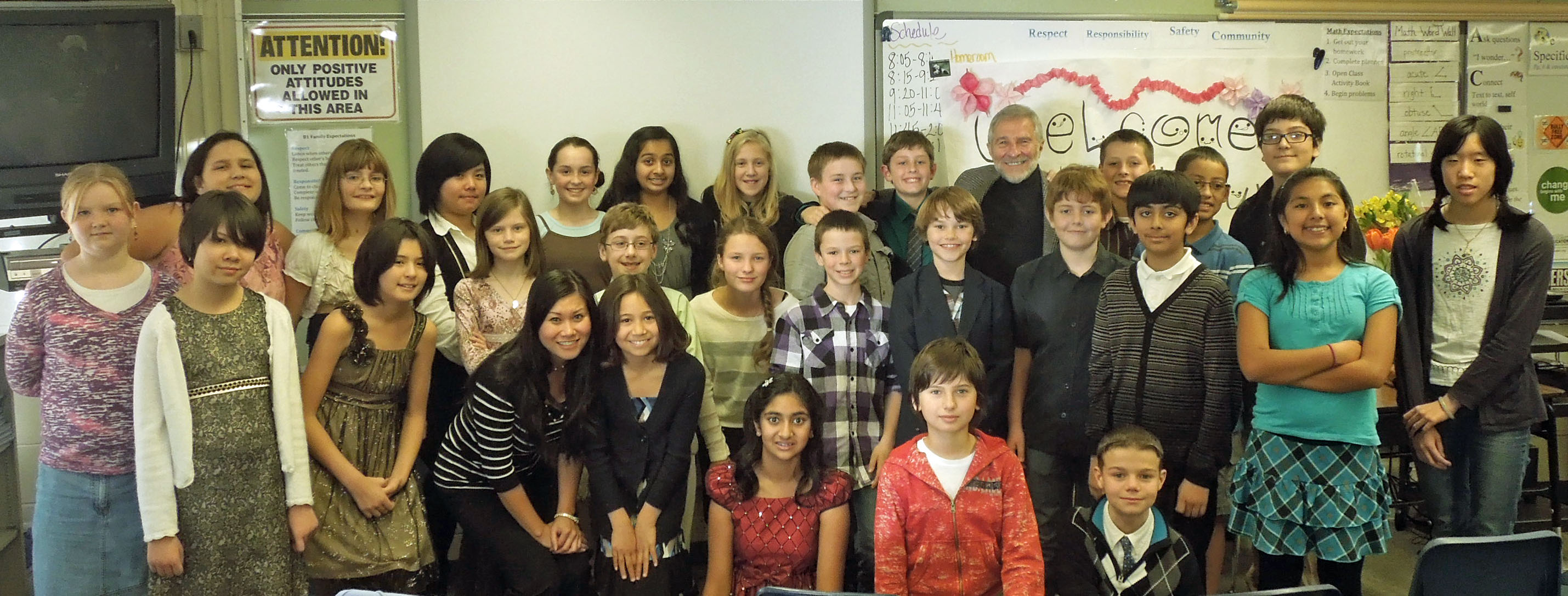
The Seven Hills School, founded in 1962 on nine park-like acres of former ranchland, is an independent day school educating almost 400 students in preschool through 8th grade.  Its stated mission is “to develop the intellect, engage the spirit and foster respect for and responsibility to our world.”  On its beautiful grounds or its modern classrooms “one might see on any day Shakespeare performed or Beethoven rehearsed; a rocket launched or a volleyball serve perfected.”  With a student-to-faculty/staff ratio of about 6, the school augments its excellent academics and athletics with a robust after-school enrichment program, and its 4th-8th grade students rank above the 90th percentile in ERB testing.

My presentation was to the 8th grade classes of history/humanities teacher Michael Sandberg and Assistant Headmaster Scott Espinosa-Brown, who teaches a “restorative justice” course.  The students were currently one month into an in-depth project on the Holocaust and genocide, which culminates with each student producing a web-based report on some aspect of the Holocaust and an oral presentation to the class.  (The web-based reports of the 2010 and 2011 Holocaust Projects are shown on http://dl.dropbox.com/u/11556412/sites/shshistory/index.html.)  Michael Sandberg is also a member of the Advisory Board of Facing History and Ourselves, and he and Jack Weinstein of Facing History arranged my presentation.

The group

Leave a comment

Temple B’nai Torah, Bellevue, WA – November 7, 2012 PM

by George J Elbaum

Temple B’nai Torah’s (TBT) Adult Education Program includes the Jewish Perspectives Lecture Series, and my talk there was part of that series.  Since my goal at these events is to educate and to “make a difference”, I usually speak to student audiences because they are still open to new information and ideas while the minds of most adults are already set, especially on politically, culturally, or religiously sensitive subjects.  Regarding the Holocaust, my personal experience with adults is that this mindset is equally strong at both extremes, ranging from those who know it well because they experienced it first hand  to its deniers who even try to convince the survivors that it didn’t happen.  At this TBT event the audience of about two dozen included some Holocaust survivors and/or their children or close friends.  After my talk I was approached by several of them who showed deep emotion about it even in our brief conversations.

I was invited to talk at TBT by my good friend and member of the congregation, Richard Gumpert, and the event was organized by Shelly Goldman, the Chair of TBT’s Adult Education Committee.

Richard Gumpert introduces

Leave a comment

Kent Mountain View Academy, SeaTac, WA – November 7, 2012 AM

by George J Elbaum

Kent Mountain View Academy (KMVA) is a grade 3-12 public school in SeaTac, WA, about 30 mi. south of Seattle.  Designated as one of Washington’s Innovative Schools, KMVA is small by intent (less than 350 students) and unusual in several aspects: students attend it by choice rather than by geographical location, many have been home schooled prior to KMVA, and the school maintains a strong focus on family and community.  For example, elementary students in grades 3-6 are grouped in multi-age home rooms where the first and last parts of each day are spent so that siblings start and end each school day together.  There is also special education on a limited scale and these students can be integrated into regular classes as ability allows.  A feeling of community/small family among the staff is clearly evident and surely benefits the educational environment for both regular and special students.

Arrangements for my talk were made by Kathleen Bergin of the Washington State Holocaust Education Resource Center and teacher Thanh Thu Do of KMVA.

Open letter to Kent Mountain View Academy

In this “open letter” I want to thank the KMVA community, its teachers, students, and parents, for an unexpectedly wonderful & gratifying visit.  I say “unexpectedly” because until the KMVA event I’ve spoken only to middle schools & high schools and thus had some doubts whether 6th grade students would be old enough to really understand the Holocaust and fully absorb my story, but indeed they were.  My visit was “wonderful & gratifying” because the students made it so!

First, I must thank teacher Thanh Thu Do for her thorough preparation of the students prior to my arrival about the Holocaust and about my history during it – this was evident from their unwavering attention, their enthusiastic response and their questions – and most of all for the enthusiasm & curiosity she instills in her students.  Inspiring teachers produce inspired students!

Next, I thank Debbie Dempsey, KMVA Principal, and Pat Gallagher, Instructional Facilitator, for their guidance and leadership in making KMVA a Washington State Designated Innovative Schools and creating an environment of community for its staff, students and teachers.

Most of all, I thank the students – their enthusiasm and energy in welcoming me with numerous hand-painted posters, home-baked cookies and bunches of flowers, attentively listening to my story, asking thoughtful questions, and volunteering applicable stories from their own lives, all made my visit truly “wonderful & gratifying.”  Some examples are: “Welcome” posters by Danielle, Annelise, Abbie, Selina, Rianna and Tatiana, greetings by Keerthie and Michael’s large “Shalom” in English & Hebrew (and a teddy bear now living with my granddaughter Emily), and Jacob’s story of his inspired response to a neighborhood bully by reading to him aloud from the Bible… and the bully stopped, then returned later and apologized!

My thanks extend to the parents who supported their children by coming to the event, “dressing nicely” as their children requested, and perhaps cleaning up the kitchen after the delicious lemon bars were baked!

In summary, my heartfelt “thank you” to all of you.

PS: In late December I received a package of some 2 dozen Happy Hanukkah greetings & cards made by the students, and the one from “the lemon bar girls” even included the recipe for their lemon bars 🙂  Thank you!

2 Comments

Temple De Hirsch & Temple B’nai Torah joint school program, Bellevue, WA – November 6, 2012

by George J Elbaum

Temple De Hirsch and Temple B’nai Torah jointly conduct a weekly program of meetings for 8th grade and high school students to study and discuss global, social, and personal subjects which are important to students’ growth.  These subjects include individual & collective responsibility in society, self-introspection (where am I in the world & in my world), history and implications of the Holocaust, and others.  I spoke to a group of 8th graders being taught by Rabbi Aaron Meyer of Temple De Hirsch and Joe Dover of Temple B’nai Torah, who together with Shelly Goldman arranged my talk.

Having given my presentation about 3 dozen times, most of the questions asked during Q&A have been asked in some previous session, so it is always surprising and gratifying to get a deep and truly meaningful question for the first time, especially from a middle-school audience.  It happened during this session when, after describing that I was saved by Polish Catholic families who hid me at the risk of their own lives, I posed the following challenge to the students: “Ask yourself now and also in the future, answering only to yourself, what would you do if you saw someone being a victim of injustice and persecution and you could save them but only at serious risk to yourself.”  During the Q&A one of the students asked me: “What would you do?” (See Student Questions for my reply.)

with Rabbi Aaron Meyer and Joe Dover

Questions & answers

Leave a comment

Charles Wright Academy, Tacoma, WA – September 20, 2012

by George J Elbaum

This was the third consecutive year that I spoke at Charles Wright Academy’s (CWA) Global Teen Summit, which in 2012 included 50 high school students and their teachers from China, Colombia, Poland, the United Arab Emirates, all staying with CWA host families during their visit.  The annual Global Teen Summit is a 10-day program designed to promote peace and social justice by exposing the visiting students to and developing their understanding of the concepts of universal human rights and justice, fair trade and sustainable life styles, and by demonstrating how the choices that each of us makes every day can impact the world. The core of the Summit is a series of speakers whose personal experiences reflect directly on these subjects, and their presentations are followed by group discussions on these very concepts. My presentation was the first time that most of these students heard directly from a Holocaust speaker, and their subsequent comments and personal expressions of thanks were very gratifying – the very reason that, in spite of some emotional discomfort during my talks, afterwards I’m always glad I did it.  The Summit’s founder, organizer, and strong guiding force is Nick Coddington, whose amazingly intense and varied background is exceeded only by his enthusiasm in instilling the Summit’s concepts in his students. (This presentation was arranged by the Washington State Holocaust Education Resource Center.)  NOTE: need photo of entire UAE group, please!

Leave a comment