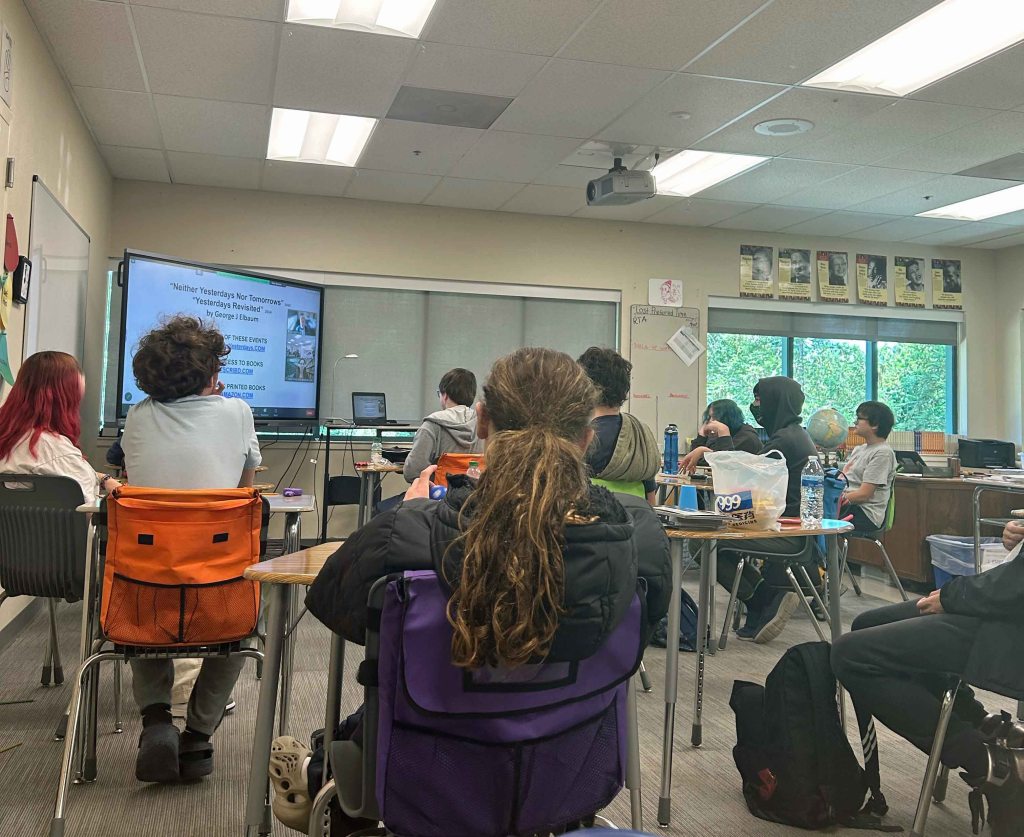
This was my 6th time speaking at the University of San Francisco (USF), a Jesuit Catholic university. Founded in 1855, USF was the city’s first university, and it is the third oldest institution for higher learning in California. Its student body numbers approximately 10,600, with 62% undergraduates and 38% postgraduates, and its faculty numbers approximately 1,200, of which 41% are full-time and 59% are part-time, or adjunct. Religious and spiritual organizations on campus include the Muslim Student Union, the USF chapter of InterVarsity Christian Fellowship and the USF Hillel: The Foundation for Jewish Campus Life.
My talk at USF this time was for 40 students in a 15 week course Introduction to Judaism (Jews, Judaism, Jewish Identities), with one week spent on the Holocaust and genocide. The course is one of the elective subjects in USF’s Department of Theology and Religious Studies. My talk was organized by its teacher Oren Kroll-Zeldin, Assistant Director, Swig Program in Jewish Studies and Social Justice Assistant Professor, Department of Theology and Religious Studies, and arranged by Sadie Simon, Education Program Manager of the JFCS Holocaust Center.
Methuen High School (MHS) is a public secondary school serving grades 9-12 with an enrollment of approximately 2000 students, 48% minority and 47% low-income families, and this was the 5th time that I’ve spoken at MHS but the 1st time in person rather than by Zoom. Since all 5 of my visits to MHS have been organized by Jackie Rubino, now the Assistant Principal for 10th gradeand previously teaching English, we had established a warm telephone relationship and I truly looked forward to finally meeting her in person. Indeed, the enthusiasm and ebullient energy that Jackie projected by phone/Zoom was only enhanced in an in-person meeting, making it so enjoyable.
The Holocaust is taught at MHS as part of English Department studies using educational materials from Facing History and Ourselves and other sources, and my audience for this talk was comprised of 125 students from several grades. As in my previous visits, the students have already studied much of Facing History’s Holocaust and Human Behavior,Schindler’s List, selections from the The World Must Know, Elie Wiesel’s Night, plus supplemental materials.
As in past years, I was pleasantly surprised by the quality of the students’ questions, and some of their most thoughtful ones were about my feelings, hopes, and concerns. I’ve long felt that Q&A is often the most important part of my talks because it represents our 2-way communication, and I was again pleased with today’s session. The best example of this occurred at my May 4, 2023 visit and helped MHS girls softball team win an important game, and it was a pleasure now to meet many of the winning players and shake hands or exchange hugs, as the mood dictated. (see https://neitheryesterdays.com/2023/05/07/methuen-high-school-methuen-ma-may-4-2023/)
The MHS staff attending this presentation, in addition to Jackie Rubino, were administrators Christine Dumont, Roger Lenfest, Dr. Golobski-Twomey, Laura Enright, teachers, Amanda Aziz, Kristen Digloria, Brittany Caprio, Jeff Bellistri, Lauren Smith, Christine Lellos, Lorie Aliano, Vanessa Fisher. My participation in today’s event was again arranged by Jeff Smith of Facing History and Ourselves.
Educators for Change (EFC) is a group of dedicated educators who have committed to taking an active role in Holocaust education in Washington state and inform the educational programs and resources of the Holocaust Center for Humanity. Teachers are selected by the Holocaust Center based on their engagement, qualifications, geographical location, and commitment to Holocaust education. The Holocaust Center strives to provide EFC with deepened knowledge, not only about the Holocaust but other considerations, such as the challenges of teaching its lessons successfully, as well as a community for collaborative purposes. At the same time EFC provides the Center with invaluable feedback and input that helps guide its decisions about its programs and resources. EFC’s total membership is approximately 40 educators, ranging from upper elementary to college educators, of which 20 attended this session.
18 months ago I spoke to the EFC and gave a much-condensed version of a my usual talk about my Holocaust childhood. Starting with my very first talk 13 years ago till now I have given more than 360 talks in public schools, private ones, inner-city schools and even some special schools for at-risk students. Since the EFC’s current membership is mostly as it was 18 months ago, I didn’t want to repeat my previous talk. However, after these 360 talks I’ve received more than 20,000 letters from the students describing their personal reactions to my talk. From these letters I’ve chosen 42 of the most meaningful and heartfelt statements which I had posted to my website and now shared these with my EFC audience. These statements are attached below in “LETTERS FROM STUDENTS”.
Over these 13 years I noticed that the quality of the letters’ content, the sensitivity, originality, thoughtfulness, understanding, was very much dependent on the quality of the class discussion held by the teacher afterwards, showing the students’ personal thoughts & feelings. The letters showed me again & again that education, real education, depends on the quality of the teacher, and thus that the quality of our future citizens and our country depends on today’s teachers. My presentation to EFC was organized by Branda Anderson, Teaching and Learning Specialist at the Holocaust Center for Humanity, and supported by Paul Regelbrugge, the Holocaust Center’s Director of Education
LETTERS FROM STUDENTS
The Holocaust – Fear, Courage, Responsibility
Philosophers disagree about human nature, but I believe that genocide is a part of it. This sounds terrible, but it’s true. If there is one thing to take away from your talk it is the importance of understanding and justice. .
After studying the Holocaust for the past few weeks, most of us couldn’t fully grasp the enormity of the subject. The books and the movies about it seemed like fiction. That is, until we met someone who was there.
When you were talking I felt scared myself.
There is no way to determine whether a person will be a bystander or upstander until they are forced into the situation.
I cannot imagine a stranger risking their life to save me.
I realized throughout your talk that responsibility of passing on the stories sits on the shoulders of my generation.
I have never thought about the Holocaust and honestly I really didn’t care about what had happened… but I decided to listen to your story and I learned a lot. I learned that there isn’t only one type of racism, ”blacks and whites.” I realized how painful it was to be alive during the Holocaust.
Personal Connection
I did not experience what you and your mother did, but I can understand to an extent what it is to be discriminated against simply because of my race.
I hugged you after the speech because you touched me deeply and I was truly moved by you. Like you said, life would be much more peaceful if we all hugged each other.
I would have loved to meet your childhood self!
Your story and your triumph was the only topic of discussion at my family’s dinner table this evening.
I was most affected by your statement that as human beings we need to stand for something, not against something. All too often we think of things that divide us and make us different, not the things that bind us together, and your words encourage us to take positive action.
I had a rocky childhood, and after hearing your story I gained strength and inspiration that will keep me going. Your words won’t be forgotten.
A pain in my chest appears when I think of what you and your mother have been through; the pain brings me to tears..
I really felt as if I was there experiencing it with you. You had a special impact on my life.
Your story will forever resonate with me, an image of hope and inspiration to us all.
Seeing you smile while talking about the simple but impacting moments, such as your being given the sugar cube, I felt like I was given a gift. I thank you for that gift.
I went through that day thinking about the question you asked us: “If you had a chance to help save someone even if might mean death for you, would you?” At first, I said yes, without even worrying about being caught. Then I thought what if they threatened my family? Friends? Then I remembered your host families, and how much they must have sacrificed to keep you with them. I would love to be able to do that and wholeheartedly say yes, but given those circumstances I honestly don’t know what I would do.
Your experience didn’t only shape who you are but hearing it changed me.
Appreciating One’s Family
You have given me more motivation to not lose faith in myself and in my family.
Your story made me realize how lucky I really am. It made me go home and tell my mother that I love her.
My grandfather is also a Holocaust survivor. He now lives in a convalescent home and seldom has any visitors. Hearing your story inspired me to visit him and ask him to tell me his story and how he survived. Maybe I’ll even write it up.
Immediately after your presentation I emailed my mom and dad and told them that I loved them and was thankful to have them in my life.
Valuing What We Have
I’ve gone through a really tough time since my parents’ divorce, but hearing your story made me feel that it wasn’t bad compared to what you endured during the Holocaust. I also appreciate my parents a lot more.
I know how you felt not knowing English when you first came to this country because I didn’t know English either, only Spanish. Sometimes I feel bad denying that I am from Mexico. I have learned from you to be proud of where I come from.
Today I felt that this is not just a story we heard; it’s a big lesson to us. We learned the truth and felt the pain.
I always thought I had a tough life moving from place to place and never really seeing my father, but as I heard your story, it made me realize that I must appreciate what I have.
Your story makes me appreciate and honor life. Thank you so much.
Religion and Faith, Luck and Fate
I enjoyed your answer concerning your faith. It amazed me how you were born a Jew, raised a Catholic, stripped of religion completely, and yet you still have the strength to have faith in something.
I loved your words that “I have no organized religion but I have faith” because I love how faith gives us something to hold onto.
You were saved for a reason. You were chosen so you would grow up to help students like us learn and remember what had happened.
I think that you were meant to be here – it was your fate to survive everything, to live through all the horror of the Holocaust, and to tell us your story
Neither Yesterdays Nor Tomorrows – Living in the Moment
You taught us that the most important thing is what we do in the present, and not to waste time wishing that we could change what we know we can’t. The future will come as long as we focus on the present.
You taught me three very important things today. One, you shouldn’t let others discourage you from your dreams. Two, you’re not going to be able to please everyone. Three, to not dwell on the past and just keep moving forward with your life.
You taught me that people can have a successful, beautiful future even if they had a dark past but can move beyond it. Your story gives me hope.
Inspiration
Hearing your story makes me want to make the world a better place. You have inspired me, and I am extremely grateful to have had this opportunity.
You reminded me of my privilege when you said: “In America, if you want something badly enough and are willing to work for it, you can do it.” I want to start better utilizing my opportunities.
I know that I was not the only one walking out of that room that day feeling inspired.
When you were telling us your story I felt like my throat contained my heart and I’m having the same feeling as I’m writing this letter to you now. You also told us things that made us all smile and laugh, and it reminded me that there’s always something to be happy about.
I learned things from you that I hope someday to teach my children, that we should never be just anti-something. To be against something isn’t a belief, but to be for something is a movement and a love.
I admire that you believe anyone who works hard for a dream or goal can make it come true, because I had dreams and goals that other people doubted, yet these happened through hard work.
You showed me that even though you went through such terrible experiences, it is still possible to move on, pursue your dreams and live a very happy and successful life.
This was my 5th time speaking at the University of San Francisco (USF), a Jesuit Catholic university. Founded in 1855, USF was the city’s first university, and it is the third oldest institution for higher learning in California. Its student body numbers approximately 10,600, with 62% undergraduates and 38% postgraduates, and its faculty numbers approximately 1,200, of which 41% are full-time and 59% are part-time, or adjunct. Religious and spiritual organizations on campus include the Muslim Student Union, the USF chapter of InterVarsity Christian Fellowship and the USF Hillel: The Foundation for Jewish Campus Life.
My talk at USF this year was for 40 students in an undergraduate course entitled Holocaust and Genocide, which is one of the selective subjects in USF’s Department of Theology and Religious Studies. It was organized by its teacher Dr. Alexis Herr and arranged by Sadie Simon, Education Program Manager of the JFCS Holocaust Center.
Notes from USF students
A few weeks after my talk to the USF students I received a couple dozen Thank You notes, and as is our custom, my wife Mimi and I read these together after dinner, excerpted the statements that most resonated with us, and these excerpts are shown below.
The profound experience of being able to hear your first hand account while being able to see your facial expressions is something I will never forget.
I am filled with deep sorrowful inexpressible feeling because you and all the others had to go through this, but I am also supremely inspired by your courage and honesty. I am honored to have heard you speak.
As I was watching and listening to you I was very emotional and so inspired by you and the strength you have is truly amazing.
I’m honored to have met you and listened to your story, a story I wish many other could know to stop hate from spreading.
Just a part of your story is enough to move someone, but your whole and continuous story is one that I am so grateful to have heard.
I recall asking you how you felt as an immigrant and how that could have caused conflict in your youthful search for identity, but the way you answered my question and the questions of my peers was so genuine and so human.
The stories about your mother are ones that have left me in awe of women who experienced such hardships.
Your courage to share your experiences in Poland is incredibly admirable; I think, no, I’m sure you have touched the hearts, including mine, of students throughout the room.
I also want to acknowledge your mother and the sacrifices she made. I know that being with her towards the end of her life must have been very difficult.
I truly wish you the best and I also hope you know your purpose here 😊. Thank you so much for surviving and making it through. I wish you the best in life and that you are with your wife happy and eating some delicious cheesecake 😊
When you came and talked to us it gave me a reevaluation of how life may vary between people. Your talk certainly helped me see how people may not be in the best places in life but there is always a possibility for hope.
After reflecting on your talk I realized that being moral during the Holocaust could get you killed. Jews as well as other minority groups were pushed during the Holocaust to such unbearable limits that being moral limited your chances of survival.
I shared your stories and lessons with my parents. I truly felt the emotion in the way you spoke and in your words. I appreciate your giving me the opportunity to listen.
I will carry your story with me throughout my life and learn from it. I aspire to be as brave as you were and are, in every aspect of my life.
Your passion for educating others is something deeply necessary in our contemporary world, to prevent more harm and hate from rising again and again.
I hope you understand the impact your story has on others, and the fact that you overcame such struggles and continued following the goals that you love – like flying and motorcycling (despite your wife’s objections) – it shows that one’s life does not have to constrain them – the sky’s the limit!
I know that nothing in my life will compare with what you went through, but it reminded me of my darkest time caused by illness in my family. Because you told your story I feel I can tell mine and maybe someone will listen and learn from it, just like I have from yours.
Hearing your story was and will always be one of the most valuable moments in my life. I wish more stories like yours were told to young people like me as they have the ability to change lives. Our world is so hateful and many people still carry this harmful hate. Stories like yours encourage strength, education, empathy and love.
When you spoke to our class it actually happened to be my birthday. As a result of your talk I reflected a lot on my own life which caused me to feel very emotional considering the fact that if you can do anything, then I can do anything also.
I remember when you came to St. Peter’s school in the Mission when I was in 8th grade, but at that time I didn’t really understand too much about the Holocaust. Now that you came again to USF I was able to better understand and found your experience extra special to me.
It is very difficult for people to really grasp the pain and torture that came with living during that time. Therefore I really appreciate your bravery and courage in sharing those personal thoughts with us.
Your view on the world is admirable. I admire how you were able to turn something so sad like hiding in the shed and seeing the Nazi airplane into a career in aviation.
I am Jewish like you, and hearing your stories along with others I feel more proud of who I am and my heritage.
I really admire how you spoke of the instances of students who heard you speak and were born into prejudiced families. You are playing such an important role in breaking the cycle of hate and generational prejudice, and your ability to empathize with those students was incredible.
As a descendant of the Rome (Gypsy) I find it difficult to source narratives with which I can relate or grasp with some sense of understanding of what victims truly went through; yet with your account and passion the story for the first time came alive.
I really appreciated hearing your story, but I was especially moved by your forgiveness and empath.
I know that even through you love to share your story with people, it can be hard to talk about your trauma at times, so thank you for doing what you’re doing and keep at it.
Your talk helped me put into perspective just how much Holocaust survivors had to endure to stay alive.
Your positive outlook on life inspires me and makes me appreciate my life more 😊
I would like to express my gratitude toward when you mentioned how no one believed you could go into aviation but you proved them wrong. Lately people have been telling me what I can and can’t do, but you proved that anything is possible!
I feel that sharing stories like these is extremely important for future generations. It has definitely helped me be more compassionate toward others, but also to intolerance.
It was truly a privilege to hear you speak so openly and earnestly about your experience. I am part Armenian and I’ve heard about what my family went through in the Armenian genocide, and how they got here. I believe telling the story of genocide no matter how awful or difficult is so, so vital to future prevention.
I am so glad that luck was on your side all these years and you are here now making a difference in the world.
This presentation via Zoom was to an audience of approximately 70 teen interns based in three JFCS regional offices in Palo Alto, San Mateo, and San Francisco. The three groups include Jewish and non-Jewish students who have varying knowledge about the Holocaust and genocide education, so the purpose of this program is to support teen interns in transitioning smoothly from adolescence into adulthood. Thus the presentation by a Holocaust survivor serves to engage the interns with the JFCS Holocaust Center and with Holocaust education in general, enhancing their active listening skills and patience, and building empathy and support for those who may be different from them.
The Youth First intern program is organized by Debra Massey, JFCS Associate Director of Youth Programs. I was invited to present my story to the interns by Sadie Simon, the Holocaust Center’s Educational Program Manager, and introduced to them by Andrea Struve, the Center’s Director of Education.
Notes from JFCS interns
A week after my talk to the JFCS interns I received a couple dozen Thank You’s on JFCS-embossed notes. As is our custom, my wife Mimi and I read these together, excerpted the statements that most resonated with us, and these excerpts are shown below.
I want to thank you from the bottom of my heart for sharing your story with me today. I actually just visited Poland this year, specifically the Warsaw ghetto (the wall that remains) and many concentration & death camps. It was so surreal & horrible that I almost felt detached, but hearing your story brought me light.
Unfortunately, many survivors fade into the cracks of history, so I am very glad that you were able to tell my generation of the horrible events which transpired years ago, so that these may never be forgotten and never repeated.
For someone who has seen so much loss and lived through such tragedy, you remain to carry a positive energy and a remarkable humor – a quality I certainly admire.
I understand your story. Thank you for inspiring and teaching it. It’s inspiring me to speak up about antisemitism as I am planning a rally against antisemitism with my schoolmates.
This is a meaningful moment to me because I have never been taught about that before.
I will indeed share with others what I learned from you. (I love cheesecake too 😊)
P.S. I also love cheesecake, but with a hint of lemon& orange peel.
I really enjoy how you focus on the positives and remember the Sugar Cube Miracle.
Your story was really touching, and hearing first hand WWII experience from Jewish people has always felt much more informative than any writing on the matter.
My grandpa was also a Polish Jew who managed to escape 2 weeks before the Nazi invasion. I also feel like I’ve gotten here through his luck and perseverance, like you and your mom.
I really appreciate your message of not listening to others when they try to discourage you. I will remember your words whenever I feel stuck in life and use your story to motivate me be a better and more hardworking person.
I find it really inspiring that in spite of all the circumstances you were put in, you never failed to be optimistic and not take yourself too seriously. You have made a huge impact on me with your talk and I will make sure to tell your story to as many people as I can.
It was so inspiring to hear about the perseverance you and your mom had to endure the horrible atrocities to and around you.
Thank you for your strength in sharing your story & your teachings & words about being a good person and following the Golden Rule.
Your presentation was extremely meaningful, especially to me because my great-grandparents were Holocaust survivors. They never liked to share or talk about their extremely traumatic experiences, so I really appreciate you speaking to us about your experience and lessons. I will spread your meaningful story in the future.
I’m glad to see you’re still here on this planet after everything you’ve been through. From the Warsaw ghetto to the shed, to the day you crashed a hang glider & survived, and when you met your great wife. I’m happy to see you being able to live & see this world’s beauty.
You said during the seminar many times how you got “lucky” throughout your childhood & throughout your life, but I want you to know lucky we are to have heard your story & experience.
It is crazy to me that people currently living on this planet witnessed a genocide of an entire religion.
Your story really opened our perspective on cherishing the present moment and not dwelling on the past.
Story telling allows one’s legacy to live on forever, so sharing your story is important for future generations to reflect on.
My parents are both immigrants and have taught me the importance of gratitude. Before your presentation I never quite fully understood the meaning of gratitude, but now I can understand gratitude and the overall appreciation one has in life. Thank you.
Your story reminded me of my grandfather who also survived the Holocaust and grew up in Poland. I never knew much about him, but your story connected me to the type of person he could have been.
You taught me not to focus on the past, but only on the present. You also taught me to always try my best, and I hope to use these skills and become better.
I think that my favorite part was hearing you laugh and seeing you smile.
As a privileged Jewish teen growing up in the Bay area I haven’t ever really experienced antisemitism, but I have experienced ignorance. It truly shocks me that in a place that supposedly values diversity so much and how little people know about Judaism and the Holocaust. Thank you so so much for telling your story, thank you for spreading awareness.
I like how you shared your time when you came to America after the war. I felt I could relate to that the most because I am a high-schooler and I do feel some antisemitism. Your speech really gave me some confidence and resilience against this hate.
I will bring the lesson you taught about forgetting the past and future and focusing on the present throughout my life. Your story was very inspiring. P.S. I hope you have lots of cheesecake 😊.
Esther B Clark School (EBC) is a private nonprofit therapeutic day school for children who are unable to attend and learn in a “normal” school setting due to circumstances such as behavior, mental health and emotional challenges. Students who are admitted into ECB’s basic therapeutic program are helped to access their grade level curriculum with accommodations when they are at emotional baseline, and are grouped according to age, social and educational needs. Program highlights are 6 hour school days to build academic skills in all subject areas, a highly structured, yet low stress positive behavior support and intervention system, Individual, group and family therapies, and a maximum class size of 12 like-aged students staffed by a team of 4 professionals: a credentialed special education teacher, a licensed therapist, a trained behaviorist and a classroom assistant. The school’s K-10th grades have a current enrollment of 52 students.
Behavior specialist Lesly Rios organized a special summer program to inspire students who believe that they are basically stuck where they are due to their background (race, low household income, single parent, adoption, etc.) and need to be taught how to advocate for themselves and express their needs. Noticing that these students react to and are motivated by real life scenarios, Lesly Rios organized this summer program (June-July) to focus on motivation by inviting a list of guest speakers for a series she calls “Why I do it Wednesdays.” These speakers would tell their story of achievement to the students, describing the hardships they faced, overcoming these hardships, and highlighting where they are now.
As part of this special program I was invited to speak to 12 students in 9th and 10th grades, as organized by Lesly Rios and teacher Cole Walton. While my favorite part of any presentation to students is the subsequent Q & A, this time it was an unexpected and especially rewarding experience because of the quality of the students’ questions: they were thoughtful, substantive, and serious, definitely above what I’d expect of typical 9th and 10th graders. One example is “How would you handle hate?” It was clear to me that the students were not only well prepared but were also considering how they should or would react in similar situations. I was and am very impressed!
Arrangements for my talk were made by Sadie Simon, Education Program Manager, JFCS Holocaust Center.
College Park High School is a highly rated public school with a current enrollment of 2050 students of which 60% are minority, 23% are economically disadvantaged, 10% are first-generation college students, and 6.1% are English Language learners. Despite these demographics, College Park is far above California state averages of college and career readiness, such as student test scores (reading 74% vs. 51% CA average and Math 48% vs. 40% CA average) and has 97% graduation rate. It is therefore rated by Niche.com as A for diversity and A- overall, also for college preparedness.
This presentation to College Park, my 5th since 2019, was to the entire sophomore class (350 to 400 students) and was again organized by World History teacher Lauren Weaver, as she had done each year since 2019. Her students have studied WWII and the Holocaust, so were therefore aware of governmental persecution in Germany in the 1930s, including anti-Sematic policies and hate crimes, targeted boycotts, the Nuremberg laws, book burnings, Kristallnacht, forced relocations to the ghettos, deportations, and death camps under the “final solution”.
My presentation once again was via Zoom because of my continuing medical restrictions, so unfortunately there was little real-time feedback which I’ve missed for the last 3 years. However I fully expect that next year I will be able to return to College Park and Lauren Weaver’s class in person.
Arrangements for this talk at College Park were made by Sadie Simon, Education Program Manager of JFCS Holocaust Center.
Notes from Students
Two days after this visit to College Park High School the teacher Lauren Weaver emailed me 10 pages of “Thank you” notes from her students. Scanning the notes on the first page I was instantly impressed by the students’ personal thoughts and feelings expressed there, so the next day my wife Mimi and I read these together and excerpted the statements that most resonated with us. The list is long, and the excerpts below are impressive – they speak to me of excellent students and excellent teacher.
In this time of heightened political tensions regarding race, religion, and other minority identities, it is extremely important to listen to the first hand stories of those who have survived tragedies centered around their identity, like the Holocaust.
As both a racial and a romantic minority, it truly meant a lot to hear you talk about what you’d been through as sometimes I fear that that’s where America is heading, but when people are reminded of the horrors of the Holocaust I feel as though they’re more likely to be open-minded.
I especially liked when you mentioned seeing the plane through the hole in the shed, as the concept of finding beauty in a terrible situation is something that I can relate to very well. There was a moment in my life where I witnessed something truly awe-inspiring during a very traumatic event, and I’ve been fascinated with that object since. So hearing that you had a similar story really made me feel a connection.
Thank you for answering my question about antisemitism being on the rise, as I do agree that we have fostered an environment where people feel more comfortable to voice their prejudices and therefore feel like it’s their right to spew hate against groups they view as lesser. Once again, thank you so much for speaking with our class. I will remember this experience for the rest of my life.
I would like to sincerely thank you for sharing your story and your experience in one of the most difficult situations to live through in human history. I identify with your viewpoints heavily and admire your general attitude and resilience to antisemitism and other forms of hate
In a way you remind me of myself and as a Jewish American who grew up not knowing his roots that well I felt empowered hearing your speech. I sometimes feel ostracized or like having to choose between being perceived as Jewish and risking hate from others or being perceived as Protestant and assimilating into being a “white American”.
I’d like to say, in the most sincere way possible, thank you. People like us will learn from this experience of pure survival and instinct, meaning that everyday could be your last. You are a teacher, a model, and a person of luck.
I find it very inspiring that you overcame your fear of telling your story publicly, and I’m grateful that we got the chance to hear about your experiences. With deep respect…
I found it interesting to hear how the younger you thought that because you broke your leg you would need it cut off because you saw soldiers with lost limbs and assumed it was the same. I too would’ve thought the same thing if I was in the same situation as you.
Your presentation made me realize that you can’t give up.
Thank you for taking the time to tell us your life story. I will never have a way to make up the favor, but I can however continue telling others of your story.
It is nice to know that you no longer feel belittled by your past and continue to pass on your life story, because if people like you stayed quiet, then history would be forgotten and be doomed to be repeated.
Being able to go through something so big as a child must be terrifying. When you said that you saw your mother after six months, it made me realize how lost you must’ve felt at that time. I appreciate your time, and you’re so strong for going through this unfortunate event.
I’ve read a lot of books and I’ve learned extensively about the Holocaust throughout my life but I’ve never heard someone’s first hand account in person.
Thank you for teaching us about tolerance and compassion towards others.
I never really wanted to think that little kids went through it, but they did. And hearing you talk about it made me really realize it
When you asked if we’d take in a child even if it put our own lives at risk, without a hesitation I answered yes. I answered yes because there is the chance to save a small child, an innocent life.
When it came to segregation in America, when you talked about what happened when you went to the back of the bus, it was very eye opening and I really appreciated it.
Thank you for making a difference by letting your story be known
The most memorable details that I took from your story is the first plane you saw in the dark shed. It was almost like the light at the end of the tunnel that made your story come full circle after choosing to study Aerospace Engineering. It also inspired me how to prove your high school counselor wrong by getting into MIT and studying there. I strive to be as brave and courageous as you when I’m older.
Thank you for being able to share such terrifying and traumatizing times with us.
Sometimes I forget to stop and think about how fortunate I am to not have to worry about war occurring or being hunted or searched for in the middle of the night.
I’m very grateful that I got to temporarily experience a day of life in the Holocaust through your eyes.
That part of your story (about luck) really moved me in a way I’m not certain how to express, but it helped me to understand more about the Holocaust and how so much of survival really was based around pure luck.
Before your presentation I had never really thought about how people survived outside of concentration camps.
Thank you for your bravery, to speak up about what you experienced is not an easy task. The way you keep doing this throughout your life, you keep going and never give up, inspires me to work harder.
The information you shared with us made me realize how cruel a human can be to one another just because they dislike their religion. So glad you made it out alive!
Thank you for being able to talk to us and allowing us to properly visualize the atrocities that occurred.
Thank you very much for sharing your story. I really found it interesting and it actually touched me in a way that makes me feel kind of guilty for all the times that I thought my life was terrible because I didn’t like something that happened or because of someone that did something that I didn’t like, because there are always more people around the world like you that suffered through horrific times.
Methuen High School (MHS) is a public secondary school serving grades 9-12. It has an enrollment of 1950, of which 48% is minority and 47% from low-income families. The Holocaust is taught at MHS as part of English Department studies by teacher Jackie Rubino, who organized my presentation at MHS and uses educational materials from Facing History and Ourselves and other sources. This was my 4th visit to MHS, and 60 of its 9th– 12th grade students were gathered for my talk in 3 classrooms plus attendance via Zoom. As last year, the students have already studied much of the Holocaust and Human Behavior book from Facing History, Schindler’s List, selections from the The World Must Know, Elie Wiesel’s Night, plus supplemental materials.
As in past years, I was pleasantly surprised by the quality of the students’ questions, and some of their most thoughtful ones about my feelings, hopes, and concerns. I’ve long felt that the Q&A is often the most important part of my talks because it represents our 2-way communication, and I was again pleased with today’s session, especially by one “give and thou shall receive” situation. As frequently during my 360+ talks to date, I was asked how did the Holocaust shape my life, and my answer was the usual, that it is contained inthe title of my book, “Neither Yesterdays Nor Tomorrows“. “The reason for “Neither Yesterdays” is that some of the families who kept me, and thus saved me, were nevertheless not always nice to me, so my wartime yesterdays were not very pleasant and I learned instinctively not to think about my past and to quickly forget it. The reason for “Nor Tomorrows” is that my tomorrows were very uncertain: I never knew when or even whether I would see my mother again. I therefore learned not to look to the past nor to the future, but rather to focus totally on the present, to survive it (then) and to solve whatever needs to be solved (now). That attitude has remained with me and has served me well.”
Above is how I have answered this question in past situations, but this time it occurred to me that teacher Jackie Rubino is also an enthusiastic coach of MHS girls softball team, and her whole team was in attendance, so I added especially for them: “So when you are at bat, don’t think about what you did in the past or what you might do in the future, but focustotally on the ball that’s coming toward you right now, and smash it.” The softball team let out a big cheer! This was surely the talk’s highlight for them, and it was for me also!**
The MHS teachers attending this presentation, in addition to Jackie Rubino, were Jason Smith, Dan Favreau, Aaron Romano-Meade, Jacob Aronson, MHS Principal Richard Barden and English Department Chair Lisa Golobski-Twomey. My participation in today’s event was again arranged by Jeff Smith of Facing History and Ourselves.
**Two days after our talk I received the following email and photo from Jackie Rubino: “Big game last night AND we had a HUGE win! I’ve included an awesome team picture with this email. Before the game we talked in the locker room about your words of wisdom and how we needed to carry them onto the field. You inspired them so much! It was their best game of the season so far.”
Open WindowSchool (OWS) is an independent school for students in Kindergarten through 8th grade who have been formally identified as intellectually gifted. The school’s mission is to nurture and inspire students of high intellectual ability. Its current enrollment is 355 students, of which 140 students are in grades 5 thru 8.
My presentation was organized by humanities teacher Arren Ellingson for 41 7th graders. This study unit is designed for students to understand the causes of the Holocaust and explain the horrific events that occurred. Beginning with a study of the history of anti-Semitism in Europe, students come to understand how racism fueled the events to come. The students were provided a history of Germany after WWI, including how the Nazis came to power and Hitler’s racist ideology, how Jews were systematically targeted, the Nuremburg laws, Kristallnacht, life and death in ghettos, concentration camps, and Jewish life after liberation.
The Q&A session following the talk showed the students’ preparation and genuine engagement – having so many students asking questions was an encouraging thing to witness. Following the Q&A session teacher Ellingson informed me of their tradition that following presentations by visiting speakers the students are given an opportunity to comment and thank the speaker for what they learned from the presentation. Several students took this opportunity, came to the microphone and individually expressed their “thank-you’s” – a very nice and gratifying tradition.
This was my 2nd visit to OWS, the first one being exactly a year ago (4/22/2022). Attending the current presentation in addition to teacher Arren Ellingson were also OWS teachers Michelle Bowers, Marcelo Sanjines and Clarissa Toupin. My involvement was arranged by Lexi Jason, Education Program Manager, Holocaust Center for Humanity, with technical support from volunteer Liz Ebersole.
Temple Israel is the second oldest congregation in the Boston area, and the largest Reform congregation in New England. Founded in 1854 in Boston, its long history follows the rise of the local Jewish community. The Temple Israel Archives serves as the repository for records, documents, publications, and images relating to the history and administration of Temple Adath Israel of Boston. These records document the congregational history and provide primary source material to assist the clergy, staff, and members of the synagogue.
Although Yom Hashoah falls on April 18 this year, the 18th falls during the April 2023 school spring break in Massachusetts so the Temple scheduled its commemoration ceremony another day, in this case for the 10th,, so students and their parents could attend it, and I was invited to participate in this ceremony and tell my story of surviving the Warsaw Ghetto and the Holocaust. (I welcomed speaking on April 10 as it is a memorable date for me: it was the date of Yom Hashoah in 2010 when I gave my very first talk about my Holocaust childhood at the ceremony organized by MIT, my alma mater, at the Holocaust Memorial in downtown Boston.)
Today’s ceremony at Temple Israel was attended by approximately 90 synagogue members, guests and children, with people joining both online and onsite. The evening started with a memorial service led by the Temple’s clergy, then transitioned to my presentation followed by a Q&A.
My presentation was organized by Brigid Goggin, Director of Programs and Community Engagement, and Roberta (Bergstein) Axeloons, Director of Elementary Education, and my participation was arranged by Jeff Smith of Facing History and Ourselves.
Notes from students
Five weeks after my talk at Temple Israel I received in the mail an envelope containing a dozen brief notes handwritten on blank paper from students attending the event, some with small decorations such as the Star of David and signed with the student’s name and “7th grade, Temple Israel.” One note in particular truly impressed me with its power and that student’s sensitivity and awareness of what’s important, all encapsulated in the note’s first and last sentences:
“Thank you for being able to retell and share your story……. Thank you for never giving up, never collapsing in a dangerous situation and impossible time, but most of all, thank you for never forgetting.”