Jefferson High School, Daly City, CA – Nov 10, 2011

by George J Elbaum

Jefferson High School in Daly City, just south of San Francisco, has about 1200 students with a rather unusual diversity of 44% Latino and 36% Filipino, with all other ethnic or racial groups comprising only 20%.  This is reflected in its tri-lingual website: English, Spanish, and Tagalog.  My presentation to almost 200 students was organized by teacher Stacey Farrell together with Pilar Coronado and John Falabella and arranged by Jack Weinstein of Facing History and Ourselves, who spoke about each person’s responsibility in the face of intolerance.

LETTERS FROM STUDENTS, ETC.

A week after my talk at Jefferson High School I received in the mail an envelope with about 40 letters from students and one from teacher Stacey Farrell.  A nice surprise in these letters was that, in addition to thoughtful and heartfelt words, many also included small decorations such as colored-in words and phrases, delicate curlicue border trim, various flowers, sun with its rays falling on a flower, a happy face with “thumbs up”, several hearts, a smiling turtle with a “for you” caption, an exploding hand grenade (presumably referring to my story in chapter “August 1944 – Warsaw Uprising”), and even a sensitive letter on paper printed with  the student’s photo with me!  My wife and I read these letters together and were truly touched by them.  Short (and some not-so-short) excerpts from letters that particularly resonated with me are listed below, including the first one from Stacy Farrell herself.

  • Many of my students found hope in your ability to live in the present.  Many mention that they have experienced challenges in their lives and that you inspire them to focus on the good, not the bad.  As much as students connected to your story of survival, I think that many also connected to your story of immigration.  It is so valuable for those students who were born in other countries to hear the story of someone with similar experience, who met challenges and succeeded in the United States.
  • I always thought I had a tough life moving from place to place and never really seeing my father.  But as I heard your story, it made me realize that I must appreciate what I have.  I hope you have changed the way other students thought just like the way you changed my thinking.
  • One thing I appreciate about your story is that life is never easy, and if you want to survive you must make sacrifices.  Hearing about your experiences changed my view of the world by realizing that we only have one life and we should live it to the fullest.
  • Your story made me think “what if I was in this situation?”  I admire that you forget the bad things in life and focus on the present and good memories.
  • What you told us about the Holocaust made me feel like I was there.  Your story connects to my life because when you spoke about your dad and was wondering where he was, I was wondering how it would be to have a dad, which is probably how you felt at the time.
  • Your presentation bettered my understanding of the Holocaust by showing me the little details in-between the big topics that usually define the Holocaust, such as concentration camps and Nazis.  I admire that you acknowledge your luck and the fact that you moved on instead of letting the past trap you.
  • Your story connects to my life because when I was young I also suffered many things growing up.
  • You taught me that as long as you are persistent and have a little luck, you can accomplish your goal.  (This was followed by a “thumbs up” drawing.)
  • I learned that hope is very important because you never lost hope for a better life, and you got it.
  • Your presentation will help me learn to leave the bad memories behind.  It is important to me because I have a bad habit of dwelling on the past and it begins to to affect my future.  You taught me that people can have a successful, beautiful future even if they had a dark past.  Your story gives me hope.
  • Hearing your experiences changed my view of the world by letting me know that there are good people who are willing to risk everything for something they believe is right.
  • I admire that you are able to step out of your comfort zone and not hide your story any more.  You have taught me not to take for granted the moments I have with my family.
  • You helped me understand that even in the darkest of times you should enjoy the smallest of things.  This is important to me because I always expect too much from my parents.  Your story connects to my life because when I’m feeling sad I push everybody away and don’t talk about my feelings, but I’m learning to stop hiding and it makes me a better person.
  • I learned from you that there were many people who actually cared for complete strangers.
  • I learned from you to block out the bad things in life and stay positive.
  • Recently my great grandmother passed away, just yesterday actually.  Her death made me appreciate everyone in my family and enjoy their company, a privilege that can be taken away any day.  My grandma and great grandmother both are Jewish.  I’m not sure if they had any relatives who were in the Holocaust but I’ll ask my grandma. ….  Hearing about your experiences made me realize how cruel people can be and how taking a stand we can make a difference.
  • I get really scared to speak in front of many people but you inspired me to get up on stage to speak in front of everyone.  I can’t imagine how hard it is for you to tell your story, but if you can do it, so can I!
  • I admire that you believe anyone who can work hard for a dream or certain goal and it can come true because I had dreams and goals that other people doubted, yet these happened through hard work.
  • Your story connects to my life because I also have been taken to another family who took care of me for at least a year because both of my parents were working hard at that time.  When I make choices in the future I will consider how these affect others and not just me.  I would like to thank you for your courageous speech.
  • I learned that during the Holocaust one would be afraid to go out for fear of never returning.  When I go out with friends I never give it a second thought since it is a “yes” that I’ll come home to kiss my mom goodnight again.
  • I find it very wrong that mankind will willingly kill mankind for little or no differences whatsoever.
  • You helped me understand that the Holocaust was a tragic time, and that there are people who react ignorantly and refuse to know the truth.
  • I learned that your mom did everything she could to protect you and I know that my mom would do the same.
  • Your story connects to my life because my older brother was in the Airborne and in one of his parachute jumps he had a major accident.  I had never been more scared in my life.  I think we experienced the same feeling of being useless to help or make a difference, of giving up and wishing it was all a bad dream.  My brother is learning to walk and run again but we will never be the same, just as you will never be the same with your experience of the Holocaust, which  reminded me of mine, so I understand better what you went through.  Even though I will never understand your pain first hand, I will always understand the feeling of being alone and lost.  Thank you for sharing your story and making all the difference. 


Leave a comment

Lake Washington Girls Middle School, Seattle, WA – Nov 7, 2011 PM

by George J Elbaum

Lake Washington Girls Middle School (LWGMS) is an independent school for girls in grades 6-8 whose mission is reflected in its motto: “strong in mind, body and voice”.  As such, it seeks to provide a challenging academic program that educates the whole girl intellectually, socially, and emotionally.  The focus is thus not only on academics and participation in student life and athletics but also on social justice and each one’s responsibilities to improve their community.  As such, LWGMS students have won numerous awards from the Washington State Holocaust Education Resource Center (whose Janna Charles arranged my presentation) as well as the King County Civil Rights Commission, the Washington State Science Fair and the Rainier Valley’s & ACT Theater’s Young Playwrights Program.  The event was organized by teacher Lindsey Mutschler with support from Director of Advancement Shannon Blaisdell and Director of Admissions Colleen West.

Leave a comment

St. Luke School, Shoreline, WA – Nov 7, 2011 AM

by George J Elbaum

St. Luke School teaches more than 330 students in K-8 grades based on the belief that “quality Catholic education teaches the whole child spiritually, emotionally, academically and socially.”  The eighth grade Social Studies Curriculum, organized and taught by Rosemary Conroy, is very intensive as it covers both U.S. history and Washington State history, geography, economics, politics, and current events.  The curriculum highlights the formative periods of U.S. history: the Revolutionary War, development of the Constitution & Bill of Rights, Civil War, WWI and WWII, including an in-depth look at the Holocaust.  Where possible, Ms. Conroy invites outside speakers who witnessed first-hand the events being studied, and the past year has included speakers on the Armenian genocide, the Holocaust, the Nisei relocation program, WWII POW camps and the Tuskegee Airmen.  I spoke to 40 of Ms. Conroy’s 8th grade students, and afterwards I received a totally-unexpected and wonderful gift: an old-fashioned red tricycle similar to the one I received 70 years ago on my 3rd birthday, as described in my book.  It is shown in some of the photos below.  It was truly a wonderful surprise, so I immediately had to try riding it.  (Thank you, Rosemary!)  The event was arranged by Janna Charles of the Washington State Holocaust Education Resource Center (WSHERC).

LETTERS FROM STUDENTS, ETC.

The day after my talk at St. Luke School I met teacher Rosemary Conroy again at WSHERC’s 7th Annual Voices for Humanity Luncheon, and she gave me a large manila envelope saying it contains letters from her students written shortly after my talk.  It did indeed, 40-some letters, some short, some long, but all heartfelt and touching.  Short excerpts from most of these letters that particularly resonated with me are listed below, including the first one from Rosemary herself.

  • My job as an educator is to touch both the mind and the heart of each student.  You did that today by telling your story with honesty, compassion, and a sense of humor.
  • Learning about the Holocaust from a survivor’s point of view really opened my eyes.  Since today was my birthday, it seemed like a birthday present a bit.
  • You taught me the importance of tolerance.
  • I was moved by the kindness of strangers, saddened by the loss of so many people, and outraged at the wrong that was done to so many. … I really enjoyed the part about the Russian soldier and the sugar cube.  I also have a sweet tooth, so the story was extra “sweet: to me!  Your new friend
  • A story like yours really makes me think about how lucky my friends and I really are.
  • It was very meaningful to me to learn history from a survivor.  Your new friend
  • You gave us the life lessons you’ve taken from your experiences.  Thank you for giving me a new way of looking at life, to never look back and not let bad experiences keep me from doing amazing things.  Good luck with speaking to other schools, and I sincerely hope they learn what I did from hearing you speak today.
  • I also learned that when I see bullying I need to stand up and stop it, and I learned to appreciate each day.  Thank you for coming – you really taught me a lot!
  • From your story I knew the importance of family and how lucky I am to be in a safe environment.
  • You reminded me of the importance of family and how strong love can be.
  • When people like you tell your stories, it gives everybody an appreciation for human life.
  • You showed me to not take anything for granted.
  • I learned many things from you, mainly not to dwell on sorrowful things.
  • Your story gives courage and thought to many people and me.  Germany and Holocaust gave you pain but the sugar cube cured your mind and it made you happy. Your new friend
  • I learned a few things from you, things like speaking up if you see hatred and racism.
  • You have really helped broaden my view on the Holocaust and its survivors, how it effected people after the war and changed their lives.
  • You made me realize how fortunate I am to live in a safe place. … My favorite part was to see the big smile on your face when we brought out the tricycle.  I’m so glad I got to met you.
  • I hope you enjoy your brand new red tricycle.  …. God bless you and your wife.
  • I hope you continue to speak so others my age can learn to rid the world of those evils.
  • The thing I thought most about was my grandfather, who escaped Hungary by pretending to be dead.  I am glad you came today.
  • I will never forget your story because it is truly a gift to hear from a survivor.
  • I felt saddened when you talked about your family and all the shooting stars, and especially about the people who didn’t believe that the Holocaust really happened.  I’m grateful to be safe and to live where I do.
Leave a comment

Charles Wright Academy, Tacoma, WA – Sept 23, 2011

by George J Elbaum

September 23, 2011, was the last day of Charles Wright Academy’s (CWA) Global Teen Summit 2011, with 24 high school students from Poland and the United Arab Emirates visiting CWA for 10 days with their teachers and staying with CWA host families.  The annual Global Teen Summit is designed to promote peace and social justice by exposing the visiting students to and developing their understanding of the concepts of universal human rights, fair trade and sustainable life styles, and by demonstrating how the choices that each of us makes every day can impact the world.  The core of the Summit is a series of speakers whose personal experiences reflect directly on these subjects, and their presentations are followed by group discussions on these very concepts.  Both this year and last year my presentation was the first time that some of these students heard from a Holocaust speaker.  The Summit’s founder, organizer, and guiding force is Nick Coddington, whose amazingly intense and varied background is exceeded only by his enthusiasm in instilling these concepts in his students.   (This presentation was arranged by Janna Charles and Ilona Kennedy of the Washington State Holocaust Education Resource Center and the photos are courtesy of Ann Vogel, a CWA Parent Volunteer.)


Leave a comment

Mother Caroline Academy, Dorchester, MA – June 2, 2011

by George J Elbaum

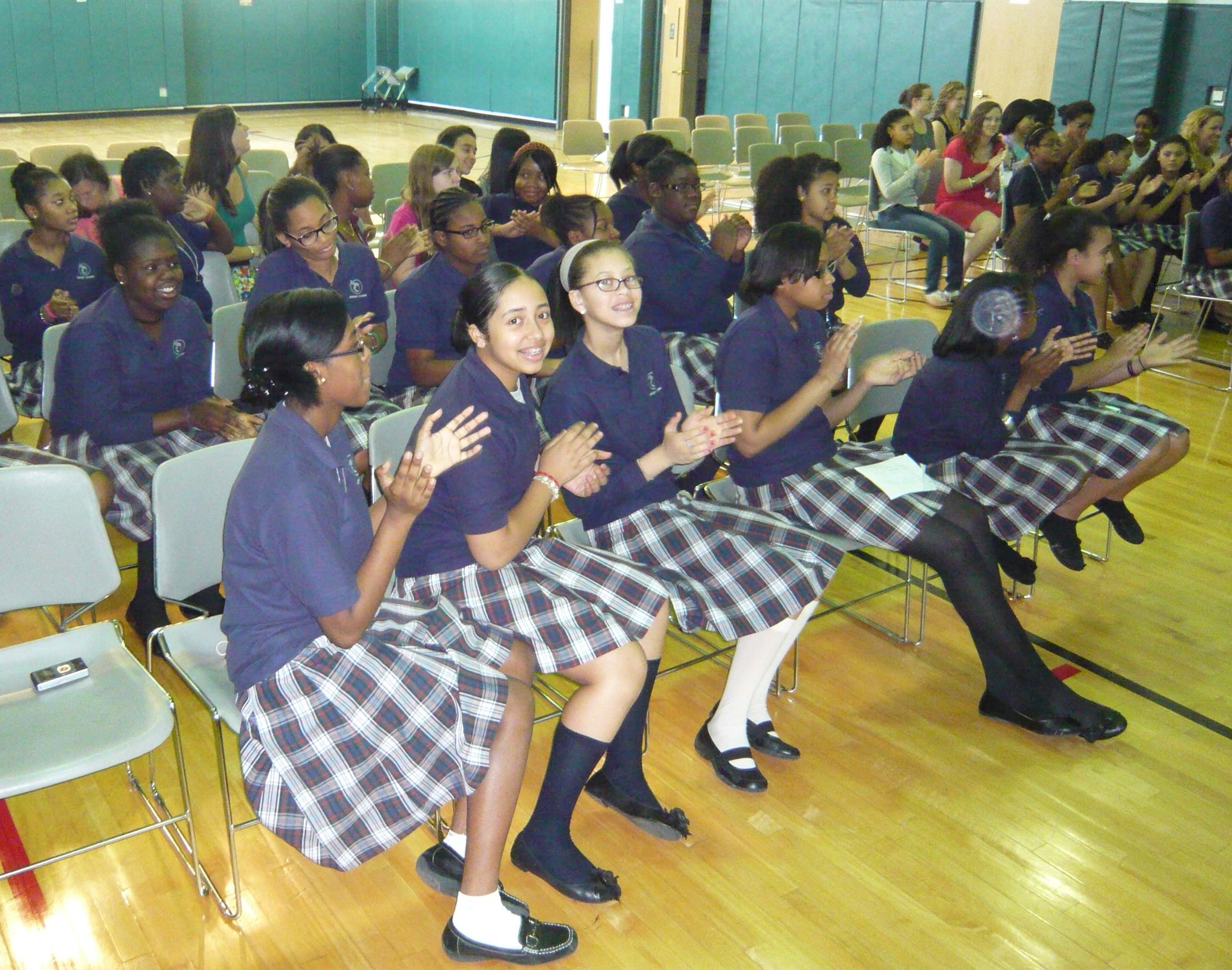
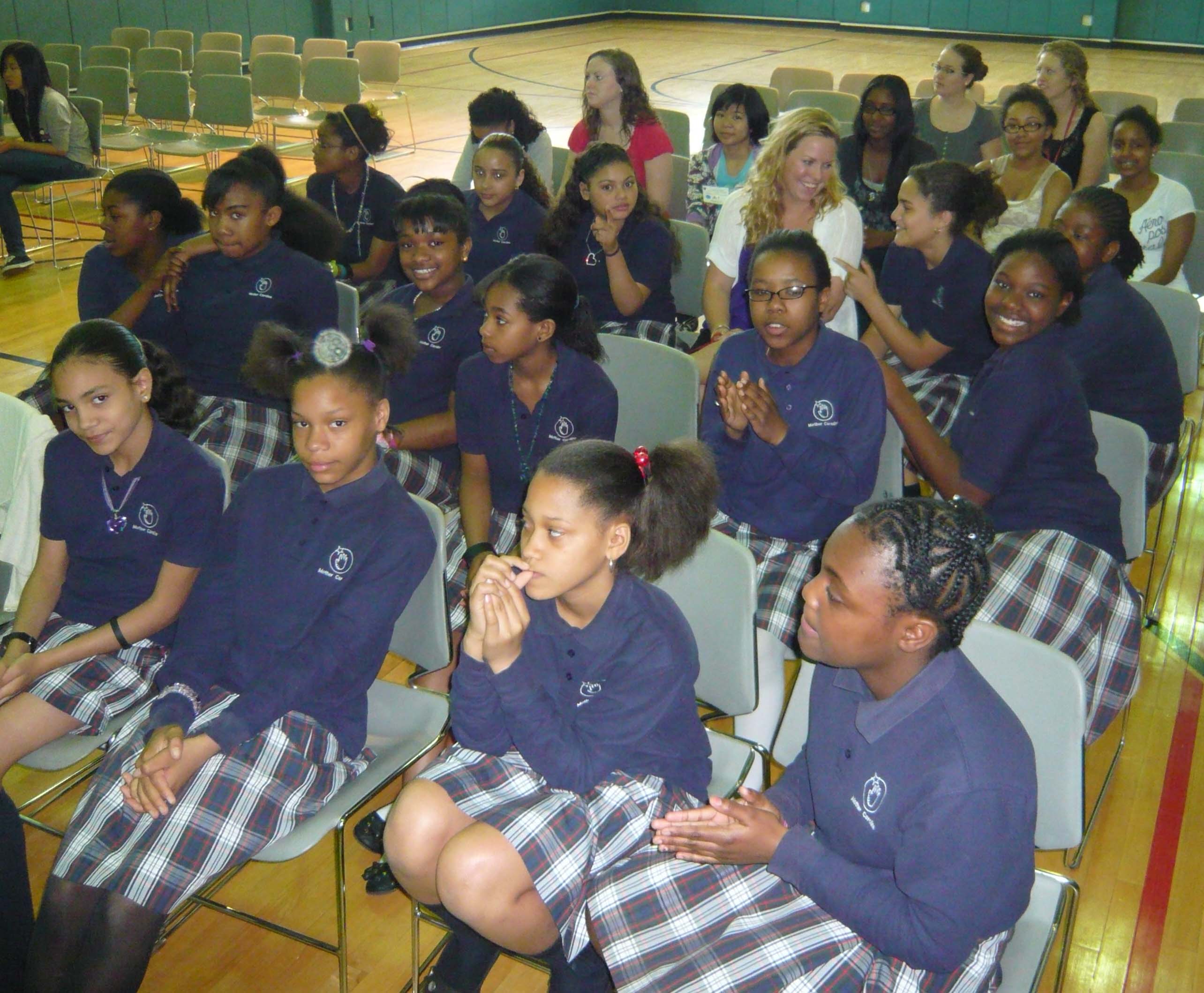
Mother Caroline Academy is a private middle school for girls in grades 5-8 from low income families.  Founded in 1993 in the Catholic tradition, the school provides an excellent educational experience to approximately 60 girls in inner city Boston, and the best proof of its effectiveness is that in the 18 years since its inception, 100% of its girls have graduated from high school and 94% matriculate college.  It accomplishes this by having a 13-hour school day, including after-school activities, and emphasizes hands-on personal mentoring by its staff, including its several volunteer teachers.  Many of the girls are from immigrant families from around the world: Central & South America (Haiti, Costa Rica, Venezuela, Barbados), Africa (Congo, Nigeria), and Asia (Vietnam, China), so with the US-born students this results in a truly diverse group.  Several of the girls with whom we spoke impressed us with their friendly openness and enthusiasm.  Learning that one of them had transferred from a public school, we asked her why, and she replied that her parents thought that Mother Caroline Academy would provide not only a superior academic environment but also a friendlier and safer one, and after a year there she was glad that she had transferred. 

I spoke to 45 girls from classes 6, 7, and 8, of which the 7th & 8th graders had studied about the Holocaust, and the 7th graders had even seen the movie “Paper Clips” (which inspired me to write my book).  My presentation was organized at Mother Caroline Academy by teacher Lily Sitron and coordinated by Judi Bohn of Facing History and Ourselves.           

with teacher Lily Sitron


bag of gifts & "thank you" card


with Erica and Yffka

Leave a comment

American High School, Fremont, CA – May 12, 2011

by George J Elbaum

American High School in Fremont, CA, with enrollment of 2000 students, teaches a World History course for sophomores which includes an extensive curricular exploration of the Holocaust.  As the culmination of that unit of instruction, teacher Sarah Hylas organized an all-day event on May 12, 2011 which included my talk to about 275 students in the morning, then break-out sessions, a short film, art projects, etc, and another Holocaust speaker and concentration camp survivor in the afternoon.  Before my talk, Jack Weinstein of Facing History & Ourselves (who arranged this talk for me) spoke to the students about the importance of learning about the Holocaust directly from the few remaining survivors, and for the students to pass it onward someday when no survivors remain.  My talk, supported by Sarah Hylas and her fellow teachers, Chris Fulton and Audrey Suratos, and Vice-Principal Anette Reichbart Saxe,  resulted in an active Q&A session during which many hands were still raised when we reached the 90 min. limit allocated to that session.

Jack Weinstein speaking to students


with teacher Sarah Hylas

my talk, same audience


with Nicholas


with Deborah

2 Comments

CSU Dominguez Hills, Carson, CA – April 26, 2011 afternoon

by George J Elbaum

This presentation, my first in a college, was arranged by our long-time friend Janis Davis, who is the Coordiator of Ceremonies and Events at CSUDH.  The audience of 2-to-3 dozen was  approximately half students and half staff, and included Sheela Pawar, Associate Professor and Chair of the Philosophy Department, Toby Bushee, Manager of the Office of Ceremonies and Events, and several students from the Negotiation, Conflict Resolution and Peacebuilding Program.  As a result, their questions after my talk were both thoughtful and thought-provoking, and I very much enjoyed the interaction and subsequent conversations. 

with Janis Davis, Mark, and Lauren


with Brenda & Naomi (?)


Leave a comment

Banning High School, Wilmington, CA – April 26, 2011 morning

by George J Elbaum

On arrival at Banning High School we were met by Gabriela Narez, Banning’s GATE/AP Coordinator, who led us to the auditorium where I would speak.  My first surprise was its large size, so I asked how many students are enrolled at Banning, and the answer was 3200, so much larger than any school where I’ve spoken so far.  As students began filing in, I met and chatted with teachers Adela Retana, Elia Garcia and Gloria Dyson.  About 10 min. later the auditorium was about 3/4 full (with 325 students, I’m told), and I launched into my presentation, having shortened it to about 35 min. to allow time for Q&A.  However, I obviously didn’t time it well because I was still 5 min. from finishing when the bell rang.  Thus there was neither time to finish nor for Q&A, which I deeply regret because it’s the students’ questions that reflect their reaction to and understanding of my story, and also allow me to  add what I may have omitted unintentionally.  Still, the next day a number of students emailed me commenting on my talk and asking how they could get my book, so I felt gratified by that reaction.  This presentation was arranged for me by Janis Davis, a long-time friend who is currently the Coordinator, Ceremonies & Events, at CSU Dominguez Hills.

PS: Excerpts from several students’ letters that especially resonated with me are below.

  • I myself had a rocky childhood, and after hearing your story I gained strength and inspiration that will keep me going, so your words won’t be forgotten.
  • Your story made me realize that I have nothing to complain about, none of us do.  We are all very fortunate to be living the lives that we have, so we should be really appreciative for that.
  • You inspired me to overcome life’s difficult situations.  I was lucky to witness a survivor with my own eyes and thank you for visiting our school; it was an honor.
  • I know that to remember sad things about our lives is more difficult than we think.  However, I know that life can only be understood by looking back, but at the same time it can only be lived by looking forward.
  • At times, your story made me feel emotional, just imagining what you went through.  I also noticed that you would get emotional at times and understandably would take a pause.  It showed how difficult these memories really were for you.
  • You made me appreciate life.  

with Antonio

with Gabriela Narez

with Gloria Dyson


with Adela Retana


with Elia Garcia

4 Comments

Social Justice Academy, Boston, MA – April 8, 2011 afternoon

by George J Elbaum

Social Justice Academy, a small school-within-a-school located in Boston’s Hyde Park education complex, was established “to foster the growth of social activists who can identify problems and have the skills and confidence to solve them.”  By design, the school’s focus and schedule would “enable students to participate in advisory programs and sit on its governance committees, participate in community meetings, and eventually get credit for outside-of-school internships.”  Unfortunately, it appears that budgetary issues and other external considerations have resulted in a decision to close the Social Justice Academy at the end of this school year.  As a result, the well-maintained but empty hallways, classrooms and unstaffed library of the building where I spoke gave me the impression of a city recently deserted by its inhabitants because of some calamity.  It was a sad sight, and it must be doubly sad for the students and teachers who will presumably be scattered among several other schools in the next school year.

However, this rather gloomy prognosis was not evident in the classroom with teacher Paula Motta and her Sophomore Humanities class.  The Q & A session after my presentation was active and spirited, but especially impressive were the students’ written questions that Paula gave me afterwards, questions her students prepared before my talk (!) showing considerable knowledge of the Holocaust and applicable to my story.  Clearly Paula did a great job in preparing her students so they would get the most out of the event, and many of their pre-talk questions are in the Student Questions section of this blog.  The event was arranged by Judi Bohn of Facing History and Ourselves.  Paula Motta and the Social Justice Academy have previously hosted other speakers from Facing History.

with Rashawn

Leave a comment

Jewish Community Day School, Watertown, MA – April 8, 2011 morning

by George J Elbaum

Teacher Eliana Lipsky’s Facing History class of 7th and 8th graders surprised me by asking several questions about facts and feelings that had not been asked since I started making these presentations, questions that were so natural and obvious that I had expected these would have already been asked in some of my previous talks, yet were not asked until this session.   It is these differences in the reactions and questions of the students that make each session unique, interesting and stimulating, and encourage me to continue.  This presentation was arranged by Shira Deener of Facing History and Ourselves.

Leave a comment