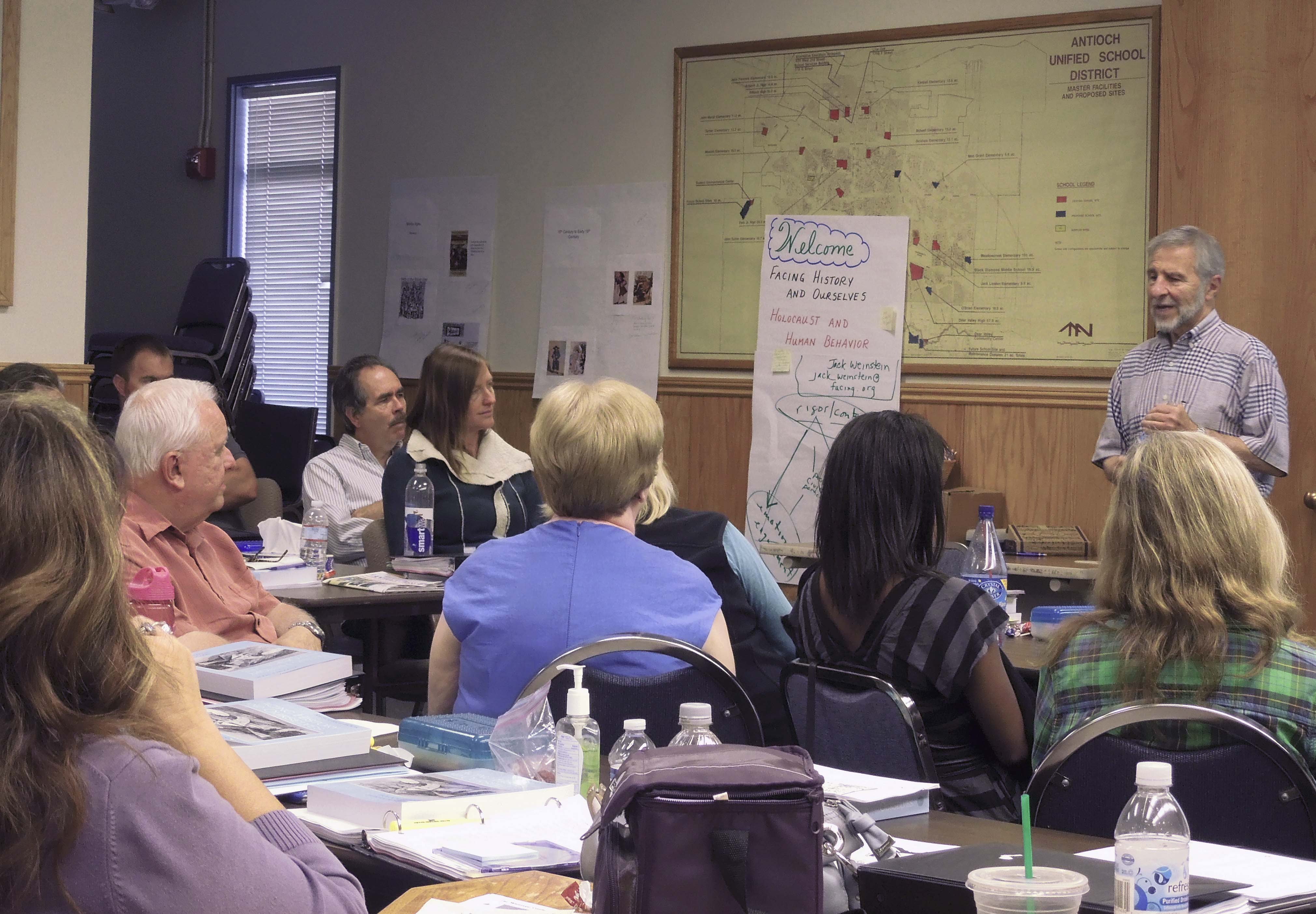
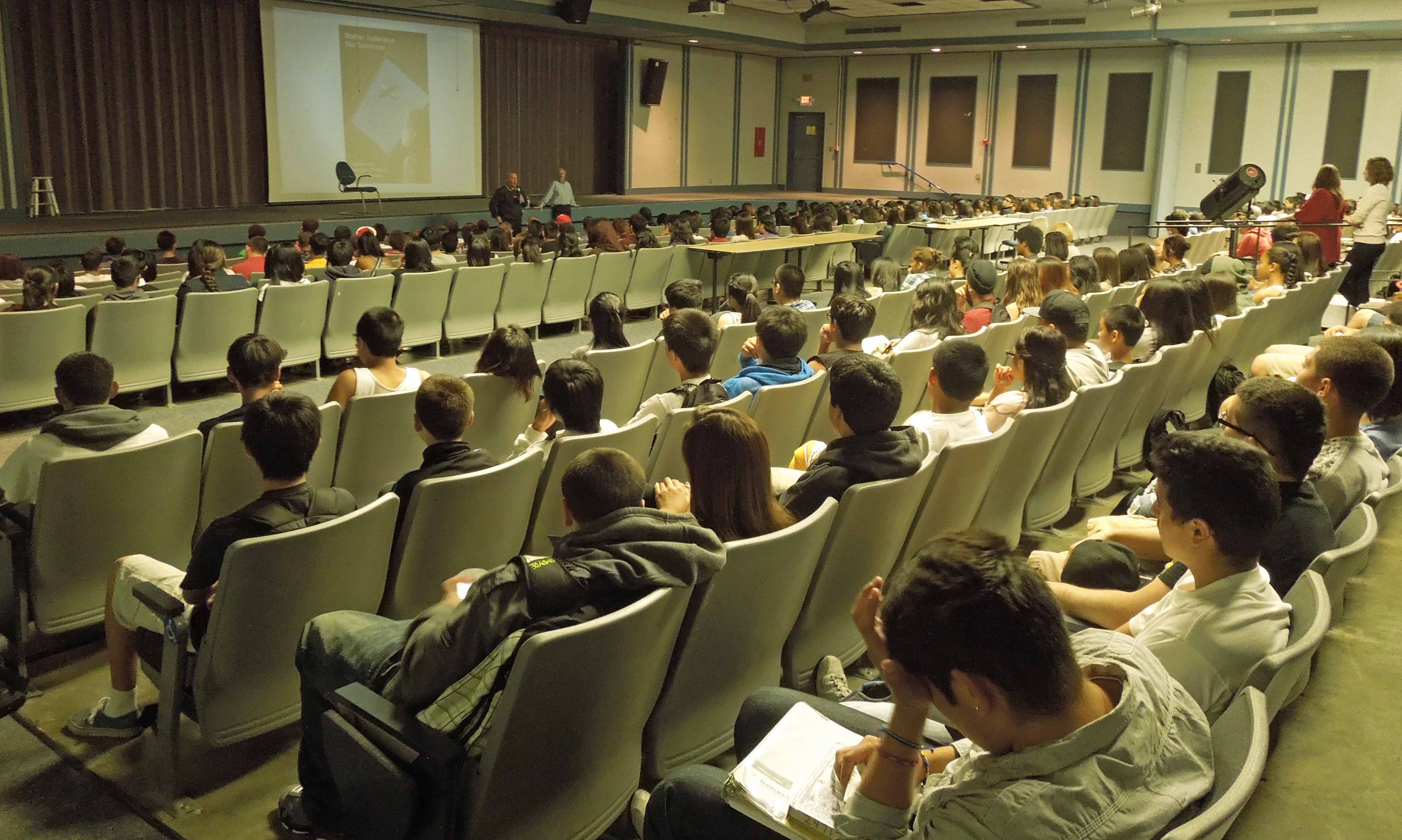
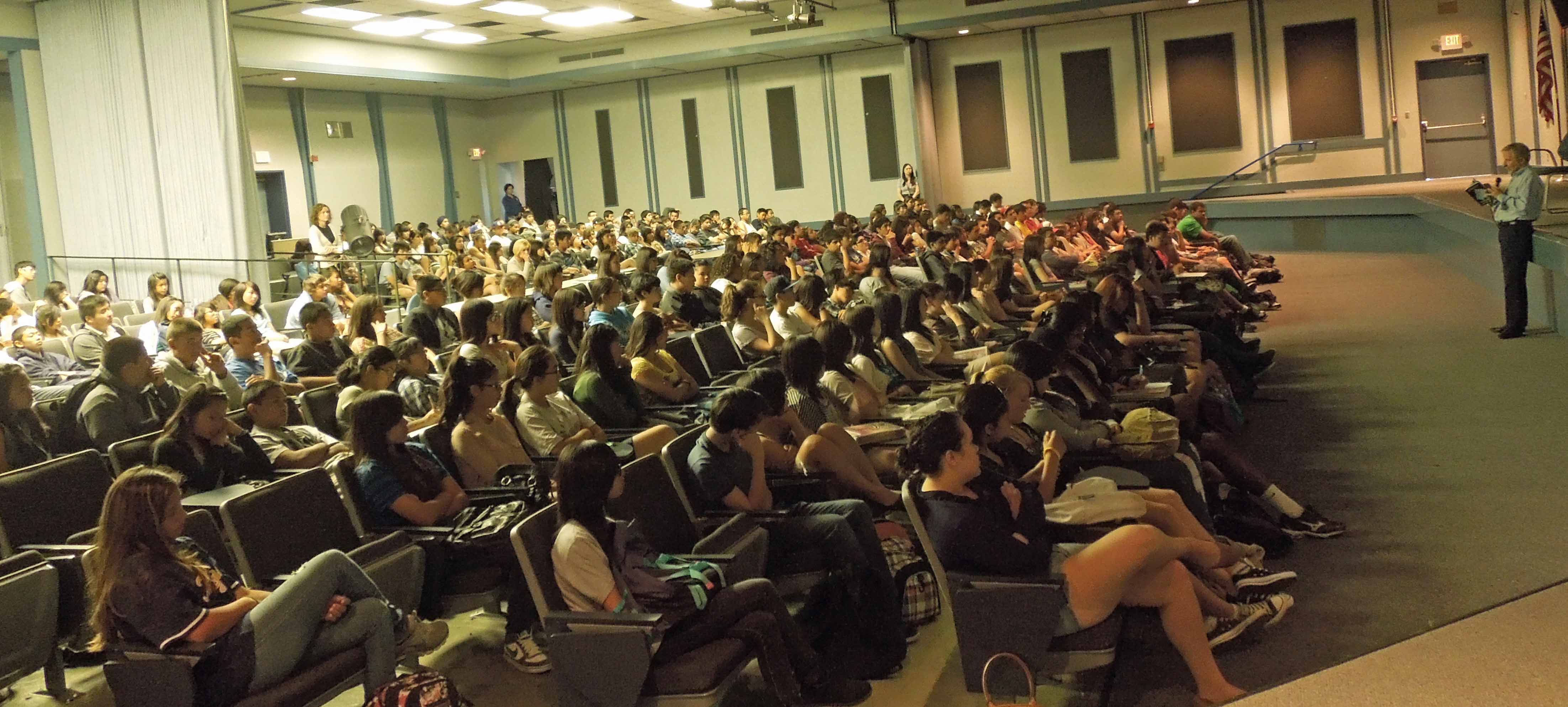
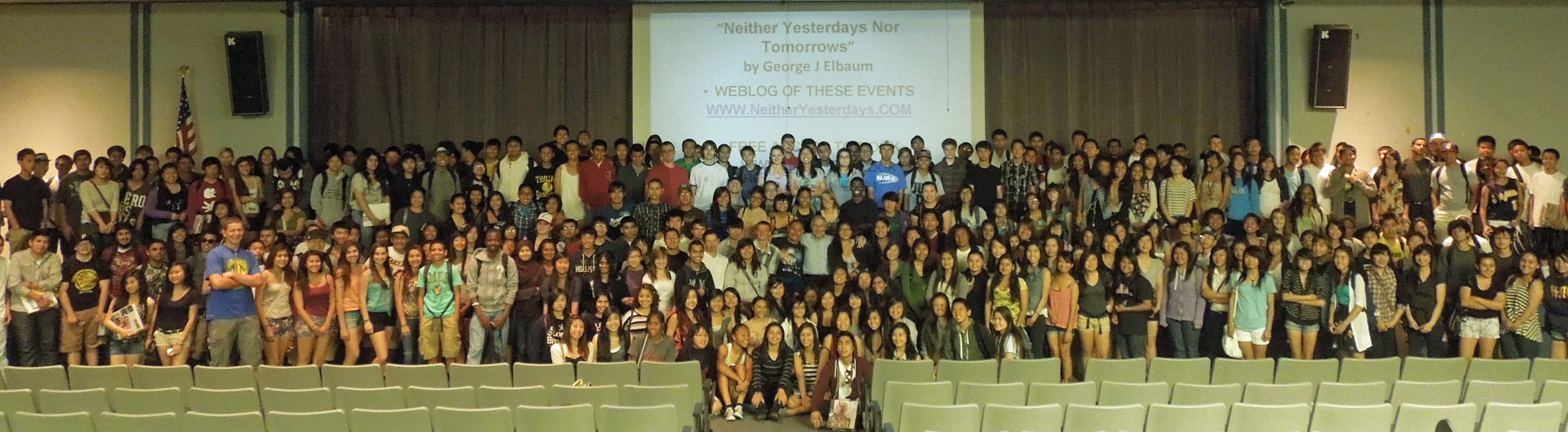
Antioch Unified School District, Antioch, CA – June 20, 2012

by George J Elbaum

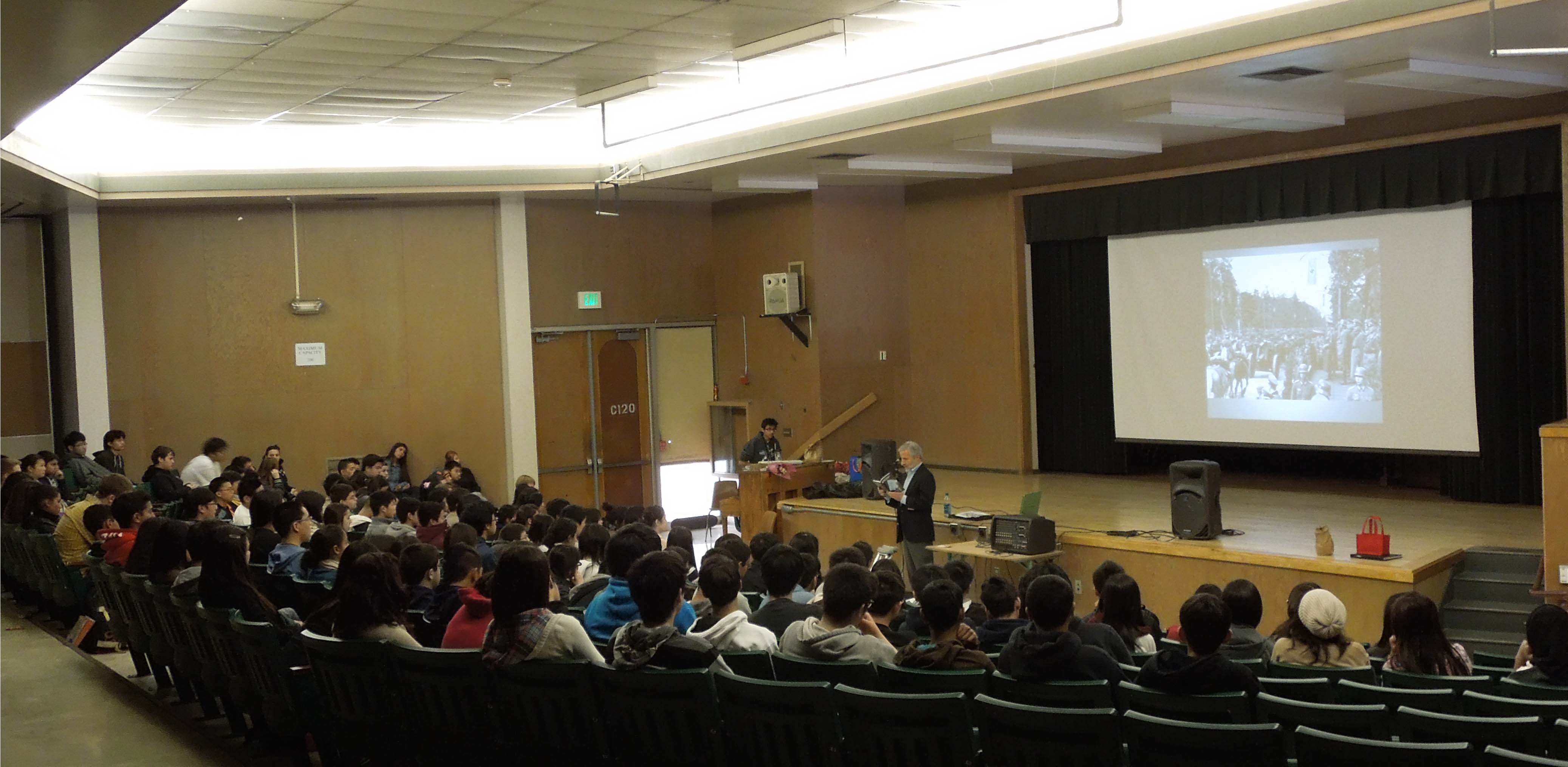
The Antioch Unified School District (AUSD) held a week-long training seminar on “Holocaust and Human Behavior” for its high school and middle school teachers.  The seminar was organized by Gail Pinnell, AUSD’s Coordinator of Education Services and conducted by Jack Weinstein of Facing History and Ourselves.  Since I truly believe that teachers, as a group, have more influence in shaping the future of our society than any other profession, I welcomed the opportunity to tell my story at this event which was attended by 30-some AUSD teachers (several of whom invited their parent) and also Don Gill and Stephanie Anello, the Superintendent and Associate Superintendent, respectively, of AUSD.

It was very gratifying for me to find that the overall reaction of the teachers, including their enthusiasm and questions and subsequent letters, were quite similar to that of the many student groups at my previous presentations.

A letter from one teacher totally sums up the take-away that I or anyone could hope for:   “I give you here a small piece of what I’ve taken from your presentation and story:

  • Motivated me to be a better person
  • Inspired me to see the story behind the person
  • Rekindled my passion for teaching history and people
  • Gained confidence to teach what I think is valuable
  • Encouraged me to hug my kids, and
  • Gave me the courage to speak up”

I thank you from the bottom of my heart for these words – they’ll keep me motivated to continue in spite of the lump in my throat that arises with painful memories.

Leave a comment

Terra Bella Academy, Mountain View, CA – May 10, 2012

by George J Elbaum

Terra Bella Academy is a small school for special risk students in grades 9-12 who are placed there for reasons such as expulsion, truancy, out-of-control behavior at school or home, and probation. The students typically work in a classroom setting, interact with their peers and change classes in ways similar to those of a comprehensive high school.  However, the classes are small enough so the students are able to receive one-on-one assistance from their instructors, who not only provide academic instruction but also emphasize the skills needed to improve attendance and behavior. There is strong emphasis in maintaining a safe, orderly school environment conducive to learning.

My visit was arranged by Jack Weinstein of Facing History and Ourselves, and the event was planned and organized by teacher Maria Magana for her 2 classes of English totaling 37 students.  Other teachers and staff attending the event were Angel Fuentes, Mitzi Marek, and Marques Buriss.

Jack had prepared me by stressing that students in this special alternative school often lead very insular lives in a narrow social environment, yet paradoxically are quite ”worldly” in ways that may or may not be acceptable in society at large – they may have made serious mistakes or bad choices, but can sometimes reinvent themselves and commit to improving academically and in their life choices.

(Note: Student photos will be added after approval by the school.)

4 Comments

Milpitas High School, Milpitas, CA – May 8, 2012

by George J Elbaum

Milpitas High School (MHS) has a large and highly diverse student body – 3000 students, 38% Asian, 22% Filipino, 20% Hispanic, 20% White, and 4% African-American – and was the very first school in northern California to develop a Facing History course.  Jack Weinstein, Facing History’s Director, taught at MHS from 1978 to 1997 and integrated Facing History’s resources early on within many of the school’s English courses. Then, in 1990, he developed a full-semester Facing History course focused on the Holocaust and Human Behavior. That course was an inter-disciplinary English and Social Studies course for 3 years, and then it evolved into a Social Studies elective focused not only on the Holocaust but on multiple case studies of genocide, human rights, and issues of race in American history.  When Weinstein left MHS in 1997 to establish the Bay Area office of Facing History, teachers Cathy Mellera and Sky Draeger became the instructors, and the course is among the longest-running electives in the school’s history.  In addition, nearly all freshman English courses now include a multi-week unit on the Holocaust with the study of Elie Wiesel’s Night as its centerpiece.

The 300-some students attending my talk were therefore well-prepared – most were from the multiple freshman English courses taught by Sanjit Roy and Ginger Roy (who jointly organized the event) and by Lindsay Mohundro, teachers who clearly pass their own enthusiasm to their students, plus students from Sky Draeger’s junior/senior elective course Facing History.  Also in attendance were teachers Sharon Roth, Annie Marple, and Lynn Marozeck.   Arrangements for my talk and the introduction were made by Jack Weinstein of Facing History.

Letters from Students

Ten days after our visit to Milpitas High School I received (via Jack Weinstein) a large, thick envelope with 75 letters from the students taught by Sanjit Roy and Ginger Roy, and a week later another envelope with a dozen letters from Lindsay Mohundro’s students.  As has become our habit by now, after dinner my wife Mimi read each letter aloud while I listened and absorbed it, mentally and emotionally.  We were both touched by the students’ openness and sensitivity as reflected in the letters, and we felt very gratified by their responses to my story.  Statements from these letters that particularly resonated with us are excerpted below.

  • I have this haunting question I must ask: what, in your eyes, is the best response to the Holocaust?  My response: to stand up & speak out against injustice whenever you encounter it – to be what Facing History calls an “upstander.”
  • After reading the book Night, by Elie Wiesel, I still cannot imagine the horror and cruelty of the Holocaust.  It makes me wonder how a human being could be so cruel to another human being.  Even if I cannot fully wrap my mind around it, the Holocaust did happen and we cannot change the past.
  • When our class started learning about the Holocaust we only knew that it was a tragedy in history.  I believe if you had not come to speak with us that all it would be was an event in history books.
  • Reading from a book only tells me about what happened and what the author wants me to know.  Listening to your life-story tells me more about what you had to do and how you felt while moving around and hiding from the Nazis.
  • I now understand what it means to go through life with struggle, pain and loss of close family members.
  • You got very personal as well, which was most definitely something I didn’t expect.  It’s something that will be hard to forget in the future.
  • After studying the Holocaust for the past few weeks, most of us couldn’t fully grasp the enormity of the subject.  The books and the movies about it seemed like fiction.  That is, until we met someone who was there.
  • It’s much better to witness someone who actually went through the Holocaust talk about when he or she experienced than just sitting in a normal classroom learning about the Holocaust in general.
  • Please continue speaking to kids because it will help them learn about the Holocaust and make the world a better place.
  • Thank you for giving your testimony, for it will remain within us until we die.
  • You were saved for a reason, though.  You were chosen so you would grow up to help students like us learn and remember what had happened.
  • I’m very pleased that even after all the things you’ve been through, you’re still a very optimistic person.
  • Your vivid details from your vignettes had an awe-striking spark to my heart and emotions.
  • I don’t know if your religious beliefs have changed since the Holocaust because being in that situation people’s views on God may have changed.  However, in my point of view, you are truly blessed.  Hearing your stories made me smile for some crazy reason.
  • Even though you think that you were just lucky, I think that you were able to live because someone up there really wanted you to survive and be able to see another smiling face on Earth.
  • What I noticed about hearing you speak is that you were very calm and had a sense of peace of mind.  That is great that you were able to keep that part of your past in the past.
  • You inspire some people to always keep hope and keep going through a bad situation.  Thanks to you, I will look at bad situations and try to make something good happen.
  • Your presentation has really enlightened me to stress the phrase “Never Again.”  However, after witnessing these horrific tragedies, how can you trust in humanity not  to be broken forever?
  • I am worried that some people still do not understand that something of this scale, while maybe not in the immediate future, could still happen.
  • Such mass murder should never be allowed to happen again, and the only way to make that possible is by spreading awareness.
  • Your comparison of 100,000 murders a month (during the Holocaust) to a city like San Francisco getting exterminated in 8 months was easy to comprehend, and now I understand just how many people died, and how quickly, too.
  • Your description of how it was after the war also helped me imagine how someone who lived through the Holocaust would start over.
  • I especially liked when you read passages from your book, Neither Yesterdays Nor Tomorrows.  I could almost visualize how life must have been for you, and I felt as if I was reliving all the joyful and saddening events you encountered.
  • I especially enjoyed how you were very open about retelling your past.
  • I cannot imagine a stranger risking their life to save me.
  • I understand that there are many who survived the tragedy, lost loved ones, and are pained whenever they are reminded of that dark corner of history.
  • You gave me a different perspective on all the Holocaust survivors.  I now realize that not everyone who was a survivor was hidden in a single place or survived the death camps, but all have different experiences and stories.
  • It gave me a great insight on how life was for some people and the difficulties they had because they were different.
  • Thanks to you, I know more about the Holocaust and how people rebuilt their lives after it was over.
  • You showed me that even though you went through such a terrible experience, it is still possible to move on, pursue your dreams and live a very happy and successful life.
  • When someone asked how you could be so cheerful and happy, your reply touched me.  You said that you were an optimist and you remember the good things and not the bad, and that will help me in the future whenever something bad happens.  I now look at the Holocaust with a different perspective, and I now understand that millions of others have their own unique stories as well.  You changed my views on the Holocaust and life itself.
  • You have inspired me to never give up and to keep pursuing my goals.
  • You and your mother have taught me that I can overcome whatever hardships life throws my way and to never give up.
  • Your talk encouraged me to cope with challenging situations.  I made a challenge for myself to try to be positive whenever I am stuck in tough situations.
  • There was a “what if” question and you didn’t necessarily answer (and) I thought that was an important lesson to be learned: there’s no reason to think about the “what ifs” – in life what happens, happens.
  • My whole life has revolved around materialistic beliefs, and I feel that I constantly choose to get what I want and not what I need.  To add to that, I myself am a bystander.  I do not act when I witness a wrongdoing, and I am guilty.  After reading Night I realized that it is selfish to complain over unnecessary flaws in life, and to stand by when someone needs help.  I am slowly starting to figure out that there are greater things in life than technology, clothes, and shoes – there is suffering.  Bullying, famine, genocide, and more occur all over the world and I now understand that it can only be stopped if people act.  I need to start taking action.
  • Your story opened up my mind to show how thankful I should be for still being alive each and every day.  I also began to realize more and more that if you primarily look forward to tomorrow you will not be able to live fully in the present, and if you were to primarily look back at yesterday you would be trying to relive the past and fix what one once had.
  • Do you still eat (and like) potatoes, bread, and soup, and does it bring back memories of your Holocaust childhood?  (see Q&A)
  • How were you changed mentally by the war, your morals and beliefs and state of mind? (see Q&A)
  • What started out as my attempt to skip my classes actually turned out to be a once-in-a-lifetime opportunity.  I grew up learning that there are only three worthwhile jobs in this world: doctor, engineer, and lawyer.  I later learned that a job should make you happy.  I still have not found that one career, but maybe one day I will be inspired just like you were.
  • I did not think hearing your story would change me in any way, but I was wrong.  Hearing your story impacted my life.
  • Thanks to you, I really understand that I shouldn’t take life for granted.
  • I feel like your stories have made me a stronger person.
  • It might have been hard for you when you first came to this country (not knowing English).  I know how you felt because I didn’t know English either, only Spanish.  Sometimes I feel bad saying that I am not from Mexico.  I have learned from you that I have to be proud of where I come from.
  • I started to think of my own life and how many futures I could choose from, whereas many others did not have this choice.  I became aware of how ungrateful I am, and that I need to change that.
  • Thanks to you I have taken a second glance, so to speak, at my own life, and I am now trying to live it in a more fulfilling way.
  • A part that really stood out for me was when you told us about how a bunch of people you did not know started to live in your home.  I can imagine how confusing this all must have been to you.  When you told us this, I really appreciated what I have in my life.
  • When your mother left you many times, I felt grateful that my mother was always by my side.
  • Learning about how you traveled from family to family yet maintained your relationship with your mother has given me a new respect for my parents, a greater realization of all the things they have given up to keep me safe and have a better life.
  • When you told us how your mom basically saved your life, it really made me think of my mom and how she would do anything to save me.
  • Before this, I could not grasp the idea of how massive the Holocaust really was until I heard it from an actual survivor like you.  It finally hit me that an unimaginable amount of people died.  Not just died, but tortured!  Your story really opened my eyes up.
  • When you told us about the sugar cube and how you loved it so much, it made me appreciate everything I have even more.
  • My favorite part in your story was when you received a sugar cube from the Russian soldier.  To me, that sugar cube symbolized hope and luck.  Ever since you came and told your story, I have been much more interested in the Holocaust – as well as in sugar cubes and airplanes.
  • I would never expect someone at your age to be riding a motorcycle and hang gliding and getting into crashes in both.
  • I think it was cute how you met your wife.  Did you know that strawberries are considered the fruits of love?  I think strawberries were the perfect way for you to meet her.
  • You have shared your story with us.  Now it is time for us to share it with others.
  • From a teacher: I was most touched by your statement that as human beings we need to stand for something, not against something.  I think that all too often we think of the things that divide us and make us different, not the things that bind us together, and your words encourage us to be people of positive action.

Jack Weinstein’s introduction


1 Comment

New Mission High School, Roxbury, MA – April 13, 2012

By George J Elbaum

New Mission High School (NMHS) is a small school community of 265 students and 31 faculty whose goal is to empower the students to become “self-directed, life-long learners.”  With enrollment approximately 67% Black, 30% Hispanic, and 3% White and other races, NMHS keeps expectations high but provides a strong support structure to assure success for all students.  Average class size of 22 provides the foundation for individual learning as well as both academic and personal support.  To that end, students experience a “project-based” approach in their classes and demonstrate their skills through portfolio presentations 3 times per year.  My presentation was to the 11th grade Modern World History class of teacher Tore Kapstad.  I was impressed with Tore’s enthusiasm regarding the Holocaust unit of instruction, and with the excellent website created specifically for this study unit (http://wh2nmhsholocaust.wordpress.com) by Tore’s assistant, Chris Shepard.  My presentation was also attended by NMHS Principal Naia Wilson and teachers Beth Kenney and Kevin St. Dick, and arranged by  Judi Bohn of Facing History and Ourselves.  

Letters from Students and DVD

A month after my visit to NMHS I received a DVD from Chris Shepard on which he had recorded my presentation (thanks much, Chris) and two weeks later I received from Tore Kapstad an envelope with letters from the students who attended it.  On receiving these letters, my wife and I read them together after dinner, noted the phrases and statements that especially resonated with us, and I’ve excerpted and copied these below.  Though the school year has already ended, I hope that the students who wrote these letters will check the weblog and recognize their own words.

  • Throughout your speech you stated that the only reason you survived was sheer luck, but I believe that it was destined to be that way.  It was your destiny to survive and eventually one day to tell students just like me about your story, so we may know that no matter how bad things get, we should always have faith and be thankful for what we can be thankful for.
  • This gives me the motivation and drive to say that I can go through whatever the situation and accomplish what I want.
  • The fact that you never gave up really inspired me.
  • The courage you possessed at such a young age was motivating for young people like me because it illustrates the will and capability that is within all.
  • If you could experience death in front of your eyes, then I could face simple things I call obstacles.  (Thank you to this student for the photos of Boston’s Holocaust Memorial, where I gave this presentation for the very first time 2 years ago.)
  • Your book makes me realize that good things do happen to good people who try and never give up.
  • I feel that the nicest hearts have been through the most pain.
  • You have motivated me to do good not only in school but in every decision that I make in life.
  • I know that I was not the only one walking out of that room that day feeling inspired.

with teachers and students

with teacher Kevin St. Dick, Principal Naia Wilson, and teachers Tore Kapstad & Beth Kenney

2 Comments

Arroyo High School, San Lorenzo, CA – March 27, 2012

by George J Elbaum

Arroyo High School in San Lorenzo, across the bay from San Francisco, has approximately 2000 students and high diversity, with 34% Latino, 30% White, 27% Asian and Filipino, 7% African-American, and 2% other ethnic or racial groups.  In preparation for my visit the students not only read Eli Wiesel’s Night but also took a field trip the preceding week to San Francisco’s Contemporary Jewish Museum.  There, they engaged in discussion with museum staff about the history of Jewish life in the Bay Area.  They were introduced to the idea that while it is crucial to learn about the history of the Holocaust, it would mean even more in the context of learning about Jewish life, culture, and diversity.  Their summative discussion was organized by Jack Weinstein of Facing History & Ourselves, who also arranged my visit to Arroyo HS and gave an introductory presentation.  My talk to about 120 enthusiastic students was organized by teachers Jorja Santillan and Kevin Beal, and attended by Assistant Principal Alex Palau.

Letters from Students

A week after our visit to Arroyo High School I received a large, thick envelope with 84 (yes, 84!) letters from the students at my talk.  As has become our habit by now, that evening immediately after dinner my wife Mimi reads each letter aloud while I listened and absorbed it, mentally and emotionally.  We were both touched by the students’ openness and sensitivity as reflected in the letters, and we felt very gratified by their responses to my story.

Statements from these letters that particularly resonated with us are excerpted below.

  • When you were telling us your story I felt like my throat contained by heart and I’m having the same feeling as I’m writing this letter to you now.  At other times you told us things that made us all smile and laugh, and it reminded me that there’s always something to be happy about.
  • You taught us that the most important thing is what we do in the present, and not to waste time  wishing that we could change what we know we can’t.  The future will come as long as we focus on the present.
  • I’m sitting here thinking how crazy it is that there could be such ignorance and hatred towards someone who didn’t do a thing to deserve it.
  • I hope that you are doing well and that reading all our letters makes you feel like you really did open each and every one of our eyes and hearts.  You trusted us with your past to inform us and others.
  • I wonder if you really love your life.  With all those near-death experiences I know I would have.  I am glad that you’ve written your book because I look forward to reading it.
  • I am impressed by the amount of work you put into making your dreams come true.
  • Coming to your event changed my mind about the Holocaust and let me realize how important it is in our history.
  • Hearing your story made me realize that even when someone goes through something horrible they are still able to keep themselves optimistic and push forward.
  • You taught me three very important things today.  One, you shouldn’t let others discourage you from your dreams.  Two, you’re not going to be able to please everyone.  Three, to  not dwell on the past and just keep moving forward with your life.
  • The fact that you and your mother made it out alive during the war is amazing, and it makes me feel like I’ve taken my childhood for granted.
  • It’s still surprising to me that something tragic like the Holocaust was not that long ago.  I almost feel like it’s something that would happen hundreds of years ago, but knowing that you’re one of the survivors makes me snap back to thinking that it was just a few years ago.
  • You went through so much as a young child but still you continued to stay strong.  I don’t know how you did it, because the littlest things happen to me and it seems like the end of the world, but what you went through was so much worse.  I would like to be as strong as you were and are.
  • You have inspired me to never give up.
  • Today I felt that this is not just a story we heard; it’s a big lesson to us.  We learned the truth and felt the pains.
  • We study this in class and we read about it in books, and, yes, we feel bad and disgusted, but then most of us move on once we’ve read the story.  To hear live from somebody who has actually lived through it makes me appreciate it a lot more.
  • I appreciate you putting a real life example to all the terrible things we are learning about.
  • By telling us the story of what you and your mother went through, you entrusted us to tell the next generation.
  • Your story has left me completely stunned.  It made me think about the atrocities that took place during the war and how we must never let any of those horrible actions ever take place again.
  • I couldn’t deal without seeing my mom.  It would always bother me because I wouldn’t know if she was OK or not.  Did you sometimes thing like that?  I probably would always think that.
  • Hearing it from a first person point of view really humanized the story for us.
  • Pure luck is what kept you alive, you said, and ignorance as well, ha ha.  All this time I thought that ignorance was the cause of intolerance but hearing your story made me think in another way because in your case “ignorance” saved you many times.
  • I find it incredible that some people don’t believe that the Holocaust happened, but I think it is because they don’t want to accept that people just sat around and let it all happen, so they prefer to put it in the back of their mind.
  • Your story helped me look at life differently.
  • That made me think about how life is measured by the actions you make and how you take responsibility for your actions.  You also made me realize that I shouldn’t be thinking too much about the future but rather taking the steps now to get me to where I want to be in life.
  • I want to say thank you for your time talking to my school because it is people like you that kids like me strive to be when I grow up.
  • I learned that even though times may be hard, to keep my head held high because it can get better.
  • I also feel that if you keep looking back at the bad things, it can hurt your future.
  • I’m German and I had a great grandfather who was a German officer.  I realize you said that you don’t have anything against German people but I can’t help feeling guilty.  I am playfully harassed by friends calling me a Nazi and such.  Anyway, for the most part I’m struggling to keep the words “I’m sorry” out of this letter.  (My response: there’s absolutely no need to feel guilty, since you are responsible only for your own actions, not for those of any ancestors.  Also, do tell your friends not to call you such a cruel name, even playfully.)
  • I took everything you told us and told my parents.  They now want to go to San Francisco and look at the museum.
  • I never really realized that history is very important, until high school.  As I got older and had a better understanding, I realized that history is what makes today.
  • I believe that everything happens for a reason.  You survived for a reason, you met your wife for a reason, you became a grandfather for a reason, you came to speak to us for a reason.
  • You are an inspiration to me to stay strong no matter what is happening in the world.  We truly can get through anything.
  • For me to hear your story makes me want to make a change.
  • It makes me happy to know that not all the people living in the Holocaust had become inhumane, since those Polish Catholic families agreed to take care of you.
  • The Holocaust was a time when the world was at its worst.
  • You have given me more motivation to not lose faith in myself, and in my family.
  • I really like that you don’t remember the bad things and focus on the good.  I wish everyone in the world could feel that way because life would be lived to the fullest.
  • People who do not believe in the Holocaust blow my mind.  Those people say it’s a lie so they can sleep at night.  They don’t want to believe the human race is capable of such things and that is what is most scary.
  • I go by “forget the past, live in the present, and expect the best for the future.”
  • I will also stand up for people when they are called bad names.  I will tell people we don’t do those things at this school.

(Note: Please send me via this site the missing names of A and B or any errors in names in the photos below and  I’ll correct these.)

2 Comments

Novo Community School, San Jose, CA – March 23, 2012

by George J Elbaum

As a repeat of my visit last year (Feb 9, 2011), I was invited to speak at the Novo Community School in San Jose.  Novo serves high risk students in grades 9-12 who are placed at the school for reasons such as expulsion, truancy, out-of-control behavior at school or home, and probation. The students typically work in a classroom setting, interact with their peers and change classes in ways similar to those of a comprehensive high school. However, the classes are small enough so the students are able to receive one-on-one assistance from their instructors, who not only provide academic instruction but also emphasize the skills needed to improve attendance and behavior. There is strong emphasis in maintaining a safe, orderly school environment conducive to learning, so my presentation this year was divided into two back-to-back talks: one to students in the regular Novo program and another to students in a separate program.

My visit was arranged again by Jack Weinstein of Facing History and Ourselves, and while Novo principal, Carey Johnson, was not on campus during this visit, I met again with instructor Ev Willason plus new ones: Amy Sinnott, Anne Elwart, Stephanie Boulianne, Gabriela Manzanares, Timon Cooly, Debra Keys, Stacy McCabe, and Jacqueline Smith.  As last year, Jack had prepared me by stressing that students in this special alternative school often lead very insular lives in a narrow social environment, yet paradoxically are quite ”worldly” in ways that may or may not be acceptable in society at large – they “may have made big mistakes or bad choices, but can sometimes reinvent themselves and commit to improving academically and in their life choices.” This potential was evident in the range and depth of their questions, some very naive and some very deep and philosophical.

with Moses – thanks for taking photos


with teachers Timon Cooly, Gabriela Manzanares, Stephanie Boulianne, Anne Elwart & Amy Sinnatt

with teachers Jacqueline Smith, Stacy McCabe & Debbra Keys

Leave a comment

Pacific Lutheran University, Tacoma, WA – March 9, 2012

by George J Elbaum

Each year Pacific Lutheran University (PLU) holds the Powell and Heller Conference on Holocaust Education.  The conference is a two-day event dedicated to bringing educators to the PLU campus to consider ways to better teach the Holocaust, and thus the lessons of tolerance, in middle and secondary schools.  I was invited to participate in this year’s Fifth Annual Conference as the Survivor Speaker, and the audience of about 200 seemed to be composed of equal numbers of educators and PLU students, with both groups enthusiastically involved in the question & answer session.  Following the talk I participated in a panel “NEVER AGAIN: Community Conversation” with Nancy Powell as moderator, Nick Coddington of the Charles Wright Academy, and Laurie Reddy, a PLU student.

The annual Powell and Heller Conference is sponsored by Nancy Powell, her sister Carol Heller and their respective families, and is organized by Robert Ericksen, the Kurt Mayer Chair in Holocaust Studies at PLU.  Both Robert and Kurt were also speakers at the conference.  My participation was arranged by Janna Charles of the Washington State Holocaust Education Resource Center.

Note: If your photo (below) has only a letter instead of your name, please email it to me via this weblog together with the letter and I’ll exchange them 🙂  Also, the first/large photo below is by PLU photographer John Froshauer.

2 Comments

Mission San Jose High School, Fremont, CA – Jan 10, 2012

by George J Elbaum

The high academic goals and commensurate achievements of Mission San Jose High School (MSJ) are best represented by the school’s rating as the Top Comprehensive Public High School in California for the past 3 years.  MSJ was also ranked by US News and World Report as the 4th best open enrollment public high school nationwide, and Newsweek ranked MSJ 10th best in the U.S. for math and science, and 1st among public high schools.  With these impressive rankings, 2011 graduation rate of MSJ is 99%, college enrollment rate is 96%, and its SAT scores (writing, reading, math) are more than 30% higher than state and national levels.  My presentation at MSJ was for approximately 150 10th grade students in the combined College Prep and Honors classes of teachers Katherine Geers and Jennifer Moore.  Each year the two teachers collaborate to teach a six-week course on Elie Wiesel’s Night and on the Holocaust and human behavior. (The Holocaust and Human Behavior is a book published by Facing History and Ourselves.) The course provides historical context and explores the choices individuals, groups, and governments made during the Holocaust.  Katherine described their goals in this course as follows: “We want to build and improve our students’ communication and writing skills while simultaneously working to touch their hearts and minds. We strive to enrich their understanding, develop a stronger level of empathy, expand their definition of membership and widen their universe of obligation; so that they may make better choices and become productive members and active upstanders within our society.”  From my observation, these lofty goals are enabled by both teachers’ personal commitment and enthusiasm.

My presentation was arranged by Jack Weinstein of Facing History, who described its goals and the “ever-diminishing opportunity” of hearing directly from Holocaust survivors.  When Jack and I arrived at MSJ around noon, we were welcomed by Katherine and Jennifer with bagels & cookies “in case we had not had time for lunch” – very, very nice!  MSJ’s Principal Sandra Prairie also attended the talk.  (The photo gallery below has a (?) instead of a missing name.  Pls send it to me via this weblog and I’ll insert it.)


Leave a comment

Central Catholic High School, Lawrence, MA – Nov 29, 2011 PM

by George J Elbaum

Founded by the Marist Brothers in 1935, Central Catholic High School enrolls approximately 1,300 students from diverse backgrounds “to form a caring community of faith, learning, and service.” The school prepares its students for college which they enter in overwhelming numbers (nearly 100%), and simultaneously “it teaches and promotes social justice and compassion to make the world a better place.”  To this purpose the school has just launched a one-semester elective course “Facing History & Ourselves: The Holocaust & Human Behavior” in its Religious Studies Department.  As taught by teacher Tim Hart, the students explore the history, causes, and aftermath of the Holocaust and reflect on racism, social justice, the importance of global awareness and their own potential for making a difference.  Tim’s class of 50 seniors attended my presentation, which was arranged by Judi Bohn of Facing History and Ourselves.  Also in attendance were Brother Tom Long, the school’s President; Jeanne Burns, Vice Principal; Brother Rene Roy, Director of Mission Effectiveness; and David DeFillippo, Director of Community Relations. The overall atmosphere was very welcoming and the students well prepared and very enthusiastic – a real pleasure.

LETTERS FROM STUDENTS, ETC.

Two weeks after my talk at Central Catholic High School the late afternoon mail brought a large envelope with 4 dozen letters from the students, including some hand made & decorated cards, and a very kind note from teacher Tim Hart.  After dinner, my wife Mimi and I read them together at the dinner table.  We were truly touched by the perceptive understanding and deep feeling shown in these letters, and Mimi commented that it surely reflected both the teaching efforts of Mr. Hart and the active participation of the school’s administration present at the talk.  Statements from these letters that particularly resonated with us are listed below.

  • We have been learning all about the Holocaust and have read excerpts and studied it in detail, but it was different hearing it from someone who lived through it.  I believe 100% that you lived through it so you could change my life and also hundreds of other kids.  I’ll always remember why you named your book by its title because it hurt too much to think about yesterday and tomorrow scared you, so right now this very moment was the place to be.  I can only hope that one day I can be as courageous and beautiful as your mother.
  • Taking this course and reading the stories of other survivors’ experiences opened my eyes to how it happened.  But now that I listened to you speak in person, I know that the duty of my generation and future generations is to prevent something like the Holocaust from ever happening again.
  • Your story made me realize how lucky I really am.  It made me go home and tell my mother that I love her.
  • Thank you for being the topic of discussion at my family’s dinner table that night.  I passed on your stories to my family who also found them inspiring.
  • Your point that we should be for something, not anti-something, struck a chord in me.
  • Your words “To be good you have to be for something” stood out to me and have stuck with me since you spoke to us.  It’s something to live by.
  • I learned things from you that I hope someday to teach my children, that we should never be just anti-anything.  To be against something isn’t a belief, but to be for something is a movement and a love. 
  • I enjoyed your answer concerning your faith.  It amazed me how you were born a Jew, raised a Catholic, stripped of religion completely, and yet you still have the strength to have faith in something.
  • I loved your quote that “I have no organized religion but I have faith” because I love how faith gives us something to hold onto.
  • What stuck out for me is when you said that you don’t have a religion but you have a faith.  To me these words are true.  Many times we get caught up in the upkeep and rituals of religion and we forget the faith and the golden rule to treat everyone in a positive and kind way.  I really think that the golden rule is the best way to live.
  • I know that being able to listen to someone’s personal story of the Holocaust won’t be available to future generations.  I hope to be able to inform the next generation so the memory of that time in history is never lost.
  • The world made a promise to never again stand by as a Holocaust occurred and they are breaking their promise.
  • … most importantly, value the time we have today 🙂
  • Moving on from the past and not worrying about the uncertainties of the future is an incredible outlook on life.  After hearing you speak, I realize that everyone should focus on the present because it is a gift.
  • Your talk is changing my outlook on life.  The idea of neither yesterday nor tomorrow is so inspiring.  Living in the present is very hard to do, but I’m going to try and do it.
  • You challenged us to face the facts of the past, traumatic as they might be, in order to prevent them from happening in the future.  We will internalize this message and apply it to our futures, thanks to you.
  • I always hear about the Holocaust stories from survivors on TV, but hearing it from someone in person, such as you, gave me a whole new understanding of what the Holocaust truly was.
  • I can’t say that I went through what you and your mother did, but I can understand to an extent what it is to be discriminated against simply because of my race.
  • I realized throughout your talk that responsibility of passing on the stories sits on the shoulders of my generation.
  • It was the first time that I heard someone’s story in person.  It made a huge difference from just reading someone’s experiences in a book.
  • By talking about your life you encourage others to value what they have.  Although you explained a few times that you survived by pure luck, I believe it was fate.
  • You told us that some people do not believe that the Holocaust occurred, or they do not want to believe it.  After hearing your story I don’t comprehend how anyone can actually think it did not happen.
  • It takes a lot of strength to stand in front of an audience and open yourself to them.  You have faith in the audience and think optimistically of them, even though you know that you may encounter ignorance and disbelief.
  • I can’t imagine the frustration you feel when someone denies the occurrence of the Holocaust.  It is absolutely absurd to think that something so tragic and wicked did not happen.  Shame on those disbelievers.
  • I especially admire your mother, she reminds me of my own: very loving, protective and smart.  She must have been an extraordinary woman to be able to escape something impossible to escape.
  • I learned that if you are set on doing something, you can do it.
  • Your entire speech made me really value my life and made me learn how to embrace the simple things a lot more than I thought I ever could.  Thank you so much again, for everything.
  • Your story made the Holocaust real for me; I have only read & seen pictures but meeting you brought up a lot of feelings & more passion to help make sure nothing like this happens again.
  • Unfortunately I was absent the day you came to my school.  Usually I don’t mind missing school but I truly regret missing the day you came because all anyone could talk about for days following your visit was your story – it touched so many of my classmates. 

Leave a comment

Lexington High School, Lexington, MA – Nov 29, 2011 AM

by George J Elbaum

Lexington High School, with approximately 2000 students, has included for many years an elective course in “Facing History: The Holocaust and Other Genocides”.  Now taught by Katie DeWitt, the students examine the roots of hate and acts of hatred to understand genocide as a sequence of events resulting from individual actions and decisions through time: how these atrocities began and what role “ordinary” citizens had in these.  By also examining genocides in Rwanda, Cambodia and Armenia, students can reflect not only on the universality of racism and social injustice but also on the importance of global awareness and activism. Students therefore review the reactions of other countries, especially the United States, to these genocides and their own roles and responsibilities as American and global citizens, stressing the potential for wide-reaching impact that every individual has daily.  One of the initial instructions that Ms. DeWitt gives to her students is “to come to class with an open mind and a willingness to share your unique point of view.”  My presentation was arranged by Judi Bohn of Facing History and Ourselves and attended by approximately 50 students, juniors and seniors, who asked some very penetrating and personal questions (see Student Questions).

with Tova, Jenna, and Colleen


with Joey and Jenny


with Jordan, Leigh, and Rebecca


Leave a comment