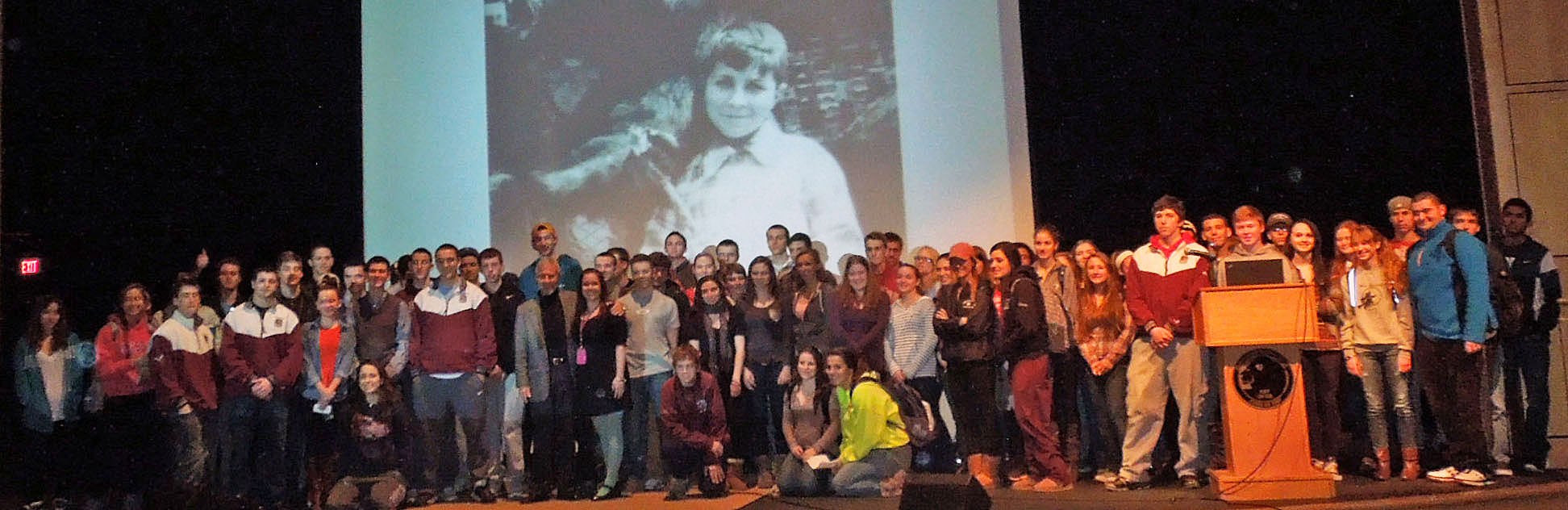
Novo Community School, San Jose, CA – January 30, 2014

by George J Elbaum

As a repeat of my previous 3 visits (March 23, 2010, Feb 9, 2011 and Feb 28, 2013), I was again invited to speak at the Novo Community School in San Jose.  Novo serves high risk students in grades 9-12 who are placed at the school for reasons such as expulsion, truancy, out-of-control behavior at school or home, and probation.  These students typically work in a classroom setting, interact with their peers and change classes in ways similar to those of a comprehensive high school.  However, the classes are small enough so the students are able to receive one-on-one assistance from their instructors, who not only provide academic instruction but also emphasize the skills needed to improve attendance and behavior.  There is strong emphasis in maintaining a safe, orderly school environment conducive to learning.

My visit was arranged again by Jack Weinstein of Facing History and Ourselves and organized by Novo teacher Stephanie Boulianne.  Novo’s new Principal Jesse Ramos also attended the session.  As in previous years, Jack had prepared me by stressing that students in this special alternative school often lead very insular lives in a narrow social environment, yet paradoxically are quite ”worldly” in ways that may or may not be acceptable in society at large – they “may have made big mistakes or bad choices, but can sometimes reinvent themselves and commit to improving academically and in their life choices.”  This potential was evident in their questions, ranging from quite simplistic to thoughtful and sensitive, and also from the personal connection that some showed afterwards.

Jack Weinstein's introduction

Jack Weinstein’s introduction

Leave a comment

San Francisco State University, San Francisco, CA – December 9, 2013

by George J Elbaum

On its official web site San Francisco State University proudly calls itself “a public urban university with a conscience located in one of the world’s most vibrant and beautiful cities.”  Its large, sprawling campus in the southern part of the city serves approximately 30,000 students of wide diversity: the largest of its 9 ethnic groups is only 28% of the total.  I was invited to speak at a graduate seminar The Reception of the Holocaust in Postwar Germany taught by Dr. Volker Langbehn, Professor of German in the Department of Foreign Languages and Literatures.  In addition to the students enrolled in the seminar, Prof. Langbehn also invited other students of German plus interested adults.   The event was arranged by Katie Cook of the Jewish Family and Children’s Services.

At the end of the usual Q&A following my talk (see Student Questions on the homepage) Prof. Langbehn commented that I had made no mention of Germans, only of Nazis, and also asked about my contacts and experiences with Germans.  I replied that referring to “Nazis” became a conscious effort when preparing for my talk this past May in Poland at an international event of high school students, including a group from Germany.  Realizing that the events I recounted in my story relate to the Nazi Germany of their grandparents rather than to their Germany or even of their parents, I needed to make that very clear.  After that talk the teacher accompanying the German students thanked me for making that distinction, saying that she had been apprehensive initially out of concern that I might be bitter about my war experiences and still be blaming it on “Germans”, and she felt responsible for protecting her young charges.

Regarding my postwar contacts with Germans, in early 1970s I skied in Austria with several young Germans and felt no different about them than any other nationality (and we had no reason to discuss the war era).  However, when working in the aerospace industry in the 1960s my office mate was a German rocket engineer who had worked during the war at Peenemunde rocket development facility.  He and I had a normal co-worker relationship and even flew his airplane and sailplane together, until one day at the office we segued into the war and he stated that its worst atrocity was the Allied firebombing of Hamburg and Dresden.  I was obviously shocked: while the two bombing raids resulted in almost 100,000 deaths, he considered this worse than the deliberate murder of 6 million civilian Jews during the Holocaust.  The next day I requested a change in my office arrangement.

This led Prof. Langbehn to describe that, having been born in 1959 and growing up in postwar Germany, he felt the weight of the Holocaust on the national psyche as well as personally, especially since his father refused to discuss his wartime military service.  In his early 20s, ensconced in the soul-searching that gripped Germany’s collective conscience, Langbehn declared himself a conscientious objector and opted out of military service.  Instead, he spent two years in alternative service with a German organization called Action Reconciliation Service for Peace, which sent young Germans to communities to promote healing and reconciliation with those affected by the Nazi regime.  Langbehn’s tour of duty included restoration work at the Auschwitz and Mauthausen camps and a stint teaching kindergarten in Boston. Though he had come to the United States to work for peace, some people treated him as if he had Holocaust blood on his hands just because he was German.  A Jewish friend’s father once asked Langbehn to leave his home after finding out he was German.  This certainly gave weight to his comment that in my talk I had not mentioned Germans, only Nazis.

I then asked my question of the audience: considering that the 20th century saw several major genocides such as the Holocaust, Turkey’s genocide of Armenians and Japan’s genocide of the Chinese (see “The Rape of Nanking” ), why is it that only Germany acknowledged its complicity and paid reparations to its victims, while both Turkey and Japan vehemently deny their actions, even to this day many decades later?  A very active discussion followed for another hour, and the final consensus was that the primary (though not the only) reason was Germany’s political leaders of the 1960s and 1970s, leaders such as Willi Brandt who were able to step out of the past and see Germany in proper light.  All-in-all, the event was a very interesting and gratifying experience.

partial audience

partial audience

smaller group

with smaller group

with Prof. Volker Langbehn

with Prof. Volker Langbehn

Leave a comment

Chelmsford High School, North Chelmsfort, MA – December 3, 2013 AM+

by George J Elbaum

Chelmsford High School prides itself in its strong academic orientation and, simultaneously, a “tight sense of community.”  As an indication of these twin goals, 90% of its approximately 1600 students go to college, and there is an annual school project to “be the change” and raise funds for such worthy causes as Mercy Corps and Feeding America.  I spoke to four sections of Juniors and Seniors taking the course “Holocaust and Genocide Studies” which teacher Jennifer Doak organized and has been teaching for the last 14 years.  My talk was arranged by Judi Bohn of Facing History and Ourselves.

groupD

Leave a comment

Central Catholic High School, Lawrence, MA – December 3, 2013 AM

by George J Elbaum

Founded by the Marist Brothers in 1935, Central Catholic High School enrolls approximately 1,300 students from diverse backgrounds “to form a caring community of faith, learning, and service.” The school prepares its students for college which they enter in overwhelming numbers (nearly 100%), and simultaneously “it teaches and promotes social justice and compassion to make the world a better place.”  To this purpose the school offers a one-semester elective course “Facing History & Ourselves: The Holocaust & Human Behavior” in its Religious Studies Department.  As taught by teacher Tim Hart, the students explore the history, causes, and aftermath of the Holocaust and reflect on racism, social justice, the importance of global awareness and their own potential for making a difference.  Tim’s class of 68 seniors attended my presentation, as did Andrew Nikonchuk, Assistant Principal for Curriculum & Instruction, and Jaffrie Perrotti, Assistant Principal/ Associate Dean of Students.  I had looked forward to speaking again at Central Catholic HS because I spoke there two years ago (November 29, 2011) and found the atmosphere  very welcoming and the students well prepared and very enthusiastic, and it was the same this time – a real pleasure then and now.  The event was again arranged by Judi Bohn of Facing History and Ourselves.

LETTERS FROM STUDENTS

A few weeks after my talk at Central Catholic High School I received a large envelope with 60+ letters from the students, including some hand made & decorated cards, and a kind note from teacher Tim Hart.  After an unplanned delay, my wife Mimi and I read them together at the dinner table, as we have done in the past.  We were truly touched by the perceptiveness, understanding and emotion shown in these letters, some even resulting in a lump in my throat with a sense of deep gratitude for their thoughtful feedback.  The statements and phrases that particularly resonated with us are listed below.

  • Immediately after your presentation I emailed my mom and dad and told them that I loved them and was thankful to have them in my life.  I am now much more thankful for my childhood growing up, along with my crazy family.
  • You’ve left a mark on my life – because of your pure strength and powerful story, I’ve learned that life is too short to be spent upset and hateful.
  • I hugged you after the speech because you touched me deeply and I was truly moved by you.  Like you said, life would be much more peaceful if we all hugged each other.  (Thank you for enclosing Sudeep Pagedar’s poem “Holocaust” and Pearl Jam’sSirens Lyrics.”)
  • Your story encouraged me by proving that life cannot end after devastation and hardship.  You have to keep going and let your story be a testament to others.
  • Your story touched me and made me think about my purpose in life.
  • I would have loved to meet your childhood self!
  • I think that you were meant to be here – it was your fate to survive everything, to live through all the horror of the Holocaust and to tell your story.
  • Your story and your triumph were the only topic of discussion at my family’s dinner table this evening.
  • I really felt as if I was there experiencing it with you.  You had a special impact on my life.
  • Your story will forever resonate with me, an image of hope and inspiration to us all.  PS: I’m short too… and I’m proud of it!  🙂
  • Surviving all those near-death experiences really shows that if God wants you home he will take you, and you were clearly not wanted…. 🙂
  • The only way to prevent injustice is to accept that it can happen.
  • The most frightening part of the Holocaust is that it occurred only 70 years ago, in the “modern” world.
  • You are like a tree that has branched your story to other people so that we may learn and grow (followed by a drawing of a lovely tree).
  • If you were to meet now the little girl who got the presents your mom gave you when she would visit you, would you hate her?  Would you hug her?  Do you feel that having your mom’s presents taken away from you as a child makes you now appreciate things more?  (I wouldn’t hate her as she didn’t take my toys, her mom did, and yes, remembering the past makes me appreciate the present.)
  • Seeing you smile while talking about the simple but impacting moments, such as being given the sugar cube, I felt like I was given a gift.  I thank you for that gift.
  • I am starting to appreciate my family more because I cannot imagine a day when they could be gone.
  • I left the theatre that day with a new mind set and appreciation for not only my family but also everyone I interact with on a daily basis.
  • All people handle things differently, and it is how they handle these things that determines their happiness.  (Signed: Forever changed…)
  • My mother is a survivor of the Cambodian genocide, and was a young child when placed in a concentration camp.  I realize that this may be difficult for her to talk about, but I want to hear more about her childhood.  I’ve always wanted to write a book about her side of the family and after your talk I’m more motivated to do so.
  • It’s truly inspiring, especially for people my age who are thinking about our future and what our passions are, to hear someone who achieved what they wanted even if all odds were against them.
  • When you first saw the plane through the roof of the shack, you didn’t see the injustice of your being in the shack but rather the beauty in the plane.
  • Your survival story and decision to inform our young minds is unimaginably valuable and I thank you for sharing a difficult story with us.
  • The Holocaust is something we learn about in history classes and it becomes more memorized than understood, but hearing your story made it real – it’s now a tangible thing.
  • I have an attitude toward my mom at times, but I probably wouldn’t last 6 months without her.
  • We were asked to write you a thank you letter, but I don’t know how to thank someone for telling me so many personal details about their life.  I feel that words are too limited to express my gratitude, so I will write a simple thank you.
  • I went through that day thinking about the question you asked us: “If you had a chance to help save someone even if might mean death for you, would you?”  At first, I said yes, without even worrying about being caught.  Then I thought what if they threatened my family? Friends?  Then I remembered your host families, and how much they must have sacrificed to keep you with them.  I would love to be able to do that and wholeheartedly say yes, but given those circumstances I honestly don’t know what I would do.
  • I would like to go into forensic psychology some day and for that reason I want to know why this happened, not how.
  • In the 8th grade we did our mini version of the Paperclips project after watching the film, and seeing all those paperclips collected it was hard to grasp the enormous number of deaths and murders that occurred during the Holocaust (followed by copies of colored paperclips!)
  • Determination and ambition are the major things I pulled out of your story.
  • I am part of the last generation that will have first-hand interactions with Holocaust survivors.  Those who come after me will not have the same understanding about the Holocaust that I do because they couldn’t hear survivors like you tell their stories and feel the emotions in their voices.
  • Your experience didn’t only shape who you are but hearing it changed me.

30

Leave a comment

Congregation Emanu-El, San Francisco, CA – November 10, 2013

by George J Elbaum

Congregation Emanu-El in San Francisco conducts a year-long course “The Shoah: Exploring History to Craft Our Future” specifically for the 9th grade students among its congregants.  This course meets weekly and takes the students on a journey from 1919 to 1945, exploring anti-Semitism in the Weimar Republic through the dehumanization of the Holocaust and the personal stories of resistance and rescue.  The stated and very worthwhile goal is that “by studying the intricacies and uniqueness of the Holocaust, the future generation will recognize the patterns of genocide and make efforts in maintaining human rights and compassion for all peoples.”  The course is organized and taught by Ariana Estoque, Director of Adolescent Education, and my presentation to the students and their parents was part of it.  The initial arrangements for the presentation were made by Katie Cook of Jewish Family and Children’s Services.

with students

with students

with students and parents

with students and parents

Leave a comment

Charles Wright Academy, Tacoma, WA – September 23, 2013

by George J Elbaum

This was the fourth consecutive year that I spoke at Charles Wright Academy’s (CWA) Global Teen Summit, which this year included CWA students plus 31 high school students  and teachers from China, Colombia, and Poland, all staying with CWA host families during their visit.  CWA’s annual Global Teen Summit is a 10-day program designed to promote peace and social justice by exposing the visiting students to and developing their understanding of the concepts of universal human rights and justice, fair trade and sustainable life styles, and by demonstrating how the choices that each of us makes every day can impact the world. The core of the Summit is a series of speakers whose personal experiences reflect directly on these subjects, and their presentations are followed by group discussions on these very concepts. My presentation, which started this year’s program, was probably the first time that most of these students heard directly from a Holocaust survivor, and their subsequent comments, questions, and personal expressions of thanks were very gratifying – the very reason that, in spite of some emotional discomfort during my talks, afterwards I’m always glad I did it.  (The next speaker was Carl Wilkens, the former head of the Adventist Development and Relief Agency International in Rwanda.  He was the only American who chose to remain in Rwanda after the genocide began in 1994 and heroically protected the locals who depended on him.)  The Summit’s founder, organizer, and guiding force is Nick Coddington, whose amazingly intense and varied background is exceeded only by his enthusiasm in instilling the Summit’s concepts in his students. (This presentation was arranged by the Washington State Holocaust Education Resource Center.)

Letters from Students

A week after the CWA event I went abroad for a month, and in the mountain of mail that accumulated during my absence I found a packet of 85 letters from the students who attended my talk, plus a very kind “thank you” note from Nick Coddington.   A few days later, after dinner, my wife Mimi read each letter aloud to me while I listened and absorbed it, mentally and emotionally, and felt very gratified by the students’ responses to my story.  Statements from these letters that particularly resonated with us are excerpted below, grouped by the 4 countries (in alphabetical order) of the attending students.

China

  • We Chinese people have the same feeling about WWII when the Japanese did the same thing as the Nazis.  Sometimes people say they can forget history, but in fact memory is memory, and it is very hard to forget what we experienced.  But life is still life, and we should look forward and plan what to do for a bright future.  We should be tolerant and resist prejudices as much as we can.
  • I’m glad to be here to hear your story.  There is also a bad memory in every Chinese mind about WWII.  Japanese made a carnage in Nanjing where 300,000 people died.  It is difficult to escape from such a disaster and how sad we are for those who did not escape and are gone.  I thank you and wish the world will be healed by peace.
  • I think you bring very good message to us, which is “peace” and “kindness.”  I love what you said “We can choose to do what we think is right or we can let hate and anger lead us.”  You speak of your good luck, and I hope you will bring good luck for everyone else.

Columbia

  • I thank you for sharing your experience – your story teaches us about hope.
  • I have never really thought about luck, and how we can “make” somebody’s luck.  I support your quest for individuals who search for justice, and to your challenge question my answer is that I would have taken the risk to hide a persecuted minority.
  • Your experience made me realize how any decision can change somebody’s life, how a couple of minutes or a single yes or no can change the fate of a person.  I now know that I’m responsible not only for myself but also for others around me.  Thank you for making me see how terrible the Holocaust was and how with strength, brains and luck, we can overcome even the worst of situations.

Poland

  • Although I live in Poland, I didn’t really know what had happened during WWII.  Your story makes me think a bit differently about the people who surround me.
  • I thank you for your speech – I learned so much from it, and it was an amazing experience for me.  This was important for me because I live in Poland, and we should know our history.  Your memories are very deep, and I was touched by them.
  • I met you in Poland this year, so this speech in CWA was my second.  I was so glad that you fought your past and did visit us in Poland.  Thank you!

USA

  • Philosophers disagree about human nature, but I believe that genocide is a part of life.  This sounds terrible, but it’s true.  If there’s one thing to take away from your talk it is the importance of understanding and justice.
  • I learned that one’s actions can be someone else’s luck.  Thank you for giving us this opportunity to make better decisions that don’t benefit only ourselves but also others.
  • Your talk inspired me and now I’ll try to make a difference.  I’ll be more tolerant and accept that our uniqueness is what makes us special rather than a reason to fight.  Also, that my decisions can be someone else’s luck.  Thank you!
  • When I first heard that we would be listening to a Holocaust survivor I envisioned a broken skinny man with haunted eyes and an unsmiling sad face.  I was wrong, as you proved to be funny and kind and obviously full of life, and I was moved by your speech.

The group

Leave a comment

Jewish Family and Children’s Services, San Francisco, CA – July 15, 2013

by George J Elbaum

Jewish Family and Children’s Services (JFCS) is a San Francisco Bay Area social services organization whose mission statement is “Serving individuals and families of all faiths and backgrounds, guided by the Jewish value of caring for those in our community most in need.”  As such, JFCS carries a special responsibility within the Jewish community for reaching out to children, the aged, those with special needs, the alienated and the dependent, and for the resettlement and acculturation of refugees and immigrants.  Through its YouthFirst program, JFCS also offers internships for high school and college students as well as placing them in Bay Area firms, thus allowing them to learn important on-the-job skills.  Supporting these internships are YouthFirst workshops focusing on topics such as office etiquette, responsible work behavior, researching job opportunities, résumé writing, and interviewing skills.

My talk was attended by two dozen students in the JFCS Summer Internship program, and was arranged by Katie Cook, the Administrative Coordinator of the JFCS Holocaust Center, and Taylor Epstein, Director of the YouthFirst Programs.  Also attending were Rabbi Daniel Isaacson, Director of Spiritual Care Services, Jaron Kanegson, the new incoming Director of the YouthFirst Programs and Masha Perelman, Coordinator of YouthFirst Programs.

group1

with Taylor Epstein, Director of YouthFirst Programs

with Taylor Epstein, Director of YouthFirst Programs

Leave a comment

Zespol Szkol No. 2, Gimnazjum No. 3, Swidnik, Poland – May 16, 2013

by George J Elbaum

Zespol Szkol No. 2, Gimnazjum No. 3 (ZSG) is a high school located in Swidnik, a town approximately 10 km. from Lublin, Poland.  In 1997 the school launched its international student exchange program with several European high schools and in 2007 it broadened it to include the Charles Wright Academy (CWA) in Tacoma, WA.  The program at ZSG is one week long, with focus on the students’ social and cultural interaction in joint (hosts + visitors) activities and projects in art, music, dance and drama.  ZSG has also invited speakers on important issues of human rights, tolerance and justice, including Carl Wilkens on the Rwanda genocide (he was the only American to remain in Rwanda after the genocide began) and this year my talk on the Holocaust.  Visiting groups usually consist of a dozen students with one or two teachers, and they are housed by families of students in the host school.  The Swidnik event this year included 15 students from the Netherlands, 15 from Belgium, 6 from Germany, 8 from the US (CWA), and 44 from ZSG.  It was organized by ZSG teacher Ula Burda with support from teacher Marcin Pasnikowski and several others (see below) , and active involvement by ZSG Principal Ewa Darwicz.

During CWA’s Global Teen Summit in September 2012 I met the ZSG students and teachers Marcin Pasnikowski and Anna Szewczyk, and I was asked if I had been back to Poland and/or was I planning to do so.  These were the same questions I had been asked after my talks at many other schools, and my answer has always been that I do not revisit the past, physically or mentally, a habit which I might have learned for emotional survival during the Holocaust (thus “Neither Yesterdays Nor Tomorrows”), and therefore I do not plan to return to Poland.  After my talk, Anna Szewczyk privately asked if, despite my negative answer, I would consider coming to Poland to speak at the ZSG event being planned for mid-May 2013.  I thanked her for the invitation but I still declined as it would be revisiting the past.  She understood my feeling, but nevertheless asked gently if we could maintain contact by email, and I agreed.  Several weeks later she emailed me that she hoped it was not an intrusion on my privacy, but she had found on the web an archived 1939 Warsaw phone book, and in it a page with my father’s name, profession, address and phone number, and was attaching that page to her email.  When I opened the attachment and saw my father’s name in a mundane phone book page, it suddenly made him much more a real person than he had ever been for me, and I choked up!  After staring at his name a few minutes, I answered Anna’s email that I would come to the ZSG event.

….. And I am very glad that I did – the response, both from the students and the teachers was very, very gratifying!

Whole group

Leave a comment

Somerville High School, Somerville, MA – April 5, 2013 PM

by George J Elbaum

Somerville High School (SHS) is a public 4-year high school that prides itself on being “the Lab School of the 21st Century.”  Its stated primary goal is to prepare its 1300+ students to “lead satisfying and successful lives by helping them to become effective readers, effective writers, effective users of technology, and effective critical and creative thinkers.”  Furthermore, the education it offers its students sets the same high standards in both college prep academics and in vocational training.  SHS does this with the most diverse student body – in cultures, languages (50), nationalities, and aspirations (with one of three integrated vocational programs in the state) – and the richest range of in and out of school activities in Greater Boston.

SHS was reorganized in 2006 into a House System to: (a) improve connectivity between students and professional adults at SHS, and (b) provide a “home base” for core student support services for both students and parents.  The House System provides a smoother transition for incoming Grade 9 students and all transfer students.  In the Houses, Assistant Principals and Guidance Counselors collaboratively support students across their SHS careers, inform parents of important developments in their student’s education, and bring students together with one another and professional adults who can help them achieve their highest potential.  Results of this close and multi-faceted collaboration include such unique programs as the award-winning Somerville Mediation Program which annually trains and deploys student mediators to resolve peer conflicts peacefully, and the annual student-planned and run Multicultural Festival celebrating the more than 52 ethnic groups represented at SHS.  (One tangible result of the Multicultural Festival is the Somerville High School Multicultural Cookbook containing 135 recipes from 39 countries!)

SHS diversity and social awareness is also manifested in having worked closely with Facing History and Ourselves for the past 12 years, offering a year-long Facing History elective class about the Holocaust and other genocides. This class is currently being taught by history teacher Mark Quinones, and one of its highlights is the final “judgment, memory, and legacy” project wherein students create and display Holocaust memorials every spring.  My presentation was organized and arranged by Alicia Kersten, Head of SHS Social Studies Department, and Judi Bohn of Facing History.

Audience-above

Audience-side

Leave a comment

St. Rose School, Chelsea, MA – April 5, 2013 AM

by George J Elbaum

St. Rose School is a small inner city Catholic school dedicated to educating children of all races, creeds, and nationalities. It prides itself in being “a close knit community that not only embraces the diversity of its students and parents but respects it as well.”  With approximately 250 students in grades pre-K through 8, St Rose strives “to meet the needs of our students and their families through works of love, mercy, and justice since 1872.”  Its diverse student body gives the students a strong sense of appreciation for human differences, a value they will hopefully carry for the rest of their lives.  Towards that goal, St. Rose students start every morning with prayer and a PeaceBuilders Pledge, wherein they pledge “To praise people; To give up put-downs; To seek wise people; To notice and speak up about hurts we have caused; To right wrongs; To help others; To build peace at home, at school, and in our community each day.”  The aim of this PeaceBuilders program is “a common language about the kind of behavior we expect in our school.  This not only supports the Gospel values we study in religion class, but actively seeks to prevent bullying in our school community.”

To further that goal, St. Rose now includes the study of the Holocaust with support of Facing History and Ourselves, and teacher Matt Schell organized my visit together with Judi Bohn of Facing History.  I truly appreciated Matt’s serious approach to this subject and his subsequent statement to me to me that he will “never forget the message ‘Never again’ in regard to Holocaust denial.”

A week after my talk I received in the mail 27 colorful and imaginative “Thank you” cards made by Matt’s students.  All were very heartfelt, but one in particular made me smile and wish its writer success: “I want to thank you for teaching me that you can do anything if you work for it, like being accepted to MIT, which is my goal just like it was yours!”

edited group

Leave a comment