Zespol Szkol No. 112, Gimnazjum No. 32, Warsaw, Poland – May 6, 2014 (PM)

by George J Elbaum

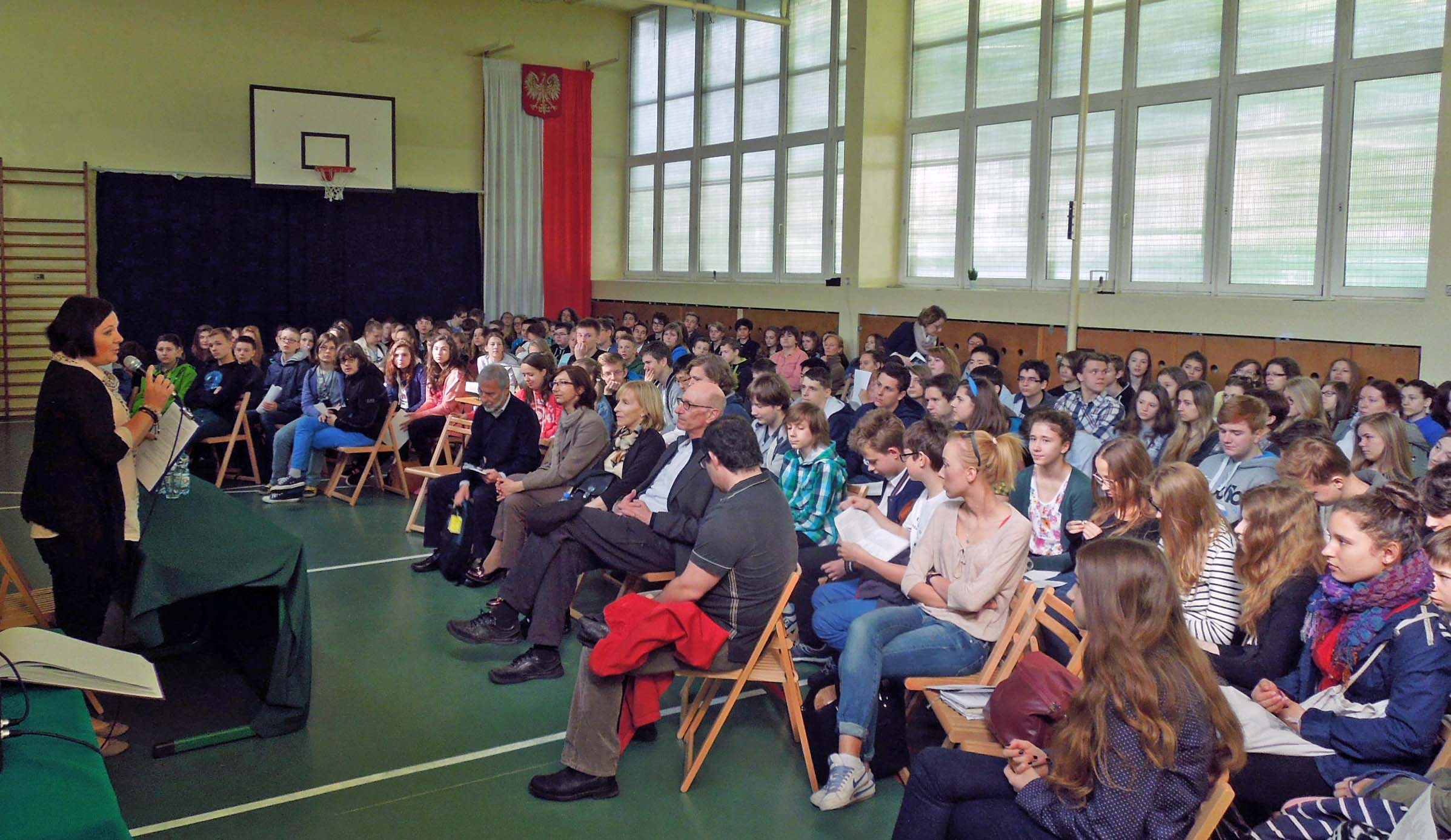
Zespol Szkol No. 112 Gimnazjum No. 32 (named after poet Adam Asnyk) is located in Warsaw’s Praga district, on the east bank of the Wisla river, and my presentation there was organized by its English teacher Yvonne Saleta.  Since her students also study history, she emailed me that “it would be very interesting for them to have a real history lesson in English.”  To prepare her students for my presentation and make them more aware of the Holocaust, Ms. Saleta launched them into several projects on the subject of hatred, such as taking them to a theater to see a monodrama of Ann Frank’s diary and also having them compose and prepare anti-war posters.  (Her explanation: “The happenings in Ukraine have had a great impact on all of us. We talk to our students, discuss possible scenarios. We naively thought that war was not possible in our region now. How disappointed we all are….”)  This preparation resulted in an engaged student audience as shown by their subsequent questions.  The relative fluency of their questions as well as their one-on-one comments to me during the book signing showed me that I need not have worried about their English – since they expressed themselves in English quite well, they surely understood it also quite well.

My presentation was attended by Ms. Saleta and her students, teachers Agnieszka Galaszewska and Renata Wilczynska, vice principal Jolanta Kudlak and principal Wojciech Nasilowski.  In addition, Ms. Saleta also invited students and officials from some nearby schools, resulting in an audience of approximately 100.

After the presentation and signing my books for the students, we joined our gracious hosts for a special lunch of Polish family-style cooking which the school’s cook had prepared for us. It was a wonderful sign of their warm hospitality and we thoroughly enjoyed it.

audience 1

audience2

Leave a comment

Gimnazjum No. 3, Warsaw, Poland – May 6, 2014 (AM)

by George J Elbaum

Gimnazjum No. 3, named for Marshall Jozef Pilsudski, is located in Mokotow on the southern edge of central Warsaw, only a few blocks from the primary school that I attended before leaving for the U.S. in 1949, so going there for my presentation felt a bit like homecoming.  The event was organized by Violetta Tarnowska, the energetic and idealistic teacher of Polish and English.  She has noticed that students are becoming less and less aware and interested in Warsaw’s history before and during WWII and she earnestly wants to ensure that they learn and remember it, including that of its pre-war Jewish community (which was 1/3 of Warsaw’s total population) and of the Holocaust.  She therefore wholeheartedly welcomed my presentation and even invited students from other gimnazjums plus representatives of Warsaw school authorities, resulting in an audience of approximately 180 in total.  Since my presentation was entirely in English, I was concerned about the need for translation, but Ms. Tarnowska assured me that most of the students were sufficiently competent in English so only unique words or terms would need translation and she would provide for it.  Indeed, I was pleasantly surprised with the students’ competence in English: during my presentation only words such as “barbed wire”, “stuttering” or “sawmill” needed translation, and in my brief one-to-one conversations during book-signing I was especially surprised at most students’ comfort in speaking with me.

My strong desire to speak to high schools in Warsaw (and Lublin also) was precipitated by a professional survey of approximately 1500 Warsaw high school students a year ago that revealed an amazingly high degree of anti-Semitism.  Since the surveyed students probably never met a Jew as there remain only several thousand in all of Poland, I wanted to speak to such students and show them that Jews are absolutely normal and nothing to fear or hate. A few days after my talk at Gimnazjum No. 3 I was very gratified by an email from Ms. Tarnowska, as follows:

“There was one thing that impressed me most. Before your arrival a 15-year old student told my colleague-teacher that he was not going to take part in an event in which a Jewish-origin person would be addressing him. The teacher talked with this boy and asked him about the roots of his attitude. He was so nervous and answered that he strongly disliked Jews because of what his grandfather told him about them. The teacher made an effort to calm him down, asked some detailed questions and explained things, but after that she told him it would probably be better if he didn’t participate in this meeting. However, the boy did attend it, and something unusual happened: the boy probably understood the simple truth that he was brought up in hate and hostility by his family, that there are good and bad Jews, just like there are good and bad Poles, Americans, etc.  I saw this boy smiling after your speech and queuing for nearly an hour for your autograph in his copy of your book. That is why I believe it is worth talking to people, especially the youth because they are so open-minded, unspoiled. If you had not come to visit us, this young boy would probably be prejudiced against all the Jews till the end of his life and would bring up his children in hate.  You know, it hurts me that there is still this kind of prejudice in my country.”

I could not have wished for anything more, and I thank Ms. Tarnowska for sending this email to me!  I feel that this one vocal boy was surely not the only one in the audience with an anti-Semitic attitude (as shown by last year’s survey), only the others did not face their teachers with it.  However, as in his case, their prejudice is probably only on the surface, caused by what their parents or grandparents have said rather than anything they’ve witnessed themselves, so perhaps some of them also had a change of heart, as he has, and I helped to make it happen.  This is what is important, and this is what makes me continue doing these talks, though it still involves some emotional discomfort.

In addition to Ms. Tarnowska, attending my presentation were the Gimnazjum’s headmaster Katarzyna Hampel and English teacher Magdalena Cieslik, my wife Mimi (who took these photographs), our son Jordan and our friends Richard & Evelyn Gumpert.

Introduction by teacher Violetta Tarnowska

Introduction by teacher Violetta Tarnowska

Start of presentation

Start of presentation


Leave a comment

Miramonte High School, Orinda, CA – April 25, 2014

by George J Elbaum

Miramonte High School is a public high school serving the residential communities of Orinda, Moraga, and others, just over the hills east of UC Berkeley. With a student body of approximately 1200, it has a strong college preparatory program with 98% of its graduates going to college. The quality of its academics is reflected in its ratings which, in the past 5 years, included #21 in California and #126 in the US as ranked by US News and World Report, #89 and #173 in the US as ranked by Newsweek, and 1st in California’s Academic Performance Index (API). In addition to high academics, Miramonte has also produced many championship teams in football and water polo.

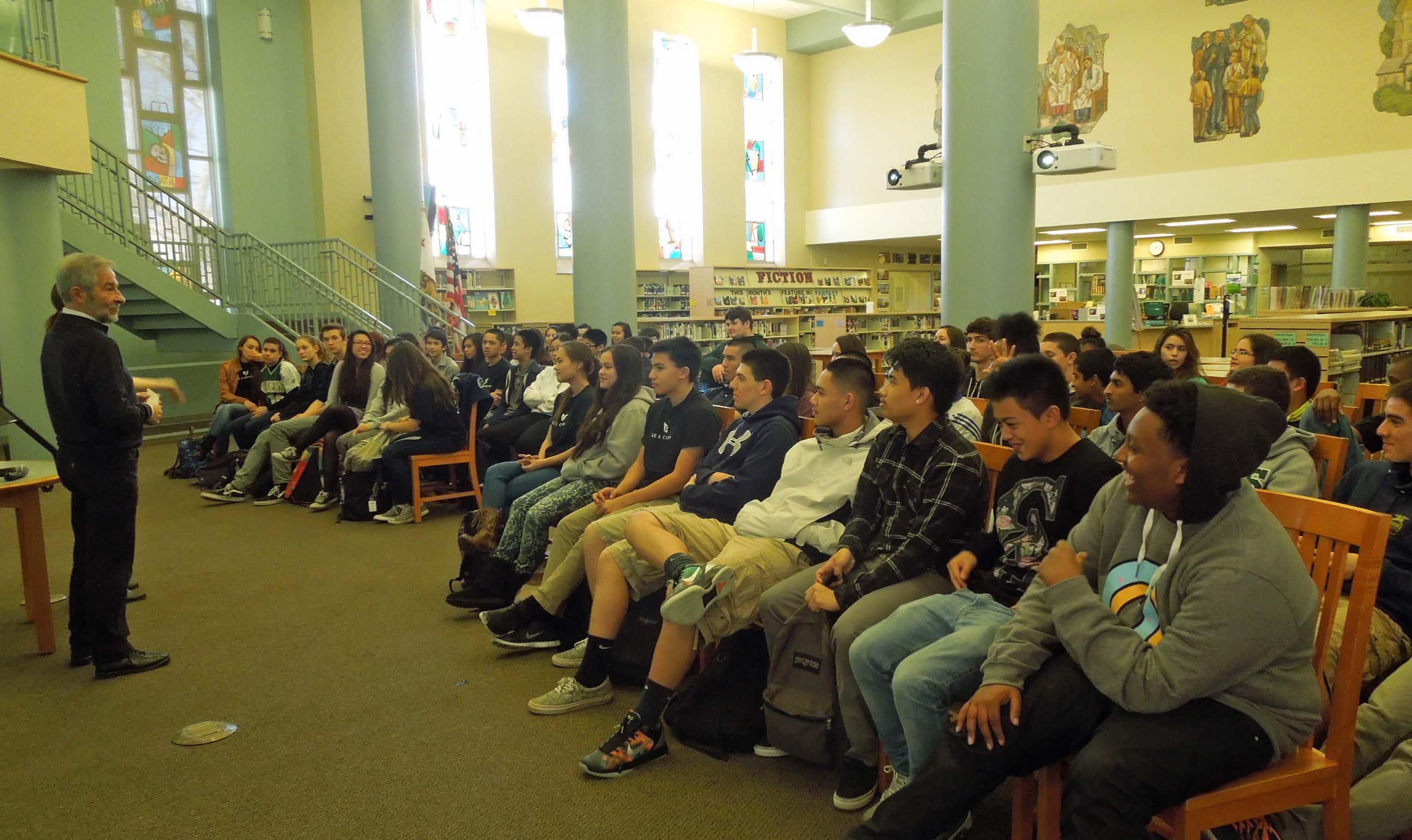
My presentation at Miramonte was part of a culminating set of activities at the end of their exploration of WWII and of the Holocaust for their approximately 300 freshman class. The timing was explicitly configured to help students connect their study of a subject that is “long ago and far away” from their own lives, and a speaker telling them about personal experiences always makes it more meaningful.  The activities started the previous day when the students met a Pearl Harbor survivor. “Mickey,” as he told the students to call him, is 95 years young and enjoyed meeting the students as much as they enjoyed meeting him. Also, just prior to my talk Facing History Director Jack Weinstein met with and presented a session for the students on the concept of bystander vs. upstander behavior in history. Through interactive exchanges and discussion about a short film, students had the chance to confront questions about moral choice-making in the context of the study of the Holocaust. These activities show that the school’s leaders are committed to the idea that history matters, that its study should not be limited to books or films, and that personal testimony is of unique value. The level of attention paid to me by the students during and especially after my talk certainly indicated that these hopes are lived out in the culture of the school, and the appreciation displayed by the audience seemed authentic and sincere. The event was organized by Associate Principal Jan Carlson, my participation was arranged by Jack Weinstein of Facing History and Ourselves, and my “photographic support” was graciously provided by teacher Meredith Hawkins.

13

66


Leave a comment

Arroyo High School, San Lorenzo, CA – April 24, 2014

by George J Elbaum

Arroyo High School in San Lorenzo, across the bay from San Francisco, has approximately 1,760 students and high diversity. It is organized into several “schools within a school,” and this is the third year in a row that I have visited its Future Academy for Social Change.  Based on my past two visits, I looked forward to an enthusiastic and well-prepared audience, and I was not disappointed.  I observed again how the enthusiasm of teacher Jorja Santillan transfers to her students, whom she prepares through her Facing History-based unit. In her own words: “It’s so important that they understand how complex the Holocaust is through different stories and how crucial it is that this history be kept alive. I tell my students that now it’s their responsibility to carry it on along with their own histories.”

The Future Academy, as it is often called, is known for attention to broadening its students’ exposure to the wider community. One example is that when the students study a subject such as the Holocaust, they not only explore its historical context but also read a memoir, meet a scholar or survivor, and consider contemporary issues related to what they have studied.  They have also visited San Francisco’s Contemporary Jewish Museum to learn something about Jewish life today.  Jack Weinstein, of Facing History and Ourselves, who arranged for my presentation at Arroyo on all three occasions, participates in teaching the Holocaust unit and says, “The students do an in-depth study of the Holocaust, and it may be among the most moving explorations of their high school experiences. And their visit to the Museum teaches them that Jewish life is vibrant, diverse, and present in their own society, and that there is more to know about this subject than the Holocaust alone.” Both Jack and I were genuinely impressed by the openness and sincere interest shown by the students, especially in some one-on-one conversations after the presentation.

Letters from Students

We were away for several weeks (including in Poland where I spoke at 5 high schools in 3 cities), and the mountain of mail that greeted us on our return included a large envelope with over 70 letters from Arroyo students.  As has become our habit by now, after dinner my wife Mimi read each letter aloud while I listened and absorbed it, mentally and emotionally.  We were touched by the students’ openness and sensitivity as reflected in the letters, and we felt very gratified by their responses to my story.  Statements from these letters that particularly resonated with us are excerpted below.

  • You went through so much but never gave up. It shows us that we need to keep fighting though our struggles.
  • My responsibility by listening to you is to keep your story alive as long as I can.
  • I felt responsible to change something in my life or spread your story. Your speech was a wakeup call that basically said this is real and still a problem.
  • You are the reason why I will stand up against intolerance. I will stand up for those who are oppressed and cannot fight back. Thank you for speaking to us, it really has changed my outlook on life.
  • I learned that the Holocaust did not just affect the people in the camps but also struck terror and fear into the lives of those outside the camps.
  • I was fascinated to learn that during the Holocaust, families who were not Jewish took in Jews who were trying to hide.   I found it amazing that these people knew that it was the right thing to do and they risked their lives to do it.
  • We need to keep history alive because many people don’t realize how prejudice and stereotyping can be harmful.
  • I actually shared your story with my cousin today. I told her that I met a Holocaust survivor, and she asked me what the Holocaust was!
  • I liked how you compared prejudice to bullying. It really made me realize that our actions do have an impact, and it has changed my perception on the little things I take for granted and on life, of course.
  • Please keep spreading your life & knowledge. You opened my eyes and I know you can open more.
  • Your story has opened my eyes to see that there was so much more to the Holocaust than just the idea of Hitler trying to get rid of Jews.
  • I hope you continue to share your story for years to come so that many others will get the opportunity to hear you as well.
  • I’ll make sure your story never dies. I’ll tell people about it.
  • This part of your life & experiences molded you into the person that you are today.
  • The Holocaust provides one of the most effective subjects for examining basic moral issues.
  • You and your mother have given me a new idea of what strength and love is.
  • I will share what you have shared with me with anyone willing to listen.
  • What impacted me the most was knowing that you might not be able to see your mother ever again.
  • Yesterday I went home and told my parents, my brother, and my grandparents all about your remarkable story.
  • I know that it is our job, as this generation, to keep this history alive so it really means something, not just another statistic in history books, but so it doesn’t repeat itself.
  • Thank you so much for telling your story and offering it as a gift to the world, even though so much was taken from you.
  • I learned from you that sometimes in life we go through tough times and we don’t know why, but we must continue to fight on and find ways to turn our problems into solutions.
  • I’m grateful for your courage, because if you didn’t tell your story I wouldn’t have the new mindset that I have now.
  • It made me really reflect on my life and think of my decisions and actions. I have made a vow that from now on I will always do what is fair and just, regardless of what the outcome may be. I will follow my heart and keep you and your mother’s story alive through the kindness of my actions, for the rest of my life.
  • You said that we have the power to live our lives the way we think is right or to live in hate. These are words I recite to myself now.
  • From hearing your story I want to work for Child Protective Services, working with kids that come from tragic backgrounds.   I can’t thank you enough for this opportunity.
  • Your story opened my mind to always help others and put myself in their shoes, and not discriminate based on who they are or what they do.
  • Whatever I can do to try and make this world a better place, I will do.
  • I know that when I am older I will help people, whether it is through donations, charities, or some other ways.
  • Hearing you speak yesterday made me change the way I look on life, to appreciate what I have right now.
  • I will keep this event in my heart.  (PS: “With will one can do anything!”)
  • I’d like you to know that your story and life have ignited a fire in my soul to always stay positive, and to know that light will always be at the end of the tunnel.


20

2 Comments

JFCS Day of Learning, San Francisco, CA – March 23, 2014

by George J Elbaum

The Jewish Family and Children’s Services (JFCS) has organized an annual Day of Learning since 2003, inviting students and educators from schools throughout California to participate in numerous workshops to gain a deeper understanding of the Holocaust and patterns of genocide, and to inspire moral courage and social responsibility in the future. Each workshop includes a presentation of eyewitness testimony by a survivor of the Holocaust or genocide. This year’s Day of Learning was held at San Francisco’s Galileo High School, with more than 700 students and 140 educators from over 100 California schools participating in 18 workshops. My presentation to a workshop for educators entitled “New Perspectives in Thinking, Learning, and Teaching about the Holocaust” was arranged by JFCS’s Katie Cook, who was one of the organizers of the whole event, and it was augmented by Janine Okmin of the Contemporary Jewish Museum, her intern Chloe Knox, and Galileo teacher Joseph Taylor in whose classroom this workshop was held. JFCS volunteer Jamie Beck was my on-site guide, ensuring that I found the right room for my presentation and, afterwards, my car in a parking lot on the other side of Galileo’s tunnel 🙂
the audience

with Janine Okmin, Joseph Taylor and Chloe Knox

with Janine Okmin, Joseph Taylor and Chloe Knox

Leave a comment

Milpitas High School, Milpitas, CA – March 20, 2014

by George J Elbaum

Milpitas High School (MHS) has a large and highly diverse student body – 3200 students, 38% Asian, 22% Filipino, 20% Hispanic, 20% White, and 4% African-American – and was the very first school in northern California to develop a Facing History course. Jack Weinstein, Facing History’s Director, taught at MHS from 1978 to 1997 and integrated Facing History’s resources early on within many of the school’s English courses. Then, in 1990, he developed a full-semester Facing History course focused on the Holocaust and Human Behavior. That course was an inter-disciplinary English and Social Studies course for 3 years, and then it evolved into a Social Studies elective focused not only on the Holocaust but on multiple case studies of genocide, human rights, and issues of race in American history. When Weinstein left MHS in 1997 to establish the Bay Area office of Facing History, it was continued by other teachers so the course is among the longest-running electives in the school’s history. In addition, nearly all freshman English courses now include a multi-week unit on the Holocaust with the study of Elie Wiesel’s Night as its centerpiece.

This was my second visit to MHS, and the 300-some students attending this talk were again well-prepared – most were from the multiple freshman English courses taught by Lindsay Mohundro, who organized the event, and Lynn Marozeck, Annie Marple, Ginger Roy and Skyler Draeger, all teachers who clearly passed their own enthusiasm to their students. Arrangements for my talk and the introduction were again made by Jack Weinstein of Facing History.

LETTERS FROM STUDENTS

Arriving home after an extensive trip abroad, the ton of mail that awaited us included a packet of letters from Milpitas High School students plus a very touching one from teacher Lindsay Mohundro.  My wife Mimi and I read them together at the dinner table, as we have done in the past.  We were truly touched by the understanding and emotion shown in these letters, and I had a sense of deep gratitude for their openness and thoughtful feedback.  The specific statements and phrases that particularly resonated with us are listed below.

  • I was most affected by your statement that as human beings we need to stand for something, not against something. All too often as humans we think of the things that divide us and make us different, not the things that bind us together, and your words encourage us to take positive action.
  • You could have easily become bitter and vengeful after your experiences, but instead you chose to teach others to question injustice.
  • Textbooks teach us about the Nazis and their genocide, but as they are entirely factual accounts, it was difficult to humanize the millions of lives that were exterminated in the war. Seeing you in front of us and hearing you talk helped me to take in the atrocities that had been committed against humanity.
  • It was easy to detach myself from history and live in comfort, but you helped me remember that history was made by real human beings, each with a life and purpose.
  • It simply amazed me how you did not let your past get in the way of being happy and having hope for the future.
  • I feel like your lecture has changed me a bit.  I wonder if I could find the courage to stand up for complete strangers who were being victimized.  It’s scary because I know that there is a possibility where I would be too cowardly to stand up for those people.  I want to genuinely reach out to someone in need and offer comfort and safety.
Jack Weinstein's introduction

Jack Weinstein’s introduction


The audience

The audience


Leave a comment

Jewish Family and Children’s Services, San Francisco, CA – March 12, 2014

by George J Elbaum

Jewish Family and Children’s Services (JFCS) is a San Francisco Bay Area social services organization whose mission statement is “Serving individuals and families of all faiths and backgrounds, guided by the Jewish value of caring for those in our community most in need.” As such, JFCS carries a special responsibility within the Jewish community for reaching out to children, the aged, those with special needs, and for the resettlement and acculturation of refugees and immigrants.

The JFCS Holocaust Center conducts training seminars for middle and high school teachers on the Holocaust and genocide. The goal of these seminars is to share curriculum and discuss effective ways to teach tolerance and social responsibility. My talk was attended by a dozen teachers from the Davis, CA area. The seminar was arranged by Katie Cook, the Administrative Coordinator of the JFCS Holocaust Center, and also attended by Yedida Kanfer, Coordinator of Education Services.

the group

with Katie Cook

with Katie Cook

Leave a comment

Moreau Catholic High School, Hayward, CA – March 7, 2014

by George J Elbaum

One year after my first visit I returned to Moreau Catholic High School and teacher Samantha Wainwright’s well-prepared and enthusiastic students. Moreau is a college preparatory Roman Catholic secondary school established in 1965 by the Congregation of the Holy Cross. With college preparation as a focus for its 900 students, the results are admirable: of the recent graduating class, 100% went to college, 50% received at least one Merit-Based Scholarship/Award, and over 75% scored 3 or higher on their AP exams. As a result of this academic strength, Moreau was one of only 8 schools in California and 54 schools nationwide to be selected as a 2010 Apple Distinguished School, recognized for educational excellence through use of technology across its curriculum to provide its students with the 21st century skills needed to succeed.

However, as a community of faith, the school also prepares its students through social and spiritual learning to become responsible citizens of the global community. Thus, as part of its humanistic and liberal arts curriculum, Samantha Wainwright’s 10th grade English class includes a 6-weeks study of the Holocaust with reading of Eli Wiesel’s Night, and a variety of stories of victims, survivors and perpetrators, plus viewing applicable propaganda posters, watching the movie Life is Beautiful. Ms. Wainwright arranged my talk together with Jack Weinstein of Facing History and Ourselves. Also attending it were Librarians Anne Arriga and Jessica Simons.

whole group 1a

with audience


Leave a comment

Urban Science Academy, Boston, MA – February 27, 2014

by George J Elbaum

Urban Science Academy (USA) is a small public high school in the West Roxbury neighborhood of Boston created in 2005 as part of the High School Renewal Effort which reconstituted large comprehensive Boston schools into smaller, theme-based learning communities. With approximately 500 students and a curriculum centered on science and technology, USA focuses on important issues to prepare its students for college and the world. Asking the essential question, “What is our place in the world?,” it allows students to consider and challenge themselves to take part in finding their interests, and how they can contribute to the communities around them. USA classes consist of Humanities, Mathematics, Foreign Language and the sciences: Physics, Chemistry, and Biology. The classes are designed, each in its own way, to recognize what part they attribute to the world, while at the same time empowering students to learn more.

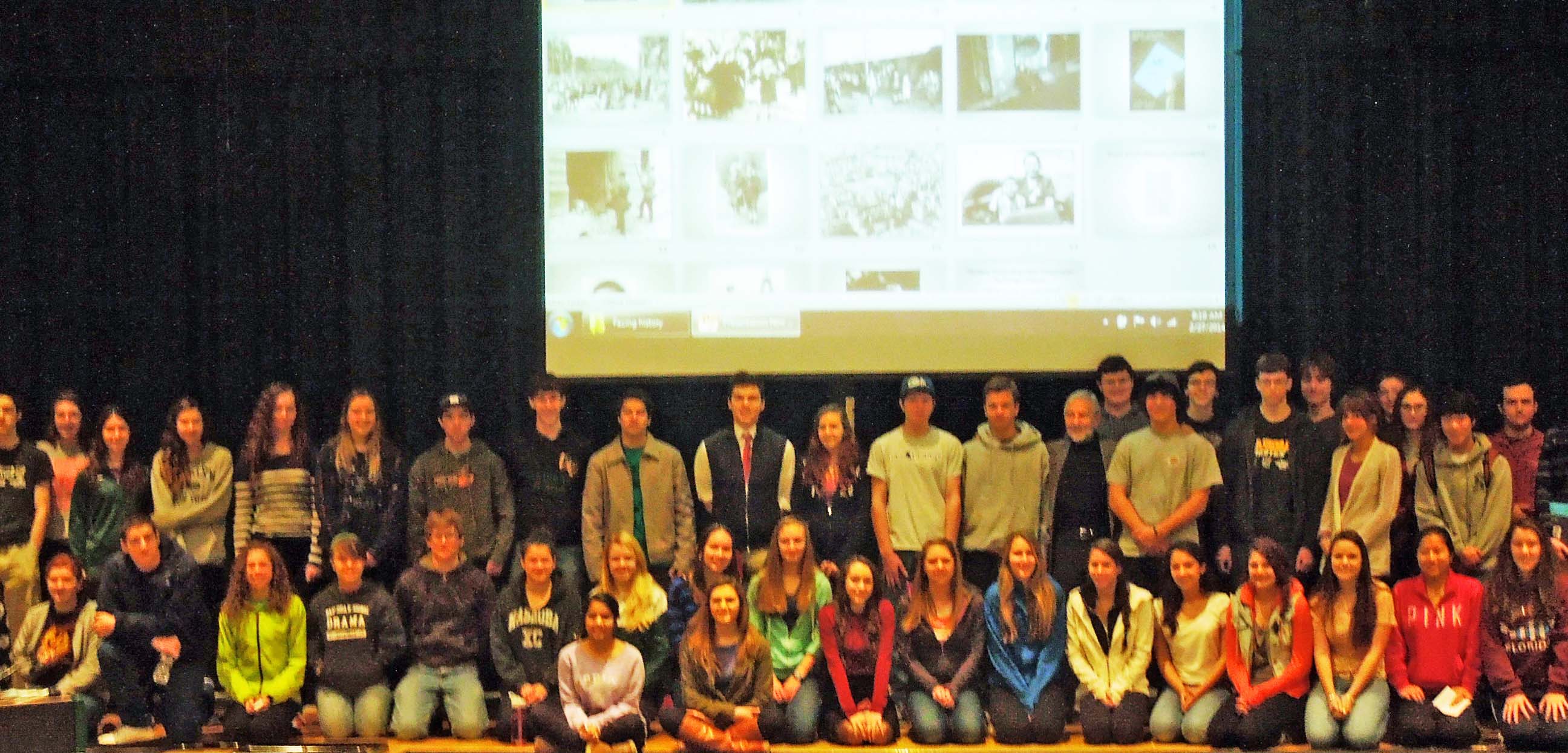
My presentation was to 11th graders of Humanities III, which is a combination of History and English Language Arts and conducts a Holocaust & Human Behavior unit with readings from Elie Wiesel’s Night and related Facing History texts. The class has been taught for 3 years by Humanities teachers Tana Becker and Isabel Perez, who organized my visit along with Judi Bohn of Facing History and Ourselves. Also in attendance were Humanities teacher Amy Eisenschmidt and Kirk Womack, who introduced me to the students.

group1a

Leave a comment

Nashoba Regional High School, Bolton, MA – February 27, 2014

by George J Elbaum

Nashoba Regional High School, in Bolton some 40 miles from Boston, is a suburban high school with an enrollment of nearly 1200 students. While there is very little diversity in the mostly white student body, there is strong awareness and interest in issues of diversity and tolerance in the world at large. To this end, a one semester elective course in Facing History was introduced and the reception has been extremely positive with 28 students registering for it the first year, which is high for a new elective. Its teacher, Michelle Fohlin, found that the students really want to look deeper into the Holocaust-specific material being studied and the broader related issues. For example, after a lesson on the all white “sundown towns” in America’s past, one of the students took the initiative by going to the town’s historical society for more information about his own region and why there was so little diversity. While the student discovered no evidence that it had been a “sundown town,” his initiative is admirable and shows the genuine interest and effects of the class.

My presentation was organized by teacher Michelle Fohlin and attended not only by her Facing History class but also joined by an English class studying World War II memoirs and an AP class of U.S. history. Facing History’s Judi Bohn and Danny Conklin coordinated my visit.

group2

Leave a comment