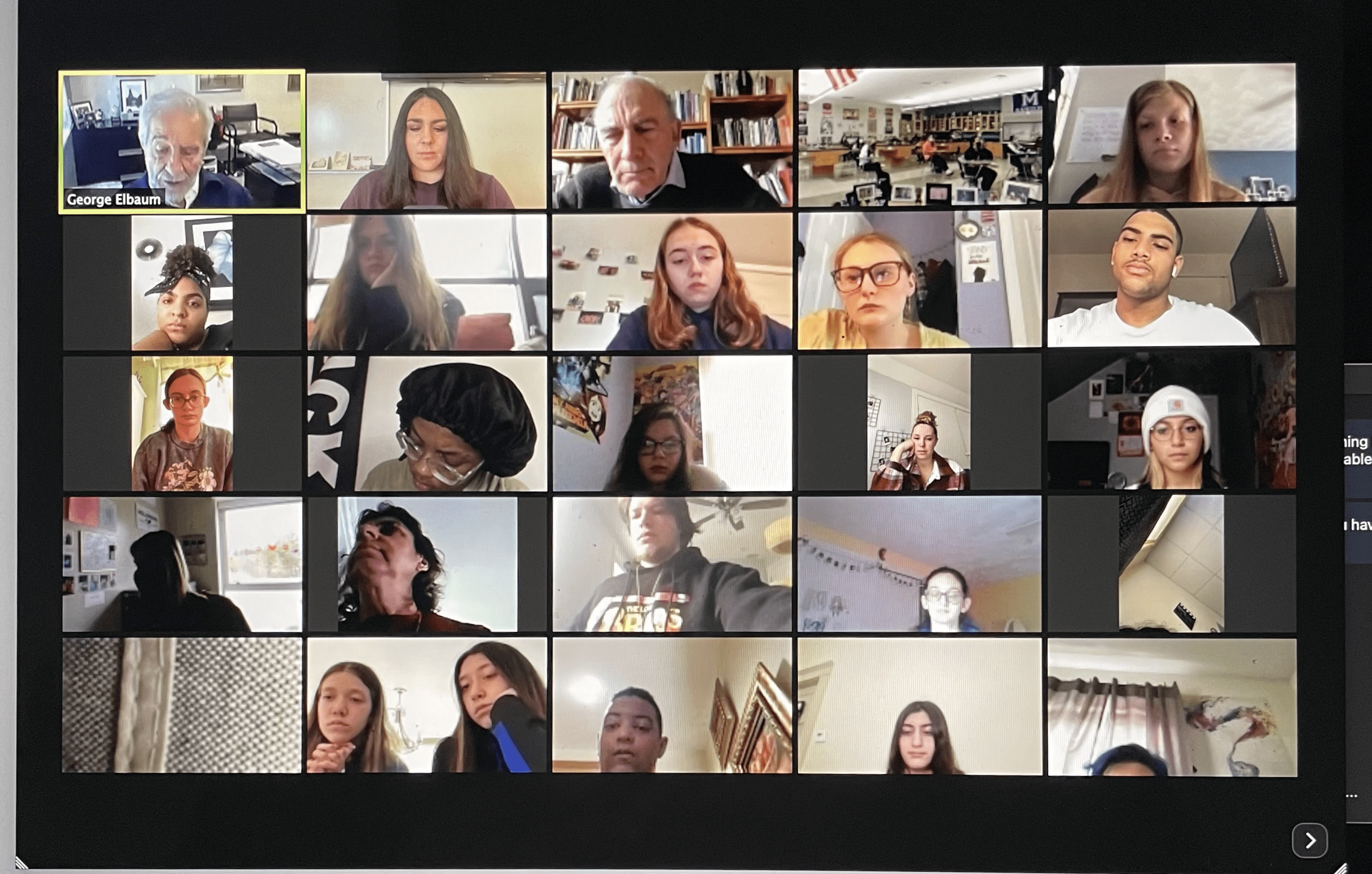
Boston Green Academy, Brighton, MA – May 27, 2021 via video

by George J Elbaum

Boston Green Academy (BGA) is an ‘in-district’ Charter School that is proudly part of the Boston Public Schools.  Founded in 2011 by a committed group of Boston educators and community members, BGA is Boston’s only school focused on sustainability and preparing the next generation of diverse leaders for college and green careers.

Asked by the Boston Public Schools to turn around a struggling high school, BGA successfully ‘re-started’ Odyssey High School in South Boston and in three years became the most improved high school in the Boston Public Schools and one of the most improved state-wide. In 2014, BGA began an expansion to include middle grades, starting with a 6th grade and in 2017 BGA achieved its goal of becoming a full school for grades 6-12 serving approximately 500 students from every neighborhood and background in Boston. BGA continues to be one of the most improved and innovative schools in the Boston Public Schools, serving a highly diverse student body with “90% Students of Color, 31% Students with Disabilities, 15% English Language Learners, 100% Amazing Human Beings!”

To fulfill the “Green” in its name, BGA prepares all its students to be leaders in environmental stewardship and activism, to live their lives responsibly and sustainably, and to be prepared to succeed in the growing green sector.  The “Green” theme is woven into all courses through BGA’s project-based learning, an Environmental Science Career Technical Education (CTE) Program open to all students, and a Project Week experiential learning program every year, including international service learning trip for high school students.  BGA’s graduation requirements exceed Boston Public Schools standards, including a required senior six-week internship for all seniors. My presentation to 55 11th graders (and some 8th graders) was organized by BGA Humanities teacher Lucia Mandelbaum and it was arranged by Jeff Smith, Resource Speaker Coordinator, Facing History and Ourselves

Student Reflections

Several days after my talk at BGA I received from teacher Lucia Mandelbaum a compilation of student reflections from all of her classes (students with disabilities, English language learners, inclusion, AP cohort).  It was a part of her “Thank You” to everyone who helped organize this event at BGA.  As with student letters & notes received from other schools, I now excerpted statements that resonated with me from these Student Reflections and added these excerpts to BGA’s webpost on my website www.neitheryesterdays.com.

  • Pretty much the whole entire experience stayed with me.  I automatically send a message to my old middle school teacher after the experience telling him about it.  He said it was a great experience for me and it actually inspired him to start writing again.
  • The excitement of talking to George Elbaum, his talk was so interesting.  He has amazing stories, they’re not all good stories, but they’re all very interesting. He could turn any question into a good story, when he didn’t have an answer for the question he answered with something that related to it.
  • It was cool hearing from someone who is still here from a traumatizing past and speaking about it.  It’s very brave to do that.  When he was talking about his mom and how she passed, that really hit home, and I noticed when he was talking about her, that he was about to cry, and it was very sad.
  • Something that stuck with me is when he said that he felt like an American, not a Jew.
  • He was truly an inspiration, a living example of no excuses, a fighter, a survivor, and even the luckiest man on earth.  His story is crazy and hard to even imagine the risks he and his mother took all their life. 
  • I would like to speak with him again and ask him more questions personally, like what kept him with hope all those years.  The things he told us yesterday are not even believable and make a kid like me think I could really do anything.
  • The thing that has stayed with me is the profound effect that the Holocaust had on George’s entire character.
  • I thought it was inspirational, especially at the end when George talked about the girl who contemplated suicide.
  • What stayed with me during the Elbaum interview was how lucky he had been through that whole ordeal.
  • I have a lot of respect for Elbaum because of the things he has gone through.  He answered all of my questions.
  • He made me want to keep going even though I have hard times, because he went through worse than me and still kept going.
  • What stayed with me was how strong his mother was through the process.
  • What stayed with me the most was the sugar cube story he told.  It was really unique and cool for him to share.  It was one of the few highs of such a sad experience.  Also how he changed a girl’s mind about planning to kill herself.  We never really know how much of an impact we have on someone’s life.
  • Yesterday’s talk with George Elbaum was pretty inspiring and interesting because he is history itself and we get to know things that happened to him first hand basically. What has stayed with me is the experience he had in the shed, when the dog had to be choked so it wouldn’t have barked for their safety. What I want to know more about are other precautions that he had to take to be safe.
  • It was terrible as a child to see the events that went on and experience the sacrifices that his mother went through to keep him safe and provide him a fresh start in life.
  • What has stayed with me is his voice when he was talking, you could hear it in his voice about the pain he was feeling.
  • Yesterday’s talk with George Elbaum is going to be memorable.  Something that surprised me was how much luck he had, like God was always on his side
Leave a comment

Inglewood Middle School, Sammamish, WA – May 25, 2021 via video

by George J Elbaum

Inglewood Middle School is a public school with 1258 students in grades 6-8 and holds a very good 9/10 overall rating from Great Schools.org.  Especially impressive is its 10/10 rating for the test scores of its students’ proficiency:  86% vs 50% State avg in math, and 88% vs 61% State avg in English.  The student body is diverse: 58% White, 28% Asian, 7% two or more races, 6% Hispanic, and 1% Black.

8th Grade Language Arts and Social Studies teachers Maria Fyles and Andrew Gustav organized this educational speaking event consisting of 3 consecutive presentations by 3 different Holocaust speakers to 3 large groups of 8th graders (approx. 300 total), some physically in classrooms and some via Teams.  Supporting the presentations as related to their concurrent teaching model were Inglewood 8th grade LASS teachers, Caroline Freidenfelt, Amy Jones, Gretchen Mason, Mary Olson, and Kacie Simpson.  All teachers have been using materials from the Holocaust Center for Humanity and Echoes and Reflections curricula to study the Holocaust in the context of their WWII Unit with connection to United States and Washington State History. Teachers and students were able to connect a historical event to their local community through the speaker narratives from the Holocaust Center for Humanity.

I made the 3rd of the 3 consecutive presentations, and speakers for all 3 presentations were arranged by Julia Thompson, Education Program Manager of the Holocaust Center for Humanity.

Leave a comment

Navy Operational Support Center, Omaha, NE – May 15, 2021 via video

George J Elbaum

Navy Operational Support Center (NOSC) Omaha is a small group of 14 active duty staff members located at the Offutt Air Force Base whose mission is to assist and support the nearly 250 Naval Reservists in the area.  Having recently established a diversity program, its Department Head and Diversity Coordinator, ITSN Collin Phillips, contacted Omaha’s Institute for Holocaust Education (IHE) for an educational speaker about the Holocaust for Armed Forces Day, May 15.  IHE’s Education Coordinator, Kael Sagheer, recommended me and put us in contact with each other.  Collin explained to me his plan to broadcast my presentation via the Navy’s secure version of Zoom/Skype so that every member of the Navy’s local community would be able to tune in, as well as their families.  After overcoming some technical issues, my presentation today was seen by 2 dozen viewers and recorded for later viewing by the broader local community of Navy personnel.

Leave a comment

Southeastern Regional Vocational Technical School, South Easton, MA – May 10, 2021 via video

by George J Elbaum

Southeastern Regional Vocational Technical School  (Southeastern) is a public high school with a high diversity enrollment of 1,416 students in grades 9-12 offering a diverse range of educational, vocational and technical programs.  The school’s multi-pronged education takes a hands-on approach to learning, integrating academic course work with vocational and technical education.  This approach  has  proven to be successful in educating today’s youth for tomorrow’s challenges in an environment that teaches through example.

Southeastern’s offerings are divided into Academic and Vocational/Technical Programs.  The academic program offers a full and rigorous series of academic classes which are kept small to foster critical thinking and exposure to honors-level content.  Academics in a 21st century vocational school are developed to ensure that students have equal opportunities for college and career success. Such offerings include AP courses, honors level courses, dual enrollment courses and virtual high school courses.

The vocational/technical program offers a choice of 22 specialized vocational courses to prepare its students in a wide variety of professions, ranging from Advanced Manufacturing & Welding to Video & Performing Arts; from Automotive Technology to Dental and Medical and Nurse Assisting; from Computer & Electronic Engineering to Natural & Life Sciences; and from Cosmetology and Culinary Arts to Marketing & Entrepreneurship – a truly wide choice for students.

Last year I visited Southeastern (2-27-2020) and spoke to 12th graders taking a year-long class of Facing History – Holocaust and Human Behavior taught by Social Studies teacher Amy McLaughlin-Hatch, who expertly organized my presentation.  Her students had been learning about the Holocaust for 6 months and thus had a background based on Facing History pedagogy plus material from Echoes & Reflections, Yad Vashem, USHMM and many other resources.  However, a week after that visit Covid-19 and the resulting lockdown occurred, and since then education has mostly shifted online, making it especially demanding on dedicated teachers such as Amy, even with her impressive credentials (recipient of Facing History MSS & TOLI Grants, Yad Vashem Int’l & Upstander Academy Educator, USHMM Scholar). My presentation today was therefore entirely online via Zoom, with part of the class in a classroom and part at home.   

I asked Amy for her thoughts on the difficulties in teaching about the Holocaust resulting from Covid, and she replied: “Covid has impacted education in so many ways, too many to count. Southeastern students participated in all modes of teaching this year including remote learning, Zoom classes, hybrid learning, asynchronous teaching, synchronous teaching, Google classroom, and so much more.  But thankfully, due to Facing History and survivors willing to share their stories and make history come alive, our Holocaust speaker talks continued and students have benefited.” 

Arrangements for my talk were again made by Jeff Smith of Facing History and Ourselves, whose presence and pre-and-post-talk conversation always add much to my gratification.

Letters from Students

Two weeks after our May 10 session I received two dozen letters from students at that session plus a truly touching Thank You note from teacher Amy McLaughlin.  As the day of my talk was a subsequently announced Senior Skip Day, half of the students’ letters apologized for not attending my talk, and some had a humorous reference to it.  I read all letters, excerpted statements that resonated or amused me, and the resulting excerpts are given below.

  • I may not be able to understand or feel what you went through during these events but I appreciate you bringing awareness to the racism that is still happening in this world.  I thank you for your contributions, time, and efforts.
  • You have inspired me to go to college, because you worked hard until you reached your goal and that is exactly what I want to do.
  • Though I did not get to hear your story, I admire you for sharing a story that was probably a very hard part of your life.
  • The people that surround me are blinded by what they have.  They take a lot of things for granted, like food & clothing, things that didn’t come easy to you.  When you talk to the next class please remind them of all the hidden blessings they have.
  • I could only imagine the pain and regret that your family must have felt.  After hearing your story I’m going to start taking an interest in the past.  Learning about the experiences and problems people face helps me widen my view of what causes thing to happen and how people handle it.  Your story will stick with me for many years to come.
  • I’ve lived through some hardships myself and was once also separate from my mother.  I also deal with various health issues such as Type 1 diabetes, heart murmur, etc., but despite going through everything I tend to go to school each and every day, help my father, take care of my little sisters, go to work five days each week, and much more.  I remain motivated because of my two little sisters, one is 14 and transgender and one is 8 and extremely sassy, but I love them more than life itself. 
  • Thank you for acting as an inspiration and sharing your story.
  • I want to apologize for missing you talk because I participated in Senior Skip Day instead.  I wanted to take the chance I had to do something ”normal” for my senior year.
  • Thank you for taking your time and energy to share your experience with us.  It was definitely worth skipping Senior Skip Day for it.
Leave a comment

San Mateo County Library, San Mateo, CA – May 5, 2021 via video

by George J Elbaum

San Mateo County Library’s activities and educational services have been necessarily curtailed by the Covid pandemic.  To compensate for this, Julie Smith, Librarian at the Half Moon Bay branch of SMCL, took the initiative and organized a presentation about the Holocaust for seven schools in the county, including Half Moon Bay High School, Cunha Intermediate School, Pescadero High School, Woodland Middle School, Woodside High School, Ingrid B. Lacy Middle School, and Ocean Shore School.  Approximately 300 students participated, some of these having studied the rise of Hitler, the Nuremberg Laws, Kristallnacht, The Diary of Ann Frank, the Ghettos, Concentration Camps, The Boy in the Striped Pajamas and Elie Wiesel’s Night.

My presentation was arranged by Penny Savryn, Education & Marketing Manager of JFCS Holocaust Center.

Leave a comment

Methuen High School, Methuen, MA – May 4, 2021 via video

by George J Elbaum

Methuen High School (MHS) is a public secondary school serving grades 9-12.  It has an enrollment of 1950, of which 46% is minority and 47% from low-income families.  The Holocaust is taught at MHS as part of English Department studies by teacher Jackie Rubino, who organized my presentation at MHS and uses educational materials from Facing History and Ourselves and other sources..  This was my 2nd visit to MHS, andapproximately 80 of MHS’s 9th grade students were on today’s presentation via Zoom. As last year, the students have already studied much of the Holocaust and Human Behavior book from Facing History, “Schindler’s List,” selections from the The World Must Know, Night by Elie Wiesel, plus   supplemental materials

In the 10 years of presentations I have noticed that the quality of students’ questions during the Q&A much depends on the quality of student preparation, and thus the quality of teaching.  Enthusiastic teachers such as Jackie Rubino result in enthusiastic students, and that resulted in our Q&A lasting another half hours after my almost an hour presentation.  As last year, I was again pleasantly surprised by the quality of the students’ questions, and some of their most thoughtful ones about my feelings, hopes, and concerns during the Holocaust had been asked of me only once or twice in the almost 300 talks I have given to date.  I’ve long felt that the Q&A is often the most important part of my talks because it represents our 2-way communication, and I was very pleased and moved by today’s session.

In addition to Jackie Rubino, attending the presentation (by Zoom) were MHS teachers and staff, including Dr. Lisa Golobski-Twomey, MHS English department head, Kara Brooks, English teacher, and Jason Smith, science teacher. My participation was arranged by Jeff Smith of Facing History.

Leave a comment

AIMS College Prep Middle School, Oakland, CA – April 30, 2021 via video

by George J Elbaum

American Indian Public Charter School (AIPCS), is a K-8 charter school with predominantly low-income, minority students and current enrollment of 794 that has had an unusual history since its founding in 1996.  Its current incarnation, however, is definitely an admirable success, earning a rating of 9 (out of 10) from Great Schools based on its test scores, equity overview, and year-to-year academic progress.  According to Great Schools, its demographics are 47% Asian, 34% Black, 11% Hispanic, 5% White and 3% all other, with 76% students from low-income families, yet its students score a proficiency rating in math of 73% vs. 40% state average and 65% in English vs. 51% state average, especially impressive since 33% of AIPCS are English learners.  Furthermore, its advanced STEM courses participation in Algebra I is an impressive 60% vs. 25% state average and pass rate is 80% vs. 79% state average.  Also unusual are the statistics of its teaching staff: with 19 students/teacher (vs. 22 state average), its teachers with 3 years of more experience are only 46% of total vs. 91% state average, and full-time certified teachers are 76% of total vs. 98% state average.  This means that AIPCS has a much higher percentage of young teachers, and in my 250 talks to date I’ve noticed repeatedly how responsive are students to young teachers

My presentation was to the AIMS College Prep Middle School (6-8) to the same 160 students, now in 8th grade, to whom I spoke 16 months ago, December 2019,  when they were in 7th grade English and History class of teacher Jennifer Ko, who organized the event both times.  Jennifer Ko impressed me in my December 2019 visit with her handling of the large, youthful group with a friendly yet authoritative manner.  This time my “visit” was online via Zoom, so no direct contact, but she impressed me by something completely different: because of the difficulties which her students faced during the past 14 months of the pandemic, she purposely asked me to present my story to the same group as before, but now to highlight the resistance that I had faced and the resilience that allowed me to overcome those hardships without being emotionally or psychologically crushed by these.  I appreciated and felt the importance of that request.  

 In preparing for my talk the students watched films and read about the experiences of others who experienced the Holocaust. They also learned about the significance of an eyewitness to history and the importance of eye witnesses being heard and listened to about their experiences.

In addition to Ms. Ko, also attending the presentation were the teachers from across the 7th grade, 8th grade and English Language Department: Ms. Hairston, Ms. Grams, Ms. Readye, Ms. Spencer, Mr. Lee, and Dr. Jay. As well as the co-Head of School, Ms. Glass.

Penny Savryn, Education and Marketing Manager of JFCS Holocaust Center, arranged the presentation. 

Leave a comment

College Park High School, Pleasant Hill, CA – April 21, 2021 via video

by George J Elbaum

College Park High School has a current enrollment of 2036 students of which 56% are minority and 26% are economically disadvantaged.  Despite these demographics, it is far above California state average of college and career readiness, such as student test scores (English 74% vs. 51% CA average and Math 48% vs. 40% CA average) and 97% graduation rate.  It is therefore rated 9/10 in college readiness and test scores by GreatSchools.org.

This presentation to College Park 10th-12th grade students was again organized by World History teacher Lauren Weaver, as she had done last year and in 2019.  Her students have studied WWII and the Holocaust, and were therefore aware of governmental persecution in Germany in the 1930s, including targeted boycotts, the Nuremberg Laws, planned stages of identification and separation in Ghettos, acts of violence such as Kiristallnacht, and eventual removal of Jews to concentration and death camps.   My presentation once again was via Zoom because of continuing Covid-19 restrictions, so my main contact with the students was via their typed-in questions but unfortunately no real-time feedback.  I missed that feedback and look forward to returning to College Park and Lauren Weaver’s class in person next year.

Arrangements for my talk at College Park were made again by Penny Savryn, Education & Marketing Manager of the JFCS Holocaust Center.

Leave a comment

Otay Ranch High School, Chula Vista, CA – April 19, 2021 via video

by George J Elbaum

Otay Ranch High School is a 4-year high school with somewhat unusual demographics: its 2372 student body is comprised of 59% Hispanic, 18% Filipino, 8% two or more races, 6% White, 5% Black, and 4% Asian.  Nevertheless, it has Great Schools Rating of 8/10 overall, College Readiness rating of 9/10, Equity 7/10, and Test Scores 8/10.  Its 4-year high school graduation rate is 97% vs. California state avg of 85%, and the percentage of graduates who meet UC/CSU entrance requirements is 65% vs CA state avg of 51%, and low-income (34% of students) are not far behind with 59% vs CA State avg is only 43%.  This is a remarkable academic performance.

This presentation was also organized by World History Teacher Robert Tilburg specifically for his other 10th grade class that missed my April 14th presentation.  As the other class, they also studied WW2 and included events prior to 1939 that discriminated against the Jewish population of Germany such as the Nuremberg race laws, Kristallnacht etc.  The students then studied the Holocaust for 3 weeks, including the flood of refugees to surrounding countries and the response of those countries, the establishments of Jewish ghettos and then the “Final Solution”.  Subsequent to my talk the students will analyze primary source text and images from the Holocaust and will also work on a research presentation in one of two areas: Jewish resistance to the Holocaust, or comparison of the Holocaust to other events of genocide in the world. 

The credit for introducing Robert Tilburg and me, and “incubating” this introduction into a successful presentation goes to Kael Sagheer, Education Coordinator of the Institute for Holocaust Education (IHE) of Omaha, who recently organized my presentation at IHE’s Week of Understanding.

Leave a comment

The Achieve Program, San Francisco, CA – April 18, 2021

by George J Elbaum

The Achieve Program is a year-round, four-year high school scholarship and academic enrichment program for underserved students from low-income families.  By providing tuition grants plus quality educational and extensive individual support, Achieve increases the options and opportunities for its students, all of whom are selected based on demonstrated academic excellence and high motivation to change and improve their lives.

Currently, achieve serves 94 students and has a staff of six, including three educators, all dedicated to supporting and mentoring the students.  Although Achieve’s tuition grants enable students to attend private schools in the San Francisco Bay area, the most important aspect of the program is Achieve’s active support to students throughout their four years of high school.  Mentoring, tutoring, cultural excursions, summer internships, community service programs, extensive college counseling, and parent support are some of the services provided to ensure that Achieve students are informed, educated, service-minded, and well-prepared to succeed in college and beyond.  Achieve thus opens a world of possibilities for its students.

One of Achieve’s students, Mia, is also a participant in the JFCS Holocaust Center’s The Next Chapter program.  She attended my talk to The Next Chapter last month and, through the JFCS Holocaust Center, she invited me to speak to her community at Achieve.  Mia wrote, “I wanted to be able to share this wonderful experience with my other Achieve mates. I wanted to share (his) inspiring stories with all of them, to help them reflect on their own lives just like I have.”  Starting with Mia’s invitation, Achieve’s Sarah Jiménez and Penny Savryn, the Center’s Education & Marketing Manager, organized my talk.

Notes from Students

Two weeks after my talk to The Achieve Program students I received via email a Kudoboard with “thank you” notes from the students.  Typically, when receiving notes or letters from students, my wife Mimi and I read these together and we highlight and excerpt those statements that especially resonate with us.  However, the Kudoboard format made it difficult to do this, resulting in a delay, but Penny Savryn graciously transposed these notes into text, and Mimi and I excerpted the key statements which are listed below.  Thank you very much for your notes, your thoughts, and your “thank you’s”.

  • One of the highlights from your speech that really stood out to me was when you said that the first time you spoke at the Boston Holocaust Memorial, you realized your story “had value.” Your story has made a huge impact on students like me, providing us with more knowledge on what happened and how it affected those who were victims of this unjust, horrific time in history. I want to thank you for allowing us to see your vulnerable side and telling us your story!
  • Your story gives me motivation to push through my struggles knowing how courageous others can be like yourself all those years ago, and even now by sharing your story of survival.
  • I like how you kept emphasizing the golden rule to treat others the way you would want to be treated all throughout your presentation. Once again thank you for your unforgettable presentation filled with amazing advice.
  • Your mother’s courage and resilience especially stood out to me because it must have been extremely terrifying having to constantly hide and outsmart the Nazi soldiers.
  • Your comment about living in the moment stood out to me because often we find ourselves anxious about the future.
  • It was a very sad and vulnerable story but very inspiring. Thank you so much for sharing it.
  • What stood out to me was that even as a child you were strong enough to live through something like this and share your story with others as an adult.
  • I will cherish your advice and call out injustice when I witness it.
  • Hearing that you struggled to take the words out of your mouth at first was something that made me understand how hard and how courageous someone must be in order to go on a podium and speak of their tragedy. I will move forward in life and speak out those words that are hard to say the first time around. As long as I get the people to hear my voice and understand my words, I will speak out as many times as necessary.
  • Knowing that your forgiveness was even extended to the people that have caused you and your family so much grief was very admirable, and it has taught me to become more forgiving towards others.
  • The number one thing that stuck with me is the Golden rule because this is something I truly believe in and abide by in my life.
  •  I appreciated how you talked about recent anti-Semitism incidents like the Pittsburgh synagogue shooting because this reminded me that injustices are still present in our society, and we must keep working hard to improve as a society.
  • One thing that stood out to me was the idea that blaming others would only lead to more hatred.
  • After hearing what you went through and knowing that you were still able to become successful despite the odds, encourages me to work harder.
  • I will never truly know the life you lived, but you helped me understand your story in such an impactful way. Thank you for having the courage to tell us your story because now we will learn to help others in need.
  • Something I took away was your journey in accepting the terrible things that have happened to you and your family, and your courage to share your powerful story. This sent an important message to me which is that everyone has a valuable story to share.
  • Thank you for sharing the courageousness of your mother and the compassion shown by the Polish families that took you in.
  • Something that amazes me was your statement that accusing others just encourages more hate. In the future, I will make it a point to speak up when I see injustice, and I’ll always uphold the golden rule.
  • Schools don’t talk about all that occurred during the Holocaust; I am very grateful that people like you take time to educate generations about events of the past. If we don’t teach future generations about the past it is doomed to repeat itself.
  • I really needed to hear someone tell me the importance of speaking up no matter what. I feel that there have definitely been areas of my life in which I could have spoken up.
  • I just returned from a school retreat and I thought a lot about the words you said and how you refused to back down in the face of adversity. It made me reflect on how I want to live the rest of my life.
  • Although I would like to believe I follow the golden rule all the time, that really isn’t the case and I need to work on that and stay true to my word.
  • I especially appreciate how you drew parallels of bigotry from the Holocaust to events happening today, such as discrimination towards Asian Americans and immigrants.
  • Your story is truly inspiring and encourages us to speak out about injustices happening in our community. Although speaking out can be a bit frightening at times, your words really impacted me and I feel much more confident in using my voice.
  • Your story was very inspiring, especially when you talked about how hatred and racism thrive in the shadows and we ourselves should speak out whenever we see something that is unjust.
  • I really appreciate what you said to us, and can honestly say that this has been one of the most impactful talks that I have ever heard. After hearing your talk, I decided to speak out about my problems instead of keeping them in.
  • Your presentation emphasized how important it is to reshare stories so that yours, and millions of other survivors’ experiences will not be forgotten. As police brutality and hate crimes keep rising, I will ensure to spread awareness to people through social media.
  • I truly felt that your story was an eye-opening experience and I found it very motivating.  I could tell how much passion you have for teaching others what it was like to survive a tragic event like this. I was able to sense the emotion you had about this topic even through the computer screen and it really touched me. 
  • I know this took a lot of courage to tell people you’ve never seen before about something so personal, I just wanted to tell you that I deeply appreciated the story of your life. It taught me some things I never knew, and how to be a better person and be more grateful because there is always someone that is less fortunate than you or the next. 
  • Your stories gave me a new perspective on life and the world as a whole. Additionally, you inspired me to make change and help others within my own community. I really valued your talk.
Leave a comment